
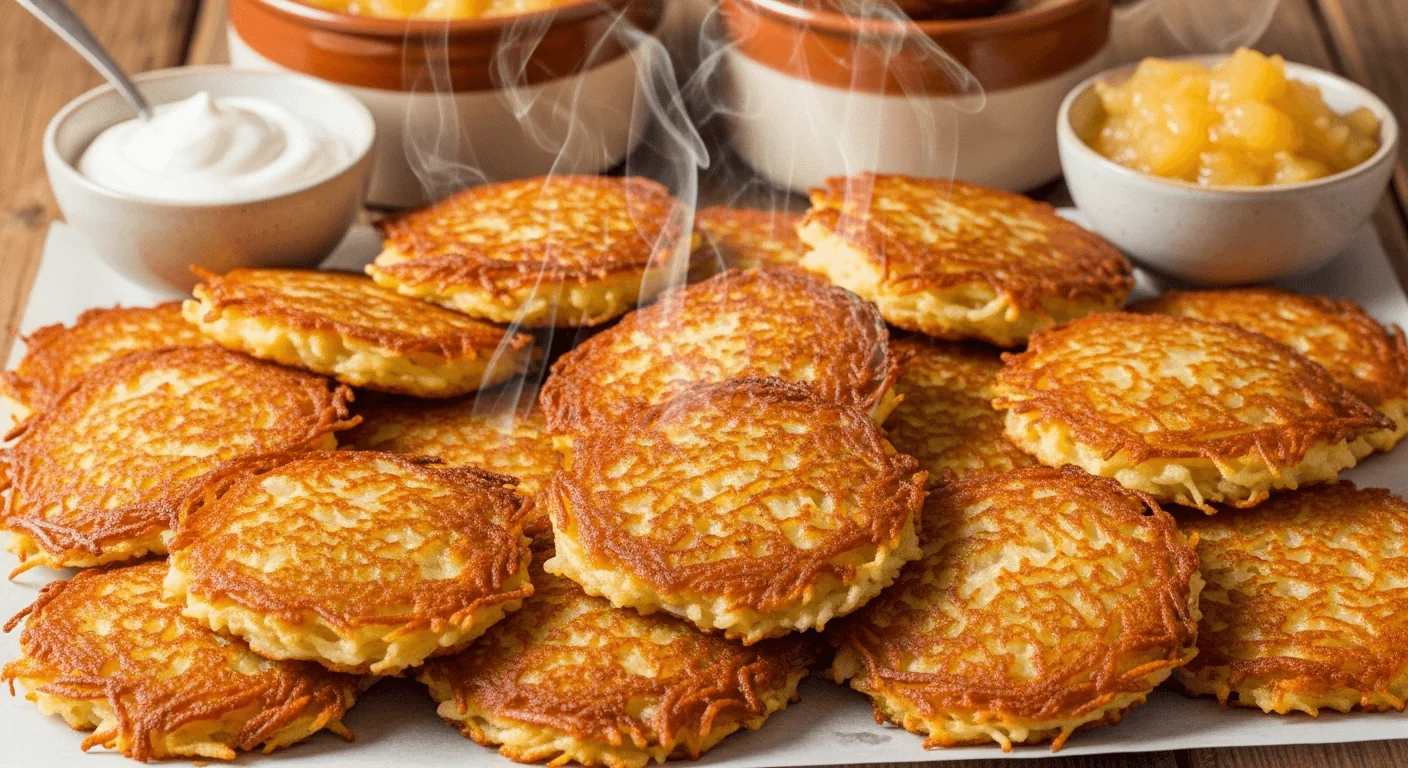
Active time: ~35 minutes | Total time: ~45 minutes | Serves: 4–5 (about 16–18 pancakes) | Difficulty: Easy
Quick Overview
- Grate the potatoes and onion together, then squeeze out as much liquid as possible — a dry mixture is what gives latkes their crisp edge
- Let the squeezed-out liquid settle for a minute, then pour it off and keep the white starch left at the bottom of the bowl
- Mix the potato starch back into the batter along with egg, matzo meal or flour, salt, and pepper
- Fry in a generous layer of hot oil over medium-high heat, flattening each spoonful, until deep golden on both sides
- Drain briefly, salt while still hot, and serve right away with sour cream, applesauce, or both
What Latkes Are
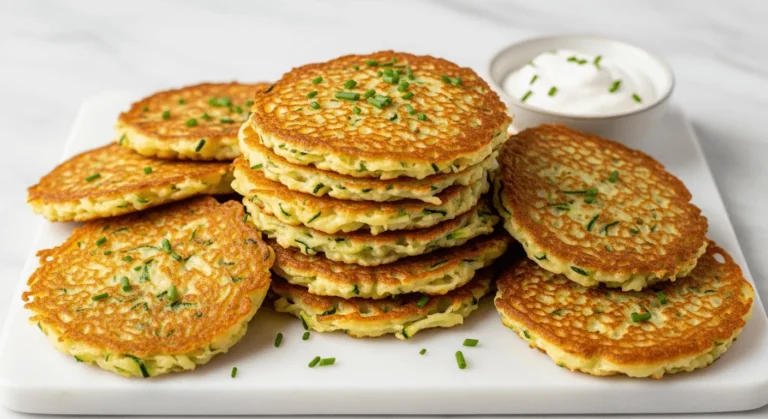
Latkes are fried potato pancakes from Ashkenazi Jewish cooking, grated potato and onion bound with egg and a little flour or matzo meal, fried in oil until the edges turn dark and crackling. The name comes from Yiddish latke, “pancake,” which traces further back through the East Slavic word oladka to a Greek root meaning oil.1 In Hebrew they’re called levivot, a word borrowed from the Book of Samuel, where King David’s daughter Tamar prepares pan-fried cakes for her brother.1
Latkes are most associated with Hanukkah, the eight-day Jewish festival of lights, when fried foods take center stage at the table.2 But the potato itself is a relatively recent arrival to this dish — for centuries before latkes meant potato pancakes, they meant something else entirely.
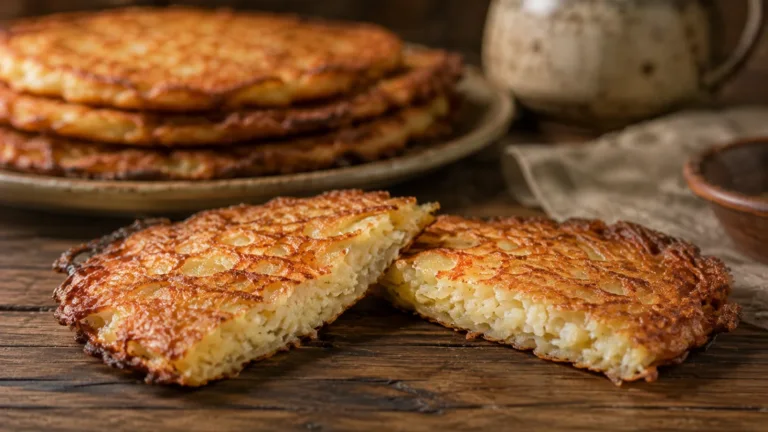
Today, grated and fried is the most familiar version, with a lacy, crisp crust and a soft center. A second, less common style uses puréed rather than grated potato, giving a smoother, almost pudding-like texture.1 Both are latkes. The grated version is the one most home cooks reach for, and it’s the one this recipe covers.
Latkes belong to the same broader story of scarcity and adaptation as other Ashkenazi staples on this site, including Traditional Challah — each shaped as much by what was affordable in a given kitchen and era as by any fixed recipe.
History and Cultural Roots
The Hanukkah connection to fried food goes back to the holiday’s central story: a single flask of oil in the Temple, enough by rights for one day, that burned for eight.2 Jewish communities have marked the holiday with oil-fried foods ever since, and the earliest written trace of that custom predates the potato by hundreds of years. A 1322 poem by the rabbi Kalonymus ben Kalonymus describes levivot “large and round, the whole size of the frying pan,” served for Hanukkah.4 Those early pancakes had nothing to do with potato — soft cheese, often ricotta, pan-fried in butter or poppyseed oil and finished with a spoonful of jam or fruit preserves.1
The cheese had its own story behind it. Jewish tradition associates Hanukkah with Judith, who is said to have fed an Assyrian general salty cheese and wine, then beheaded him with his own sword once he’d passed out drunk.4 Eating cheese at Hanukkah became a way of remembering her courage, and cheese latkes stayed the more common version in Ashkenazi communities until the potato arrived in the 19th century.1
What pushed cheese out wasn’t a change in taste so much as a change in fat. Across Eastern Europe, rendered poultry fat — schmaltz — was the most affordable option for frying, and Jewish dietary law forbids mixing meat and dairy in the same dish.3 Cooks frying in schmaltz couldn’t keep using cheese, so the filling shifted to whatever was on hand instead — buckwheat, rye flour, turnips, and other root vegetables took cheese’s place long before the potato entered the picture.1
The potato itself didn’t reach Jewish kitchens in Eastern Europe until the 18th and 19th centuries.3 The real tipping point came with the crop failures of 1839 and 1840 across Ukraine and Poland, when farmers planted potatoes on a massive scale to guard against famine.4 Within a few decades the potato had become cheaper than flour, and a dish that had spent centuries shifting from cheese to grain to root vegetable finally landed on potato — not because it was traditional, but because it was what poor households could reliably afford.4
One more shift came in the 20th century, this time from the kitchen shelf rather than the field. Crisco, a vegetable shortening introduced in 1911, gave Jewish cooks a fat that was both kosher and parve — neither meat nor dairy — which meant latkes fried in it could be served at any meal, including ones with meat.3 Crisco’s manufacturer leaned into that appeal directly, running bilingual English-Yiddish ads specifically courting Jewish home cooks.3 Vegetable oil is the more common choice today, though some cooks still add a portion of chicken schmaltz for the flavor it carries — the same rendered fat that gives dishes like Traditional Matzo Ball Soup its characteristic richness.
Beyond the Potato
Variation was never really optional for latkes — the dish has changed its main ingredient at least twice over the centuries, and home cooks kept adapting it long after potato became the default. A 1938 Yiddish cookbook published in Vilnius by Fania Lewando recorded latkes made from carrot, rice, farina, buttermilk, and apple, alongside the more familiar potato.3 Some of those root-vegetable and grain versions never fully disappeared; they show up today as zucchini, beet, or sweet potato latkes, more often framed as a twist on the classic than a return to an older one.
Sephardi Jewish communities developed their own parallel tradition rather than adopting the Ashkenazi potato latke directly. Mücver, a savory zucchini-and-garlic fritter, fills a similar role at the table without the dairy toppings typical of the Ashkenazi version, since it’s often served alongside meat.1
Traditional Latkes Recipe
Recipe developed independently by Heritage Healthy Kitchen, drawing on traditional Ashkenazi Jewish culinary methods. Sources for further reading are listed at the end of this article.
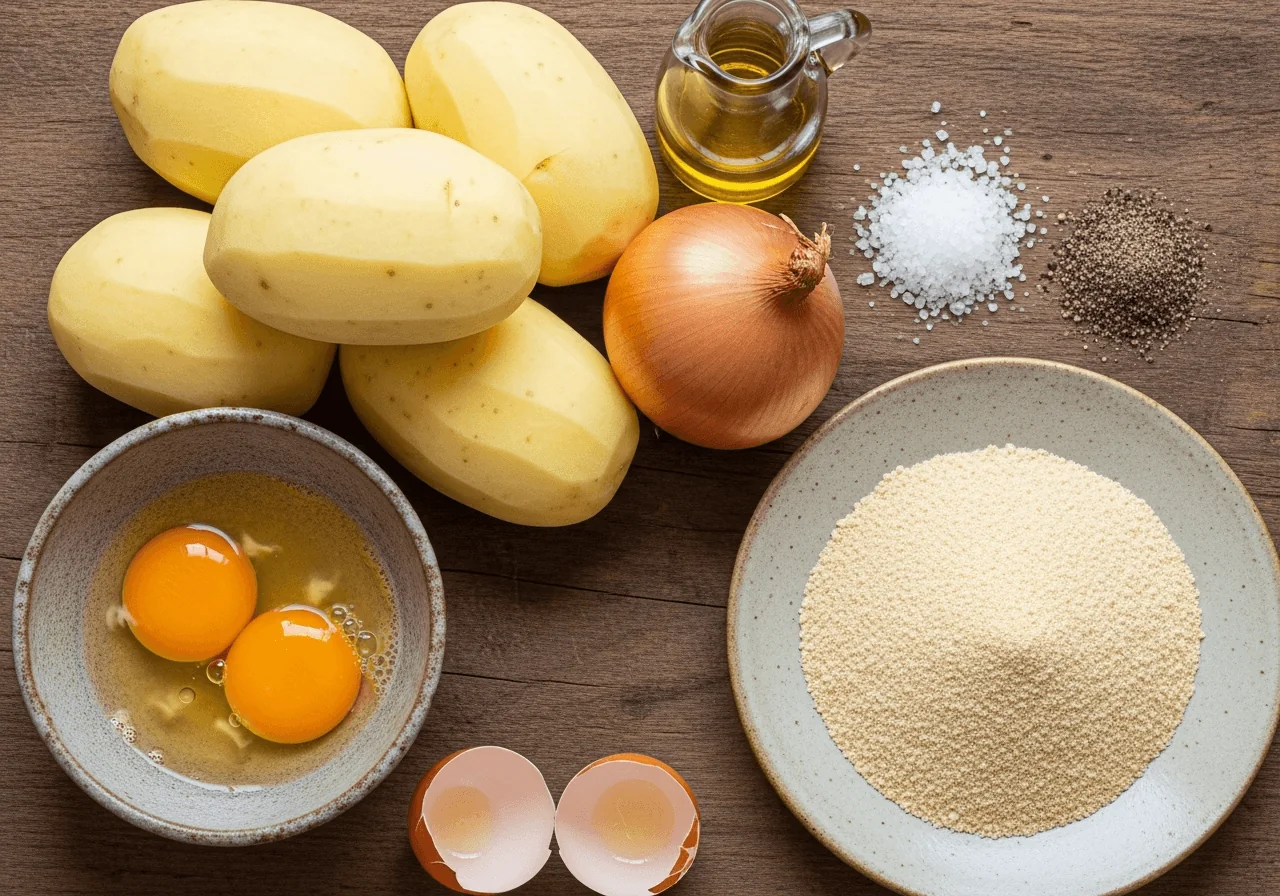
Ingredients
For the batter (serves 4–5, about 16–18 pancakes)
- 1.8 kg (about 4 lb) starchy potatoes (russet or similar), peeled
- 1 medium onion, peeled
- 2 large eggs, beaten
- 3–4 tablespoons matzo meal (or all-purpose flour)
- 1¼ teaspoons salt, plus more to taste
- ½ teaspoon freshly ground black pepper
- Neutral oil (such as sunflower or vegetable), for frying
For serving
- Sour cream
- Applesauce
Instructions
Step 1: Grate the potatoes and onion
Working over a large bowl, grate the potatoes and onion using the small or medium holes of a box grater, or the shredding disk of a food processor. Alternate between potato and onion as you go, since the onion’s juice helps slow down the gray, oxidized look raw grated potato develops within minutes.
Step 2: Squeeze out the liquid, but save the starch
Transfer the grated mixture to a clean kitchen towel or a double layer of cheesecloth, gather the corners, and twist firmly over a bowl until no more liquid comes out. Let that liquid sit undisturbed for a minute or two — a layer of white starch will settle at the bottom. Carefully pour off the watery liquid on top and keep the starch.
Step 3: Mix the batter
Return the squeezed potato and onion to the bowl along with the reserved starch. Add the eggs, matzo meal, salt, and pepper, and mix with your hands until evenly combined. Let the batter rest for about 10 minutes so the matzo meal has time to absorb some of the moisture and bind the mixture together.
Step 4: Fry
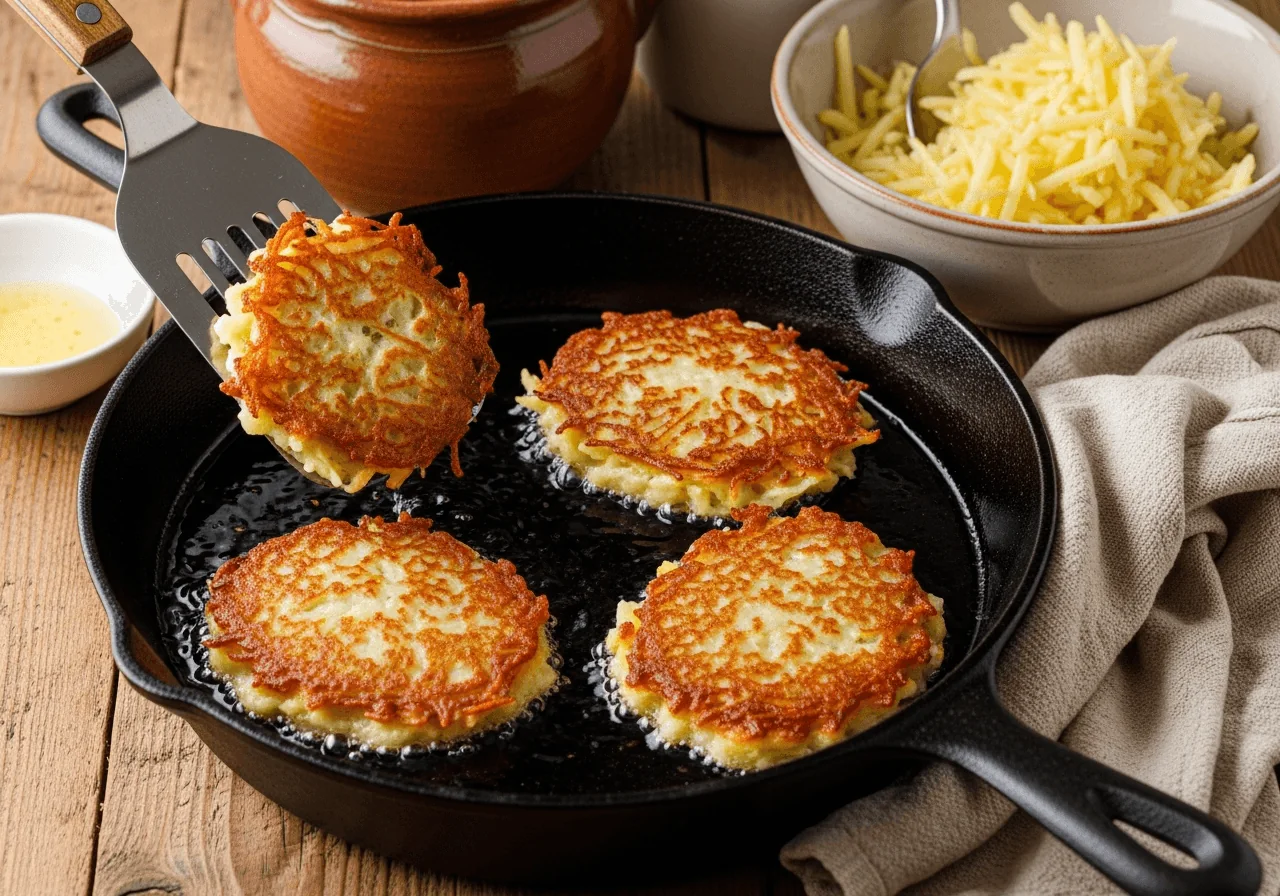
Heat about ¼ to ½ inch (roughly 1 cm) of oil in a large skillet over medium-high heat until it shimmers. Drop heaping tablespoons of batter into the pan, flattening each one gently with the back of a spoon to about ¼ inch thick. Fry until deep golden and crisp at the edges, 3–4 minutes per side, working in batches so the pan isn’t crowded.
Step 5: Drain and serve
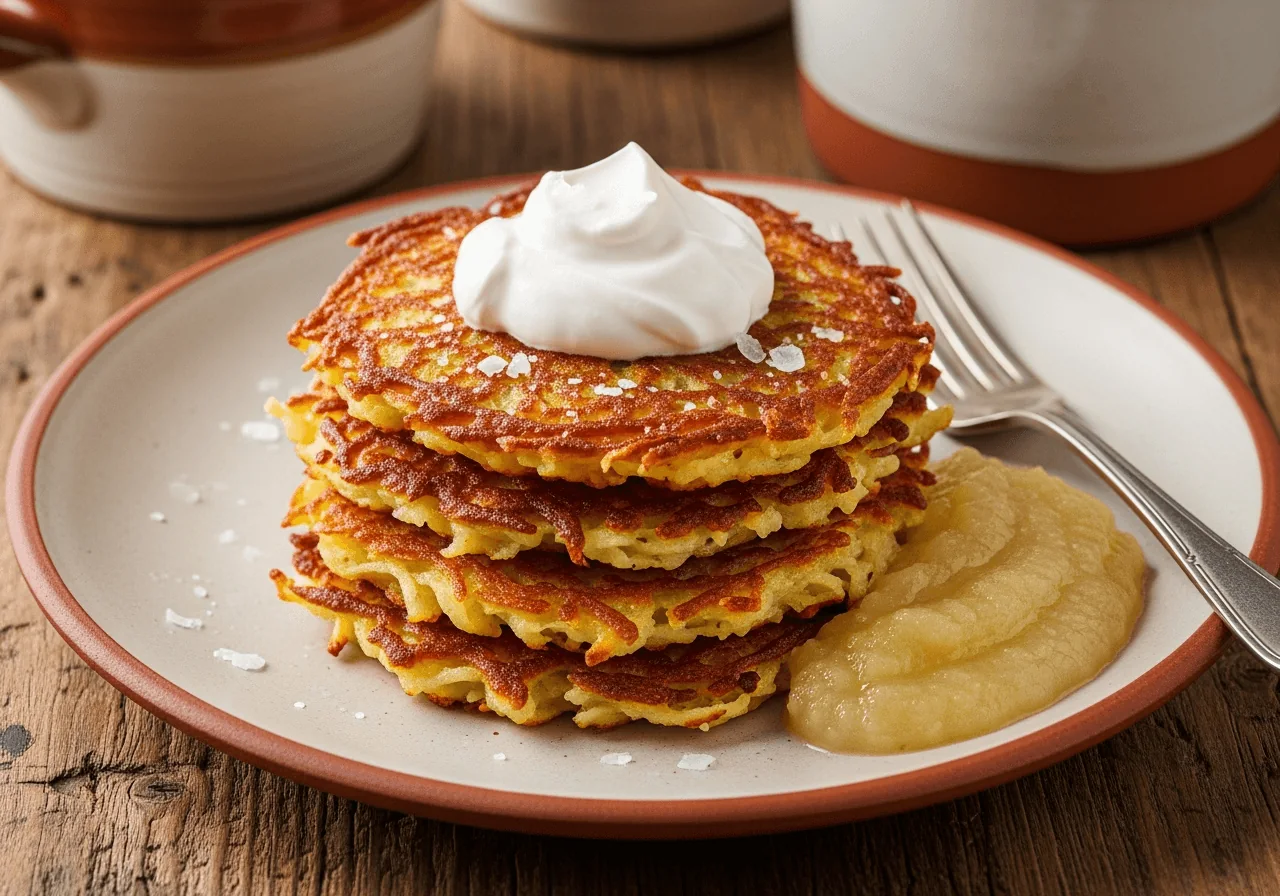
Transfer finished latkes to a plate lined with paper towels, then sprinkle with a pinch of salt while they’re still hot. Serve immediately, with sour cream, applesauce, or a spoonful of each on the side.
Kitchen Tips
Squeeze harder than feels necessary. A kitchen towel works, but a double layer of cheesecloth twisted around a wooden spoon handle gets out noticeably more liquid than hands alone — and a drier batter is the single biggest factor in getting a crisp, rather than soggy, latke.5
Don’t throw out the liquid you squeeze off. Let it sit for a minute before draining it away; the cloudy water separates into clear liquid on top and a layer of potato starch underneath. Mixing that starch back into the batter makes for a crisper crust and a creamier center.5
Give the batter a short rest once the matzo meal or flour goes in. Ten minutes lets the binder absorb liquid and swell, the same way it would in a pancake batter, which makes for a sturdier pancake that’s less likely to fall apart in the pan.5
Keep the oil at a steady medium-high heat rather than turning it down partway through. Latkes fried at too low a temperature soak up oil and turn greasy instead of crisping properly.5
If keeping a batch warm while frying the rest, use a low oven around 200°F (95°C) rather than a covered dish, which traps steam and softens the crust. Even in a low oven, latkes start picking up a burnt flavor after about 30 minutes, so timing the frying close to serving gives the best result.5
Skip any potato with a greenish tinge under the skin. That color signals solanine, a natural plant compound that can cause digestive upset in larger amounts — not dangerous in the small quantities sometimes present, but worth avoiding when there’s a choice.6
Nutritional Information
Per serving (approximately 3–4 latkes, one of 5 servings)
- Calories: approximately 230–270 kcal
- Protein: ~6g
- Total fat: ~11–13g
- Saturated fat: ~1.5g
- Carbohydrates: ~28–32g
- Dietary fiber: ~3g
- Sodium: ~350–450mg (varies with added salt)
Potatoes contribute a meaningful amount of potassium — roughly 600mg per medium potato — along with smaller amounts of vitamin C and vitamin B6, plus fiber that’s concentrated mostly in the peel.6
Nutritional values are estimates based on standard ingredient databases. They will vary depending on specific ingredients, oil absorption, and portion size.
Storage and Reheating
Store leftover latkes in an airtight container in the refrigerator for up to 3 days.7 Reheat in a single layer in a skillet over medium heat, or in a 375°F (190°C) oven for about 10 minutes, until heated through and crisp again. A microwave will warm them but leaves the edges soft rather than crackling, since there’s no direct heat to re-crisp the crust.7
Latkes also freeze well, which makes them a reasonable make-ahead option for a holiday table. Let cooked latkes cool, then layer them between sheets of parchment paper in a freezer-safe container or bag for up to 3 months.7 Reheat directly from frozen — no need to thaw first — in a 400°F (200°C) oven for 20–25 minutes, flipping once at the halfway point, until hot and crisp.7
Traditional Latkes

Ingredients
For the batter (serves 4–5, about 16–18 pancakes)
- 1.8 kg (about 4 lb) starchy potatoes (russet or similar), peeled
- 1 medium onion, peeled
- 2 large eggs, beaten
- 3–4 tablespoons matzo meal (or all-purpose flour)
- 1¼ teaspoons salt, plus more to taste
- ½ teaspoon freshly ground black pepper
- Neutral oil (such as sunflower or vegetable), for frying
For serving
- Sour cream
- Applesauce
Instructions
- Grate the potatoes and onion together, then squeeze out as much liquid as possible — a dry mixture is what gives latkes their crisp edge
- Let the squeezed-out liquid settle for a minute, then pour it off and keep the white starch left at the bottom of the bowl
- Mix the potato starch back into the batter along with egg, matzo meal or flour, salt, and pepper
- Fry in a generous layer of hot oil over medium-high heat, flattening each spoonful, until deep golden on both sides
- Drain briefly, salt while still hot, and serve right away with sour cream, applesauce, or both
Frequently Asked Questions
Sour cream or applesauce — which is more traditional?
Both have a real claim. Applesauce became common once latkes shifted from a dairy dish (cheese, fried in butter) to a meat-adjacent one fried in schmaltz, since Jewish dietary law keeps meat and dairy separate.1 Sour cream stayed in use for latkes served without meat. Most households today serve both and let everyone choose.
Why do my latkes turn out soggy instead of crisp?
Almost always too much residual moisture in the batter. Squeeze the grated potato and onion harder than feels necessary, and don’t skip reserving the potato starch that settles out of the liquid — it does real work in helping the pancakes crisp rather than steam in the pan.5
Can latkes be made without eggs?
Some versions use chickpea flour and potato starch instead of egg as a binder, which makes for an egg-free pancake with a slightly different texture. It’s a workable substitution rather than the traditional method, but it does the job for those who need or prefer it.1
What’s the difference between matzo meal and flour as a binder?
Either works to hold the batter together. Matzo meal gives a slightly heartier crumb and carries some symbolic weight in Jewish cooking, while flour produces a marginally smoother batter — the cooking method and result are nearly identical either way.
Why were latkes originally made with cheese instead of potato?
The potato hadn’t reached Eastern European Jewish kitchens yet — that happened mostly in the 18th and 19th centuries.3 Cheese latkes came first, tied to the story of Judith, and later gave way to grain- and vegetable-based versions once cooks started frying in schmaltz instead of butter, before potato eventually became the standard once it was cheap and widely available.1
Is it true latkes are only eaten on Hanukkah?
Hanukkah is when latkes get the most attention, tied directly to the holiday’s oil symbolism, but there’s nothing stopping anyone from making them any other time of year.2 Plenty of home cooks treat them as a year-round comfort food, particularly the lighter, vegetable-forward variations.
What potato works best for latkes?
Starchy potatoes like russets, since their lower water content and higher starch help the pancakes crisp and hold together in the pan.6 Waxy potatoes can work in a pinch but tend to produce a denser, slightly gummier result.
Looking for a Lighter Version?
Traditional latkes are fried in a generous amount of oil, which is a real part of what gives them their crisp edges and rich flavor. A lighter version is possible without losing too much of that character — the Healthy Latkes article on this site covers baked and air-fried methods, lower-sodium adjustments, and ways to work in extra vegetables while keeping the texture people actually want.
Further Reading & Sources
The following sources were consulted in researching the history, technique, and cultural background of traditional latkes. Heritage Healthy Kitchen’s recipe was developed independently; these links are provided for readers who want to explore further.
- “Latke.” Wikipedia. en.wikipedia.org/wiki/Latke — etymology of “latke” and “levivot,” and overview of grated vs. puréed potato pancake styles.
- “10 Latke Facts Every Jew Should Know.” Chabad.org. chabad.org — the Hanukkah oil miracle, sour cream and applesauce traditions, and the role of potatoes versus other latke ingredients.
- “The Modern Potato Latke Was Not Inevitable.” Smithsonian Center for Folklife and Cultural Heritage. folklife.si.edu — history of cheese and grain-based latkes, schmaltz and kashrut, and the introduction of Crisco in 1911.
- “The Real History of Potato Latkes Will Surprise You.” The Nosher, My Jewish Learning. myjewishlearning.com — the Judith legend, the 1322 Kalonymus ben Kalonymus poem, and the 1839–1840 crop failures that established the potato as an Eastern European staple.
- “I Tried 5 Latke Recipes and This Is What I Learned.” The Kitchn. thekitchn.com — comparative technique notes on squeezing, binders, batter resting time, and frying temperature.
- “Are Potatoes Healthy?” The Nutrition Source, Harvard T.H. Chan School of Public Health. nutritionsource.hsph.harvard.edu/potatoes — nutrient content of potatoes, including potassium and fiber, and guidance on solanine in green-tinged potatoes.
- “How to Reheat Latkes: Simple Steps for Perfect Crispiness.” Veselka. veselka.com — refrigerator and freezer storage times, and oven reheating method for frozen latkes.
Disclaimer
The information in this article is provided for educational and informational purposes only. Heritage Healthy Kitchen makes no representations or warranties regarding the accuracy or completeness of any content on this site. Nutritional values are estimates only and will vary depending on the specific ingredients, brands, and measurements used. This content is not intended as dietary, medical, or professional nutritional advice. Always consult a qualified healthcare provider regarding any dietary needs or health conditions. Heritage Healthy Kitchen is not responsible for any outcomes resulting from the use of recipes or information published on this site.
Cook by Occasion
This recipe is part of our Hanukkah menu.
You Might Also Like
More heritage recipes from our kitchen


Leave a Reply