

Active time: ~40 minutes | Total time: ~5½ hours (including rising and cooling) | Serves: 16 (2 loaves) | Difficulty: Moderate
Quick Overview
- Make a sponge of yeast, warm milk, a little sugar and flour
- Beat in eggs, yolks and a third of a cup less sugar than the traditional recipe
- Add half butter, half sunflower oil, and equal parts whole-wheat and all-purpose flour
- Rise, fill two tall pans and bake at 180°C (350°F), just as for traditional paska
- Drizzle with a thin lemon glaze made with half the sugar
What This Version Changes — and What It Keeps
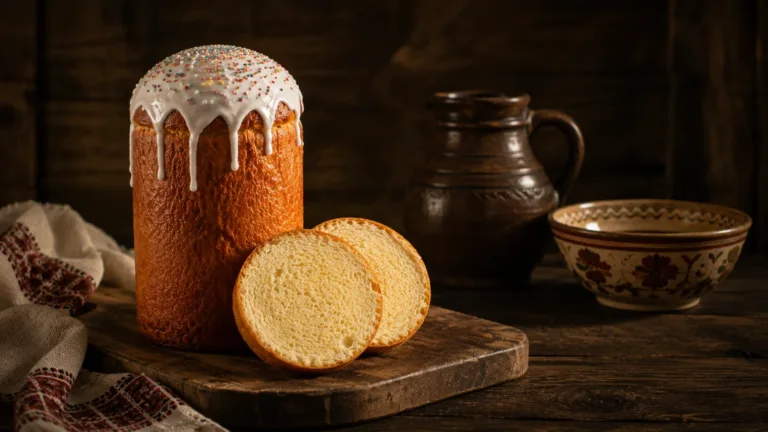
The loaf stays the paska of the traditional recipe: two tall loaves rich with eggs and yolks, made with the same sponge, rises and oven temperature, and cut into the same 16 slices. Nothing about the method changes.
Three things do. Half the all-purpose flour becomes whole-wheat flour. The dough takes a third of a cup less sugar, and the glaze half as much. And half the butter is replaced with sunflower oil, which published paska recipes already add in a spoonful or two alongside the butter.1,2 None of the swaps is drastic, but together they cut the added sugar in a slice by about 39% and the saturated fat by about a third, and roughly double the fiber.
Why These Swaps Work
Refining wheat into white flour strips away more than half of its B vitamins, 90 percent of its vitamin E and virtually all of its fiber.3 Whole-wheat flour keeps the bran and germ. A registered dietitian at Cleveland Clinic notes that it can usually replace all-purpose flour one for one, but that it tends to give a denser bake.4 Because of that denser bake, this version swaps half the flour rather than all of it.
Harvard’s Nutrition Source suggests cutting the added sugar in baking by ¼–⅓ cup, and this version takes the larger amount, ⅓ cup (65g), out of the dough. The Dietary Guidelines for Americans advise keeping added sugars under 10% of daily calories, and the American Heart Association suggests no more than about 24g a day for most women and 36g for most men.5 The glaze is almost pure sugar, so halving it and drizzling it thinly takes out more without changing the bread itself.
Butter’s fat is about 60% saturated; sunflower oil’s is about 10%. Eating unsaturated fats in place of saturated fat lowers LDL cholesterol and improves the ratio of total to HDL cholesterol. The Dietary Guidelines for Americans recommend keeping saturated fat under 10% of calories, and the American Heart Association no more than 7%.6 The total amount of fat in a slice stays about the same; what changes is the kind. Half the butter stays, so the loaf still tastes of it.
Healthy Paska Recipe
This recipe was compiled by Heritage Healthy Kitchen from published recipes and the sources for the swaps, all listed at the end of this article. Figures that are Heritage Healthy Kitchen’s own estimates rather than taken from a published source are marked as such.
The base is our traditional paska, compiled from published recipes: 700g of flour, 250ml of milk, three eggs and three yolks, and two loaves baked at 180°C for 40–45 minutes.1,7,2,8 The size of the sugar cut follows Harvard’s advice.5 The other swap amounts (half the flour, half the butter, half the glaze), the 16 slices and the storage times are Heritage Healthy Kitchen’s estimates.
Ingredients (makes 2 loaves, serves 16)

For the sponge
- 250ml (1 cup) whole milk, warmed to 30–35°C (85–95°F)
- 7g (2¼ teaspoons) instant or active dry yeast, or 25g fresh yeast
- 1 tablespoon sugar and 2 tablespoons all-purpose flour, taken from the amounts below
For the dough
- 3 large eggs plus 3 egg yolks, at room temperature
- 135g (⅔ cup) granulated sugar (65g less than the traditional recipe)
- 10g (2½ teaspoons) vanilla sugar, or 1 teaspoon vanilla extract
- ¼ teaspoon salt
- 75g (⅓ cup) unsalted butter, melted and cooled until just warm
- 6 tablespoons sunflower oil, plus a little for the bowl and your hands
- Finely grated zest of 1 lemon and 1 orange
- 350g (about 2¾ cups) whole-wheat flour
- 350g (about 2¾ cups) all-purpose flour
- 120g (¾ cup) raisins, soaked in warm water for 10–15 minutes and patted dry
- 1 egg yolk, beaten, for brushing

For the glaze
- 75g (⅔ cup) powdered sugar
- 1–1½ tablespoons fresh lemon juice
- Colored sprinkles, optional
Instructions

- Make the sponge. Stir the yeast into the warm milk with 1 tablespoon of the sugar and 2 tablespoons of the all-purpose flour. The milk should be no warmer than 35°C (95°F), or the yeast will die.1,2 Cover and leave in a warm spot for 20–30 minutes, until doubled and bubbly.1,2
- Beat the eggs. Beat the eggs and yolks with the rest of the sugar, the vanilla sugar and the salt until pale and thick.2,8
- Mix the dough. Whisk the two flours together in a separate bowl. Stir the egg mixture into the sponge, then the melted butter, the oil and the zest, and add the flour gradually.2,1 Knead for about 10 minutes until smooth. The dough will feel a little heavier than an all-white dough, since whole-wheat flour bakes denser,4 but keep it soft and slightly sticky; oil your hands rather than adding flour.2
- Let it rise. Put the dough in an oiled bowl, cover it and leave it somewhere warm for 1–1½ hours, until doubled.1,7,2
- Add the raisins. Knock the dough back and knead in the raisins, keeping them off the surface, where they would burn.1
- Fill the pans. Line the bottoms of two tall round pans, about 15cm (6in) across, with parchment and grease the sides. Divide the dough between them, filling each about a third of the way up.2,8 Cover and leave until the dough nearly reaches the rims, 40–60 minutes.7,2 Heat the oven to 180°C (350°F).
- Bake. Brush the tops with the beaten yolk and bake on a low oven rack for 40–45 minutes, until a skewer pushed into the center comes out dry. If the tops brown before the middle is done, cover them loosely with foil.2,7
- Cool. Let the loaves cool a little in their pans, then turn them out and leave them to cool completely.7,2
- Glaze. Whisk the powdered sugar with just enough lemon juice to make a thin glaze and drizzle it over the tops rather than coating them; add sprinkles, if using.
Nutritional Comparison
| Per serving (1 of 16 slices, with glaze) | Traditional | This Version |
|---|---|---|
| Calories | approximately 350–430 kcal | approximately 315–385 kcal |
| Protein | 6.5–8g | 7–9g |
| Total fat | 11–13.5g | 11–13.5g |
| Saturated fat | 5.5–6.5g | 3.5–4.5g |
| Carbohydrates | 57–69g | 48–59g |
| Fiber | 1.5–2g | 3–3.5g |
| Sodium | 55–70mg | 55–70mg |
Added sugar comes to about 22g a slice in the traditional loaf and about 14g in this one. Calories drop by around 40 a slice; the bigger changes are in sugar, saturated fat and fiber.
Nutritional values are estimates based on standard ingredient databases (USDA FoodData Central). They vary with the size of the eggs, the slice and how much glaze goes on.
Storage and Reheating
Keep the glazed loaves at room temperature, wrapped or in an airtight container, for 3–4 days. To keep them longer, wrap unglazed loaves tightly and freeze for up to 2 months, then thaw at room temperature and glaze before serving. Slices that have dried out a little are good lightly toasted. These times are Heritage Healthy Kitchen’s estimates.
Healthy Paska

Ingredients
For the sponge
- 250ml (1 cup) whole milk, warmed to 30–35°C (85–95°F)
- 7g (2¼ teaspoons) instant or active dry yeast, or 25g fresh yeast
- 1 tablespoon sugar and 2 tablespoons all-purpose flour, taken from the amounts below
For the dough
- 3 large eggs plus 3 egg yolks, at room temperature
- 135g (⅔ cup) granulated sugar (65g less than the traditional recipe)
- 10g (2½ teaspoons) vanilla sugar, or 1 teaspoon vanilla extract
- ¼ teaspoon salt
- 75g (⅓ cup) unsalted butter, melted and cooled until just warm
- 6 tablespoons sunflower oil, plus a little for the bowl and your hands
- Finely grated zest of 1 lemon and 1 orange
- 350g (about 2¾ cups) whole-wheat flour
- 350g (about 2¾ cups) all-purpose flour
- 120g (¾ cup) raisins, soaked in warm water for 10–15 minutes and patted dry
- 1 egg yolk, beaten, for brushing
For the glaze
- 75g (⅔ cup) powdered sugar
- 1–1½ tablespoons fresh lemon juice
- Colored sprinkles, optional
Instructions
- Sponge: Yeast, warm milk (max 35°C/95°F), 1 tbsp sugar, 2 tbsp flour; 20–30 min, until doubled.
- Eggs: Beat eggs and yolks with the rest of the sugar, vanilla sugar and salt until pale.
- Dough: Whisk the two flours together. Add egg mixture, butter, oil and zest to the sponge; add flour gradually; knead ~10 min. Keep it soft and slightly sticky.
- Rise: Oiled bowl, covered, warm place, 1–1½ hours, until doubled.
- Raisins: Knock back; knead in the raisins, keeping them off the surface.
- Pans: Two tall pans (about 15cm/6in across), parchment on the bottom, greased; fill about ⅓; rise 40–60 min.
- Bake: Brush with yolk; 180°C (350°F), low rack, 40–45 min, until a skewer comes out dry; foil if the tops brown early.
- Cool and glaze: Cool completely; drizzle with a thin powdered sugar and lemon glaze; sprinkles optional.
Frequently Asked Questions
Will whole-wheat flour change the texture?
Yes, a little: whole-wheat flour tends to give a denser bake.4 Swapping only half the flour keeps the loaf soft enough to read as paska.
Why doesn’t the total fat go down?
Because oil replaces butter rather than being cut. What changes is the kind of fat: butter’s fat is about 60% saturated and sunflower oil’s about 10%, so the saturated fat in a slice drops by about a third.6
Can I cut the sugar even further?
Harvard’s suggestion for baking is ¼–⅓ cup less added sugar,5 and this recipe already takes the larger amount out of the dough. The glaze can be left off altogether.
Can I replace all the butter with oil?
Published paska recipes use butter, with at most a spoonful or two of oil.1,2 This version replaces half the butter; replacing all of it would take the loaf further from paska.
Is this paska suitable for someone watching their blood sugar?
It has less added sugar and more fiber than the traditional loaf, but it is still a sweet bread with 48–59g of carbohydrates a slice. Anyone managing diabetes should ask a doctor or registered dietitian about portions.
Looking for the Full Story?
This article is about the swaps. For the history of paska, the blessing of the Easter basket and the recipe this version is based on, see our Traditional Paska recipe.
Further Reading & Sources
The recipe is a compilation based on the published recipes and the sources for the swaps listed here; these links are provided for readers who want to explore further.
The traditional base
- Yevhen Klopotenko. (12 April 2021). Velykodnia vypichka. Klasychnyi retsept drizhdzhovoi pasky [Easter baking: a classic yeast paska]. klopotenko.com. Published recipe: 750–800g flour, 220ml milk, 25g fresh yeast, 1 egg and 1 yolk, 225g sugar, 100g butter and 2 tablespoons sunflower oil, 100g raisins; milk no warmer than 35°C; 180°C.
- Yevhen Klopotenko. (6 April 2026). Zdobna paska [Rich paska]. klopotenko.com. Published recipe: 650g flour, 250ml milk, 3 eggs and 4 yolks, 100g sugar and 50g honey, 200g butter and 2 tablespoons oil; two loaves in pans 15cm across; pans filled a third full; 180°C, 40–45 minutes on the lowest rack; the dough stays slightly sticky, and extra flour gives a dense loaf; tops covered with foil if they brown before the middle is done.
- Yevhen Klopotenko. (24 March 2025). Lvivska paska [Lviv paska], adapted from Vira Manko and Olha Verbenets, Velykodnii koshyk. klopotenko.com. Published recipe: 1kg flour, 500ml whey with 200ml honey, 6 yolks, 150g butter, 1 tablespoon oil; two loaves of about 720g; 180°C, 40–45 minutes.
- Daryna Tsviakh. (30 April 2024). Try pasky vid lvivskykh hospodyn. Retsepty dnia [Three paskas from Lviv home bakers]. ZAXID.NET. Three home recipes with 520g–1.3kg flour, 250–500ml milk, 4–6 eggs or 4 yolks, 100–200g butter, 1 cup to 500g sugar; pans filled a third full.
The swaps
- Harvard T.H. Chan School of Public Health. Whole Grains. The Nutrition Source. Refining wheat strips away more than half of its B vitamins, 90 percent of its vitamin E and virtually all of its fiber.
- Cleveland Clinic. (4 March 2025). Are Some Flours Healthier Than Others? Here Are 8 Worth Trying. Health Essentials (with registered dietitian Elyse Homan, MS, RD, LD). White flour is limited in nutritional value; whole-wheat flour keeps the bran and germ, can usually replace all-purpose flour one for one, and tends to give a denser bake.
- Harvard T.H. Chan School of Public Health. Added Sugar. The Nutrition Source. When baking, reduce the added sugar by ¼–⅓ cup; the Dietary Guidelines for Americans advise keeping added sugars under 10% of calories; the American Heart Association suggests no more than about 24g a day for most women and 36g for most men.
- Harvard T.H. Chan School of Public Health. Types of Fat. The Nutrition Source. Butter’s fat is 60% saturated, sunflower oil’s 10%; eating good fats in place of saturated fat lowers LDL cholesterol and improves the ratio of total to HDL cholesterol; the Dietary Guidelines for Americans recommend under 10% of calories from saturated fat, the American Heart Association no more than 7%.
Disclaimer
The information in this article is provided for educational and informational purposes only. Heritage Healthy Kitchen makes no representations or warranties regarding the accuracy or completeness of any content on this site. Nutritional values are estimates only and will vary depending on the specific ingredients, brands, and measurements used. This content is not intended as dietary, medical, or professional nutritional advice. Individual dietary needs and suitability vary, particularly for anyone managing diabetes or other health conditions. Always consult a qualified healthcare provider or registered dietitian regarding any dietary needs or health conditions. Heritage Healthy Kitchen is not responsible for any outcomes resulting from the use of recipes or information published on this site.
Cook by Occasion
This recipe is part of our Velykden table.
You Might Also Like
More heritage recipes from our kitchen
Leave a Reply