
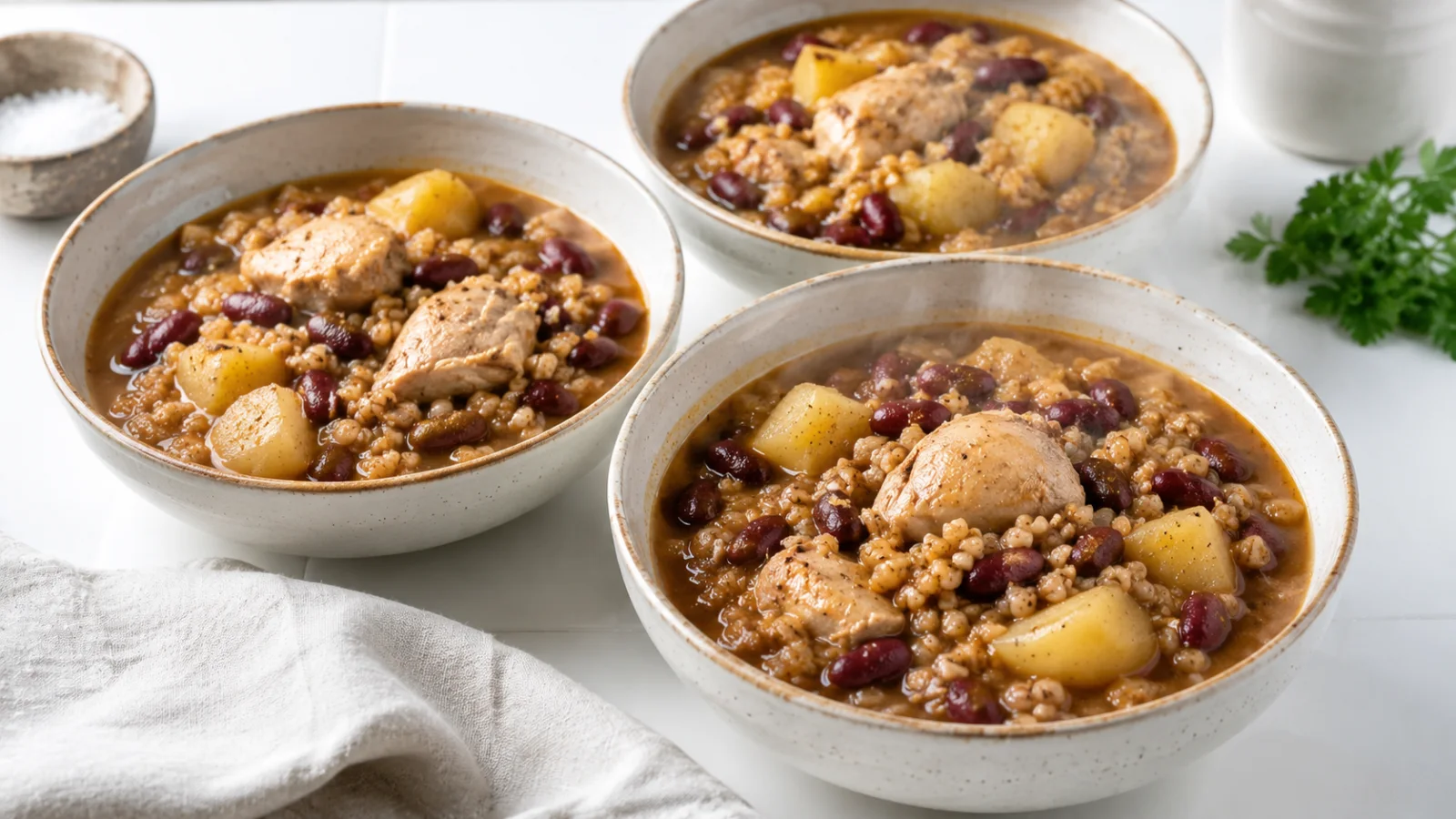
Serves: 6 | Two variants included: Leaner Poultry Cholent and Vegetarian Cholent | Difficulty: Easy
Quick Overview
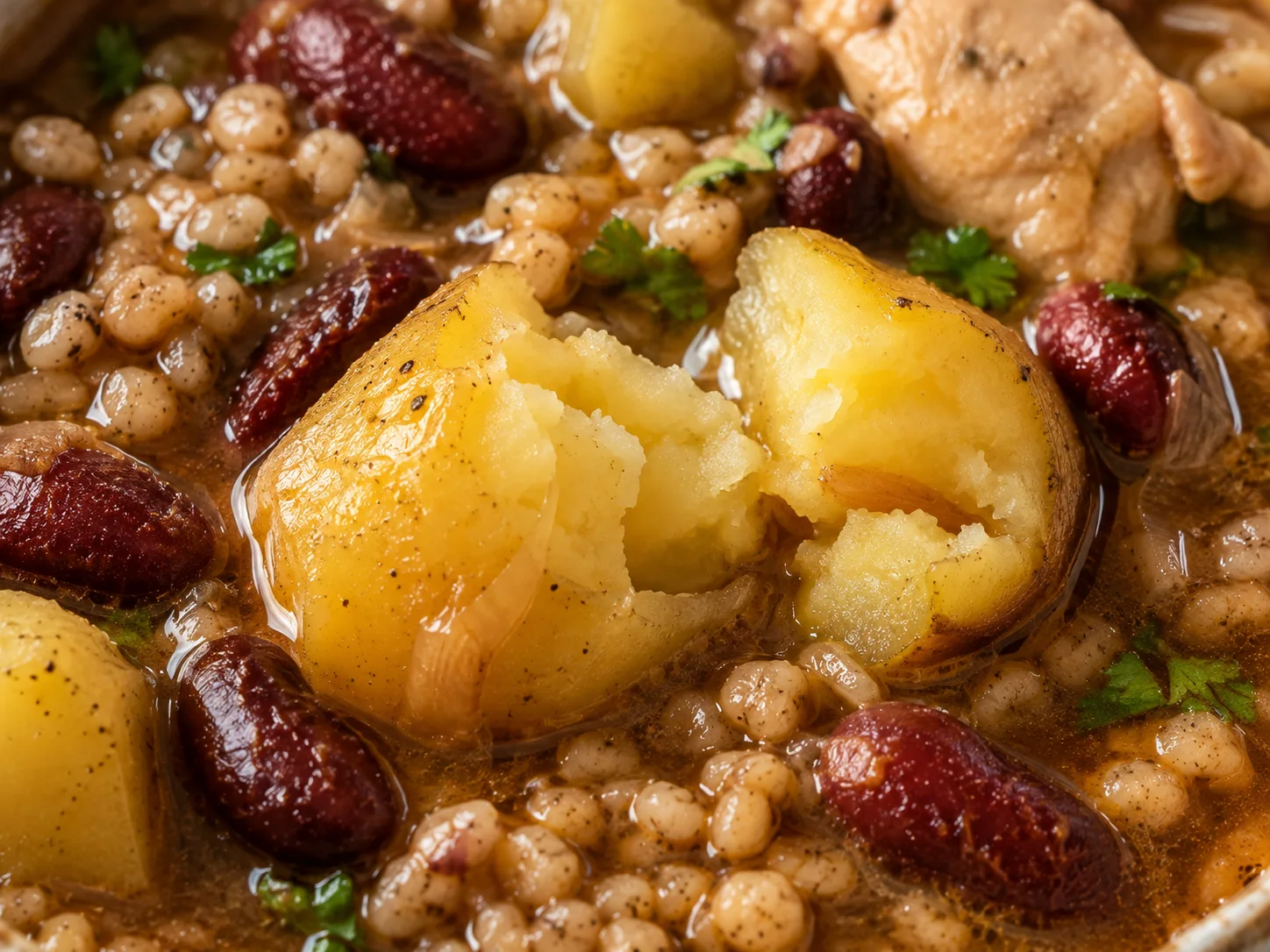
- Choose a path: bone-in chicken or turkey in place of beef, or a fully vegetarian version built on extra beans and mushrooms
- Build the same base of onions, paprika, and barley used in the traditional recipe
- Boil the dried kidney beans properly first, exactly as in the traditional version — that safety step never changes
- Bring the whole pot to a full boil, then move it to a low oven or slow cooker, same as always
- The poultry version needs several fewer hours than beef would; the vegetarian version can run the traditional length
- Compare both versions against the traditional recipe’s nutrition numbers below
What This Version Changes — and What It Keeps
Both versions keep the barley, the potatoes, the paprika, and the core method: everything goes into one pot, the pot comes to a full boil, and then it settles into a long, slow cook. Any dried kidney beans still get soaked and boiled hard beforehand, exactly as in the traditional recipe. That step is about safety, not flavor, and it doesn’t change here.
What changes is the protein, the cook time, and the salt. The poultry version replaces beef with bone-in chicken or turkey and needs several fewer hours in the pot as a result. The vegetarian version removes meat entirely and builds its heartiness from extra beans, chickpeas, and mushrooms instead. Both versions also cut back on added salt and lean on low-sodium broth.
Why These Swaps Work
Chicken and turkey carry relatively low saturated fat compared with red meat such as beef, according to Harvard Health Publishing’s chief medical editor, and that swap alone accounts for most of the drop in fat between the poultry version and the traditional recipe.1
The cut matters as much as the swap itself. Chicken breast turns dry long before a dish like this would be ready, and a food-science writer drawing on Harold McGee’s research on meat cookery specifically warns against using breast meat in a slow cooker at all.2 Bone-in thigh and drumstick meat carries far more connective tissue, which gives it a much wider window of doneness and lets it hold up to hours of low heat the way beef does.2 Poultry still doesn’t carry nearly as much connective tissue as beef chuck or brisket to begin with, though, so it reaches a tender, fall-off-the-bone texture well before the 12 to 18 hours beef needs — which is why this version’s cook time runs several hours shorter.
Mushrooms do real work in the vegetarian version rather than just filling space. Their savory depth, known as umami, makes them a genuine stand-in for meat, and Mayo Clinic Health System specifically recommends replacing a quarter to half of the meat in a recipe with chopped mushrooms, noting they arrive naturally low in sodium and fat.3
Added chickpeas do the rest of that work, supplying protein and fiber that a mushroom-and-barley broth would lack on its own. Legumes are a strong source of protein, fiber, and folate, and diets that include them regularly have been associated with lower cholesterol and reduced cardiovascular risk.4
Cutting the added salt in both versions and leaning on low-sodium broth addresses sodium directly, on top of whatever the protein swap does on its own. The American Heart Association sets 2,300 milligrams a day as the upper limit for most adults, with an ideal target closer to 1,500, and notes that cutting sodium by even 1,000 milligrams a day measurably improves blood pressure.5
Healthy Cholent Recipes
Both recipes developed independently by Heritage Healthy Kitchen. Sources for further reading are listed at the end of this article.
Variant One: Leaner Poultry Cholent
Active time: ~35 minutes | Total time: ~9–11 hours (mostly unattended) | Serves: 6
Ingredients
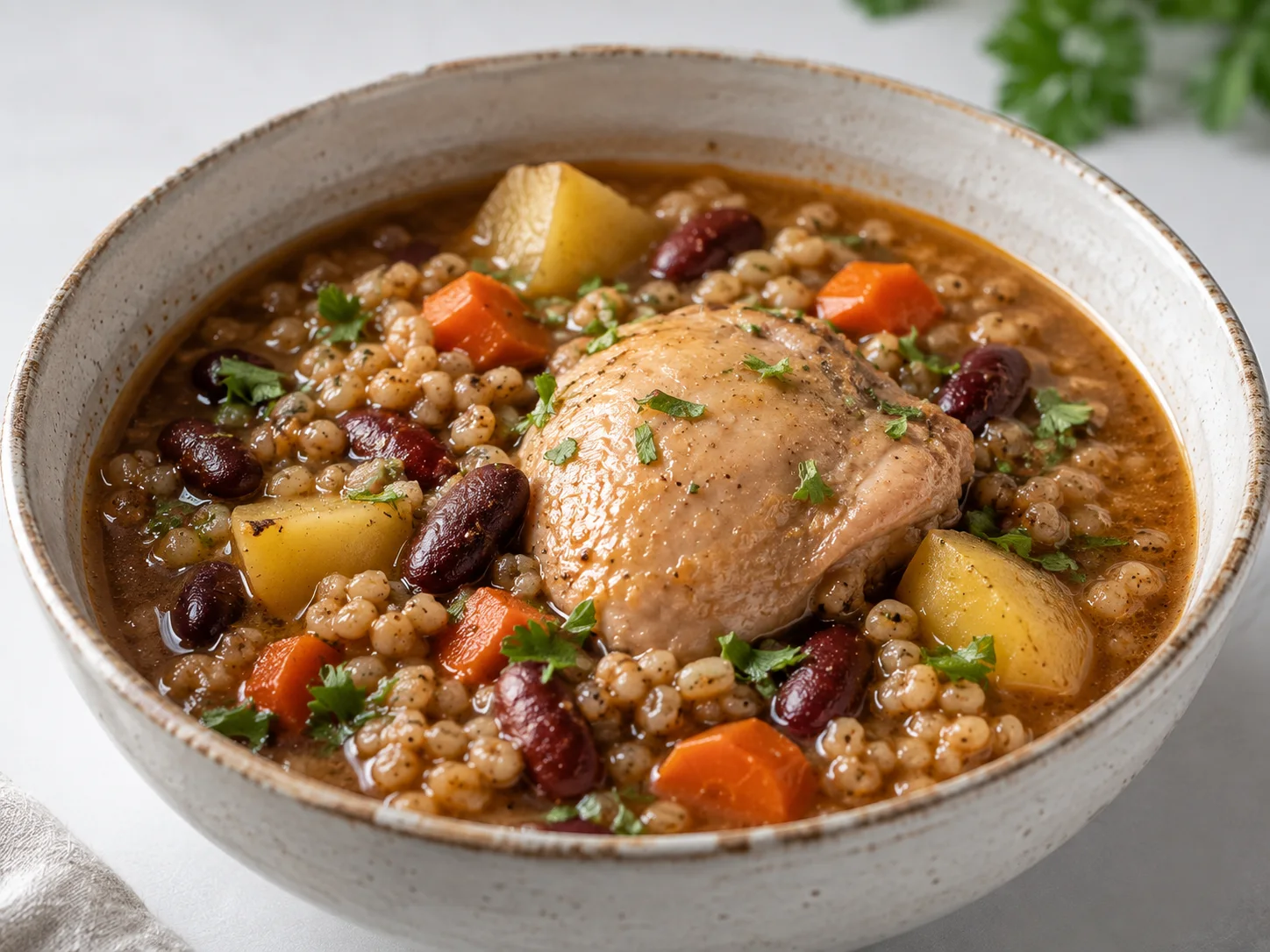
- 1.2kg (about 2.6 lbs) bone-in chicken or turkey thighs and drumsticks, skin removed
- 1 cup (200g) dried kidney beans, or a mix of kidney and pinto beans
- ½ cup (100g) pearl barley
- 3 medium potatoes (about 500g), peeled and quartered
- 2 medium carrots (about 150g), cut into chunks
- 2 large onions (about 300g), sliced
- 4 cloves garlic, left whole
- 1 tablespoon (15ml) olive oil
- 1½ tablespoons (about 11g) sweet paprika
- 1 teaspoon (about 2g) black pepper
- 1 teaspoon (about 6g) fine salt, plus more to taste
- 4 cups (1 liter) low-sodium chicken or turkey broth

Instructions
- Soak and boil the beans. Rinse the dried kidney beans and soak in plenty of water for at least 5 hours or overnight. Drain, cover with fresh water, and boil briskly for 30 minutes, then drain again.6
- Brown the poultry. Season the chicken or turkey pieces with a little of the pepper. Heat the oil in a large, heavy pot and brown them on all sides, about 8 minutes. Remove and set aside.
- Soften the onions. In the same pot, cook the onions until softened, about 5 minutes.
- Layer the pot. Spread the potatoes and carrots over the onions, then add the browned poultry, the boiled beans, the barley, and the whole garlic cloves.
- Season and add liquid. Sprinkle with the paprika, remaining pepper, and salt, then pour in the broth.
- Bring to a full boil. Set the pot over high heat and bring it to a rolling boil, uncovered, for a few minutes.
- Transfer to low heat. Cover tightly and move the pot to a 200°F (95°C) oven, or transfer everything to a slow cooker set to low.
- Cook. Let it cook undisturbed for 8 to 10 hours, until the poultry is very tender and starting to fall from the bone.
- Serve. Uncover carefully and serve directly from the pot, removing any bones as you serve.
Variant Two: Vegetarian Cholent
Active time: ~30 minutes | Total time: ~11–15 hours (mostly unattended) | Serves: 6
Ingredients
- 1 cup (200g) dried kidney beans, or a mix of kidney and pinto beans
- 1 cup (185g) dried chickpeas, soaked overnight (or 500g canned, no salt added, drained and rinsed)
- ½ cup (100g) pearl barley
- 400g (about 14 oz) cremini or button mushrooms, quartered
- 4 medium potatoes (about 700g), peeled and quartered
- 2 medium carrots (about 150g), cut into chunks
- 2 large onions (about 300g), sliced
- 4 cloves garlic, left whole
- 2 tablespoons (30ml) olive oil
- 1½ tablespoons (about 11g) sweet paprika
- 1 teaspoon (about 2g) black pepper
- 1 teaspoon (about 6g) fine salt, plus more to taste
- 5 cups (1.2 liters) low-sodium vegetable broth
Instructions
- Soak and boil the kidney beans. Rinse the dried kidney beans and soak in plenty of water for at least 5 hours or overnight. Drain, cover with fresh water, and boil briskly for 30 minutes, then drain again.6 Soak the chickpeas separately overnight; they don’t need the same boiling step.
- Brown the mushrooms. Heat the oil in a large, heavy pot over medium-high heat. Add the mushrooms and cook, stirring occasionally, until they release their liquid and it evaporates, about 8 minutes. This step builds real flavor, so don’t rush it.
- Soften the onions. Add the onions to the same pot and cook until softened, about 5 minutes.
- Layer the pot. Spread the potatoes and carrots over the onions and mushrooms, then add the boiled kidney beans, the soaked chickpeas, the barley, and the whole garlic cloves.
- Season and add liquid. Sprinkle with the paprika, pepper, and salt, then pour in the vegetable broth.
- Bring to a full boil. Set the pot over high heat and bring it to a rolling boil, uncovered, for a few minutes.
- Transfer to low heat. Cover tightly and move the pot to a 200°F (95°C) oven, or transfer everything to a slow cooker set to low.
- Cook. Let it cook undisturbed for 10 to 14 hours. There’s no meat to overcook here, so running it a little longer won’t hurt.
- Serve. Uncover carefully and serve directly from the pot.
Kitchen Tips
For the poultry version, remove the skin before cooking rather than trying to skim it off afterward. Skin left on renders a meaningful amount of fat straight into the broth, and it’s much easier to trim beforehand than to defat a finished stew.
For the vegetarian version, let the mushrooms brown properly in step 2 before adding anything else. A dry, well-browned mushroom carries far more flavor into the finished stew than one that’s still pale and wet.
In both versions, check the sodium content on the broth carton before buying rather than trusting the “low-sodium” label alone. The regulated ceiling for that label still allows up to 140 milligrams per serving, and serving sizes vary by brand, so two “low-sodium” broths can carry noticeably different amounts.5
Nutritional Comparison
The table below sets both lighter versions against the traditional beef recipe covered in the companion Traditional Cholent article on this project, which serves as the reference point.
Per serving (1 of 6 servings)
| Nutrient | Traditional Cholent (reference) | Poultry Version | Vegetarian Version |
|---|---|---|---|
| Calories | ~630–780 kcal | ~465–570 kcal | ~430–530 kcal |
| Protein | ~37–46g | ~43–53g | ~20–24g |
| Total fat | ~30–37g | ~10–12g | ~7–9g |
| Carbohydrates | ~54–66g | ~51–63g | ~76–93g |
| Dietary fiber | ~14–17g | ~13–16g | ~19–24g |
| Sodium | ~715–875mg | ~610–745mg | ~490–595mg |
Values are estimates, calculated ingredient-by-ingredient using standard reference data, and will vary with the exact cut of poultry, the brand of broth, and how much added salt is used.
The two lighter versions cut fat for different reasons. The poultry version keeps protein at or above the traditional level while cutting fat by more than half, since skinless dark meat carries far less fat than beef chuck. The vegetarian version cuts fat and calories the most and adds by far the most fiber, but its carbohydrate count runs well above the traditional recipe’s, mostly from the beans, chickpeas, and potatoes that also supply nearly all of that fiber.
Storage and Reheating
Both versions keep in the refrigerator for up to 4 days in an airtight container, the same as the traditional recipe. Reheat gently on the stovetop or in the microwave until hot throughout.
The poultry version freezes well for up to 3 months, ideally without the potatoes and carrots, which can turn grainy after thawing — the same trade-off as in the traditional recipe. Reheat it slowly rather than at a hard boil, since lean, skinless meat has little fat left to keep it from turning stringy if it’s reheated too fast. The vegetarian version freezes less predictably because of the beans and chickpeas, which can turn slightly mealy after thawing; it’s better suited to refrigerator storage within the 4-day window.
Leaner Poultry Cholent

Ingredients
Ingredients
- 1.2kg (about 2.6 lbs) bone-in chicken or turkey thighs and drumsticks, skin removed
- 1 cup (200g) dried kidney beans, or a mix of kidney and pinto beans
- ½ cup (100g) pearl barley
- 3 medium potatoes (about 500g), peeled and quartered
- 2 medium carrots (about 150g), cut into chunks
- 2 large onions (about 300g), sliced
- 4 cloves garlic, left whole
- 1 tablespoon (15ml) olive oil
- 1½ tablespoons (about 11g) sweet paprika
- 1 teaspoon (about 2g) black pepper
- 1 teaspoon (about 6g) fine salt, plus more to taste
- 4 cups (1 liter) low-sodium chicken or turkey broth
Instructions
- Soak and boil the beans: Rinse the dried kidney beans and soak in plenty of water for at least 5 hours or overnight. Drain, cover with fresh water, and boil briskly for 30 minutes, then drain again.
- Brown the poultry: Season the chicken or turkey pieces with a little of the pepper. Heat the oil in a large, heavy pot and brown them on all sides, about 8 minutes. Remove and set aside.
- Soften the onions: In the same pot, cook the onions until softened, about 5 minutes.
- Layer the pot: Spread the potatoes and carrots over the onions, then add the browned poultry, the boiled beans, the barley, and the whole garlic cloves.
- Season and add liquid: Sprinkle with the paprika, remaining pepper, and salt, then pour in the broth.
- Bring to a full boil: Set the pot over high heat and bring it to a rolling boil, uncovered, for a few minutes.
- Transfer to low heat: Cover tightly and move the pot to a 200°F (95°C) oven, or transfer everything to a slow cooker set to low.
- Cook: Let it cook undisturbed for 8 to 10 hours, until the poultry is very tender and starting to fall from the bone.
- Serve: Uncover carefully and serve directly from the pot, removing any bones as you serve.
Vegetarian Cholent
Ingredients
Ingredients
- 1 cup (200g) dried kidney beans, or a mix of kidney and pinto beans
- 1 cup (185g) dried chickpeas, soaked overnight (or 500g canned, no salt added, drained and rinsed)
- ½ cup (100g) pearl barley
- 400g (about 14 oz) cremini or button mushrooms, quartered
- 4 medium potatoes (about 700g), peeled and quartered
- 2 medium carrots (about 150g), cut into chunks
- 2 large onions (about 300g), sliced
- 4 cloves garlic, left whole
- 2 tablespoons (30ml) olive oil
- 1½ tablespoons (about 11g) sweet paprika
- 1 teaspoon (about 2g) black pepper
- 1 teaspoon (about 6g) fine salt, plus more to taste
- 5 cups (1.2 liters) low-sodium vegetable broth
Instructions
- Soak and boil the kidney beans: Rinse the dried kidney beans and soak in plenty of water for at least 5 hours or overnight. Drain, cover with fresh water, and boil briskly for 30 minutes, then drain again. Soak the chickpeas separately overnight; they don’t need the same boiling step.
- Brown the mushrooms: Heat the oil in a large, heavy pot over medium-high heat. Add the mushrooms and cook, stirring occasionally, until they release their liquid and it evaporates, about 8 minutes.
- Soften the onions: Add the onions to the same pot and cook until softened, about 5 minutes.
- Layer the pot: Spread the potatoes and carrots over the onions and mushrooms, then add the boiled kidney beans, the soaked chickpeas, the barley, and the whole garlic cloves.
- Season and add liquid: Sprinkle with the paprika, pepper, and salt, then pour in the vegetable broth.
- Bring to a full boil: Set the pot over high heat and bring it to a rolling boil, uncovered, for a few minutes.
- Transfer to low heat: Cover tightly and move the pot to a 200°F (95°C) oven, or transfer everything to a slow cooker set to low.
- Cook: Let it cook undisturbed for 10 to 14 hours. There’s no meat to overcook here, so running it a little longer won’t hurt.
- Serve: Uncover carefully and serve directly from the pot.
Frequently Asked Questions
Which version is actually healthier, the poultry or the vegetarian one?
It depends on the priority. The poultry version has the most protein of the three and the least carbohydrate. The vegetarian version has the least fat and by far the most fiber, but also the least protein. Neither is a strictly better choice; they suit different goals.
Can chicken breast be used instead of thighs and drumsticks?
It isn’t recommended for this recipe. Breast meat has very little connective tissue and turns dry well before this dish’s cook time is up, while thigh and drumstick meat is built for exactly this kind of long, slow cooking.2
Is it actually safe to slow-cook chicken for 8 to 10 hours?
Yes, provided the poultry starts out fully thawed and the slow cooker or oven runs continuously at a safe temperature, which is exactly what this recipe calls for. The USDA notes that a slow cooker’s combination of direct heat, long cooking time, and trapped steam is enough to destroy harmful bacteria safely over many hours.7
Does the vegetarian version actually taste like cholent without any meat?
It’s different, not lesser. The browned mushrooms, beans, and chickpeas give the stew real body and savory depth of their own, and the same paprika, barley, and long slow cook that define cholent are still doing their work. It won’t taste like a beef stew, but that was never really the point of making it.
Can the vegetarian version run the full 12 to 18 hours the traditional recipe uses?
Yes. There’s no meat to dry out or overcook, so extending the cook time toward the traditional recipe’s range is fine; the beans, chickpeas, and potatoes will simply continue to soften.
Can I use canned beans and chickpeas instead of cooking them from dried?
For the chickpeas, yes — use canned, no-salt-added chickpeas, drained and rinsed, and skip the overnight soak. For the kidney beans, canned beans are already fully cooked and safe to use directly, which also means the 30-minute boiling step in this recipe isn’t needed if starting from canned.6
Can the two versions be combined, using both poultry and mushrooms?
Yes. Brown a smaller quantity of poultry alongside the mushrooms in step 2 of the vegetarian recipe, then follow the poultry version’s shorter cook time of 8 to 10 hours, since the poultry is now the ingredient that sets the clock.
Looking for the Full Story?
This article focuses on the swaps and the reasoning behind them, not on cholent’s history and Ashkenazi background. For the full story and the traditional beef recipe this article is based on, see the Traditional Cholent article on this site.
Read the Traditional Cholent recipe
Further Reading & Sources
The following sources were consulted for the nutritional information and health context in this article. Heritage Healthy Kitchen’s recipes were developed independently; these links are provided for readers who want to explore further.
- LeWine, Howard E. “Is poultry a good source of protein?” Harvard Health Publishing. health.harvard.edu/diet-and-nutrition/is-poultry-a-good-source-of-protein — comparison of saturated fat in poultry versus red meat.
- Earl, Martin. “Chicken Breasts vs Chicken Thighs: A Thermal Explanation.” ThermoWorks, drawing on Harold McGee’s On Food and Cooking. blog.thermoworks.com/chicken-breasts-vs-thighs — connective tissue differences between chicken breast and thigh, doneness temperature ranges, and the recommendation against using breast meat in a slow cooker.
- “Mushrooms make healthy meal magic.” Mayo Clinic Health System. mayoclinichealthsystem.org — Mushrooms make healthy meal magic — mushrooms as a low-sodium, low-fat meat substitute and the one-quarter-to-one-half substitution ratio.
- “Legumes and Pulses.” Harvard T.H. Chan School of Public Health, The Nutrition Source. nutritionsource.hsph.harvard.edu/legumes-pulses — protein, fiber, and cardiovascular health profile of legumes including chickpeas.
- “How Much Sodium Should I Eat Per Day?” American Heart Association. heart.org — How Much Sodium Should I Eat Per Day — recommended daily sodium limits, the effect of reducing intake on blood pressure, and the regulated definition of “low sodium” on food labels.
- Peterson, Lisa. “Kidney Beans and Slow Cookers.” University of Illinois Extension. extension.illinois.edu — Kidney Beans and Slow Cookers — the safety reasoning behind soaking and boiling dried kidney beans before slow cooking.
- “Slow Cookers and Food Safety.” USDA Food Safety and Inspection Service. fsis.usda.gov — Slow Cookers and Food Safety — how slow cookers safely destroy bacteria over long cooking times when meat starts out thawed.
Disclaimer
The information in this article is provided for educational and informational purposes only. Heritage Healthy Kitchen makes no representations or warranties regarding the accuracy or completeness of any content on this site. Nutritional values are estimates only and will vary depending on the specific ingredients, brands, and measurements used. This content is not intended as dietary, medical, or professional nutritional advice. Always consult a qualified healthcare provider regarding any dietary needs or health conditions. Heritage Healthy Kitchen is not responsible for any outcomes resulting from the use of recipes or information published on this site.
You Might Also Like
More heritage recipes from our kitchen


Leave a Reply