

Part of our Heritage Kitchen Glossary – short guides to the ingredients and techniques behind Eastern European cooking.
The short answer
Farmer’s cheese is a fresh, pressed curd cheese, made by draining most of the whey out of soured milk curds until what remains holds its shape. It ends up firmer and drier than the cottage cheese sold in most American supermarkets. Depending on where you shop, or which kitchen you learned it in, it goes by other names too: tvorog in Russian, syr in Ukrainian, quark in German and Central European markets. It is the filling that turns a plain egg crepe into blintzes or nalysnyky, and the base that syrnyky is built on.
Two names, one cheese
The word carries some history. Syrnyky, the Ukrainian fried cheese pancake, takes its name from syr, an old Slavic word for soft curd cheese, and Ukrainian kept that original meaning. Russian shifted to a different word, tvorog, for the same ingredient. That small linguistic split now sits inside a much larger, ongoing conversation about which dishes and words belong to which culture. English-language recipes and grocery shelves mostly just settled on “farmer’s cheese.”
How it differs from what’s in the dairy aisle
What actually separates farmer’s cheese from a tub of cottage cheese is moisture. Pressing and draining takes out most of the whey, leaving a dense, crumbly block instead of loose, wet curds. That firmness matters at the stove: a filling made from true farmer’s cheese holds its shape inside a crepe or dumpling and will not leak while it cooks. Regular cottage cheese, straight from the tub, is too wet for the same job. It needs thirty minutes in cheesecloth, pressed to remove the extra liquid, before it behaves like the traditional ingredient.
More than a filling
Long before it ended up wrapped in a crepe or fried into a pancake, this cheese was a farmhouse staple eaten on its own: plain, with a spoonful of sour cream, or stirred into noodles, potatoes and kasha. Versions of the same fresh curd cheese, and the fried pancake made from it, turn up across Belarus, Russia, Ukraine, Latvia and Lithuania, each under its own regional name. Exactly where the dish began is not settled; food historians describe the origins as inconclusive. But the pattern is a familiar one in farmhouse cooking, a simple dairy staple stretched into something more substantial with little more than egg and a hot pan.
Where you will meet it on this site
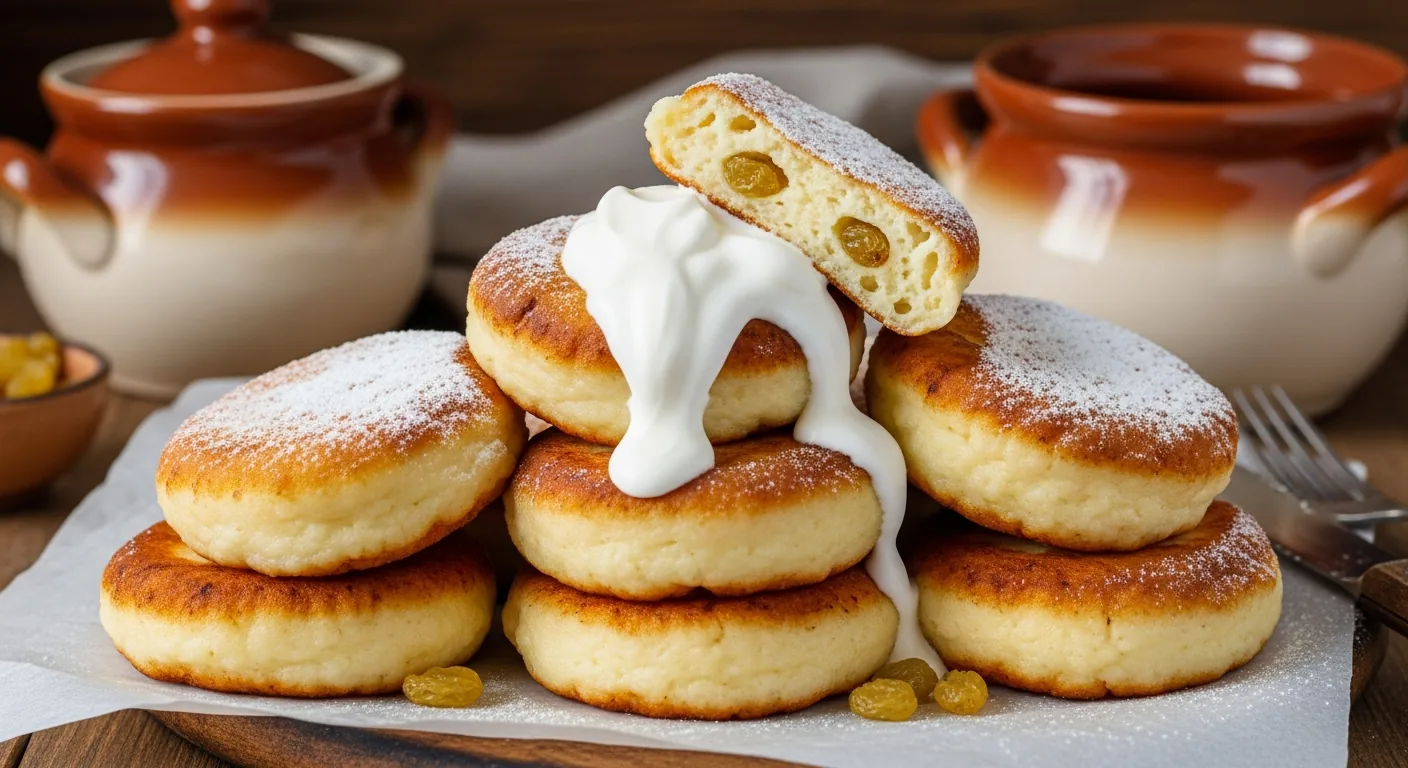
Farmer’s cheese, or well-drained cottage cheese standing in for it, is the filling in our Traditional Blintzes, folded into a thin egg crepe and pan-fried in butter, and its Healthy Blintzes counterpart. It is rolled inside Traditional Ukrainian Nalysnyky and the Healthy Nalysnyky, seasoned with dill for a savory filling or vanilla sugar for a sweet one. Left unwrapped and simply pan-fried, the same cheese becomes Traditional Syrnyky and Healthy Syrnyky, small golden patties that sit somewhere between a pancake and a cheesecake.
Substitutes and the lighter view
Where farmer’s cheese is not sold, well-drained cottage cheese is the standard stand-in, and it is what our healthy adaptations reach for by default. Cleveland Clinic’s nutrition team points people toward low-fat, 2 percent cottage cheese rather than nonfat for this kind of swap: a 100-gram serving of 2 percent provides 84 calories, 2.3 grams of fat and 11 grams of protein, keeping most of the protein of full-fat farmer’s cheese while cutting a real share of saturated fat. Greek yogurt shows up in some of our lighter fillings too, standing in for the sour cream that traditionally tops these dishes at the table.
Further Reading & Sources
This entry draws on the sources below and on the recipes it links to elsewhere on this site. They are listed for readers who want to go further.
- “Kosher Dairy.” Smithsonian Center for Folklife and Cultural Heritage. folklife.si.edu — fresh curd cheese in the Ashkenazi kitchen and the rules around dairy.
- “Why Dairy on Shavuot?” My Jewish Learning. myjewishlearning.com — the holiday that put cheese dishes on the table.
- “These Light Ukrainian Cheese Pancakes Carry a Heavy Load.” TASTE. tastecooking.com — farmer’s cheese as the base of syrnyky, and how dry it needs to be.
- “Traditional Foods.” Internet Encyclopedia of Ukraine. encyclopediaofukraine.com — soured milk products in the Ukrainian diet.
Leave a Reply