

Active time: ~40 minutes (plus 8–12 hours soaking) | Total time: ~13 hours | Serves: 4 | Difficulty: Medium
Quick Overview
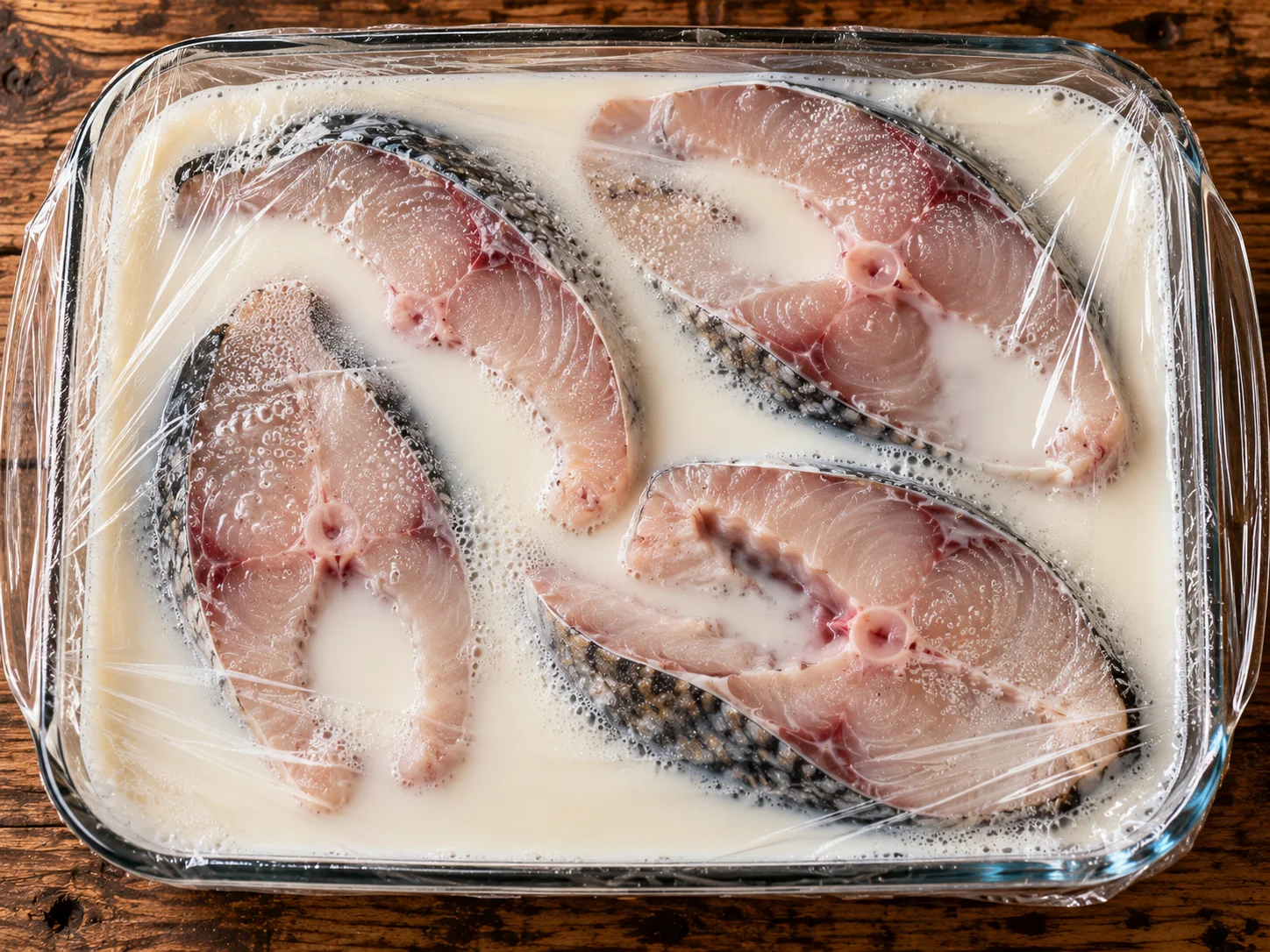
- Soak carp steaks overnight in milk to draw out the fish’s earthy, “muddy” flavor
- Pat the fish dry and season it with salt and lemon juice
- Set up a three-station dredge of flour, beaten egg, and breadcrumbs
- Coat each piece and pan-fry until the crust turns deep golden and crisp
- Serve hot, traditionally alongside potatoes, sauerkraut, or a simple beet salad
What Karp Smażony Is
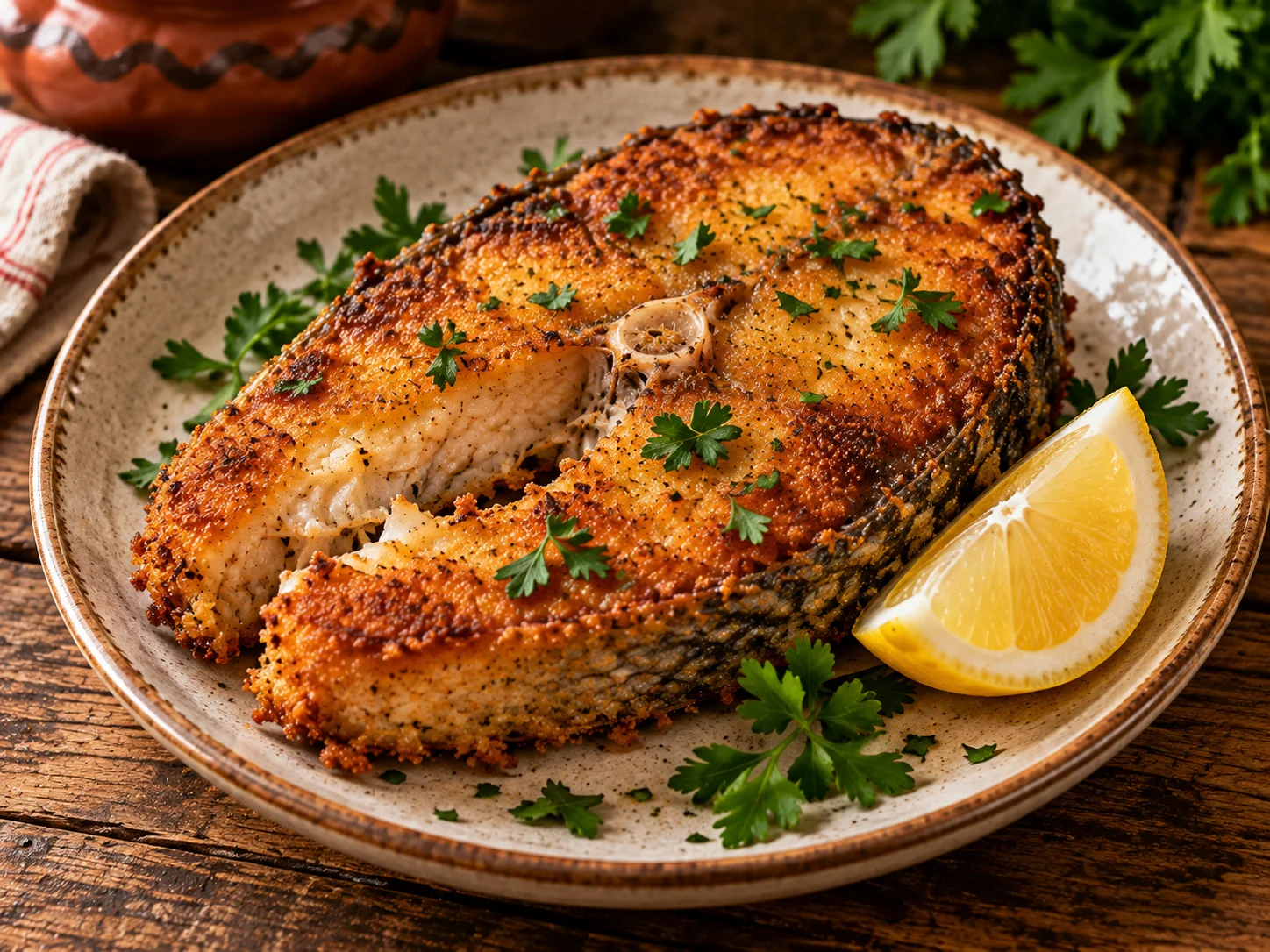
Karp smażony, “fried carp,” is one of the fish dishes of Wigilia, the Polish Christmas Eve supper. Poles traditionally prepare twelve dishes for the meal,2 and carp is so central to it that Culture.pl calls the fish a culinary symbol of the Polish Christmas Eve.1 Cross-cut steaks of carp are soaked to mellow the fish’s naturally earthy flavor, coated in flour, egg, and breadcrumbs, and pan-fried until the crust turns crisp and deeply golden.6,7
It is one of two classic ways Polish households serve Christmas carp. The other is karp po żydowsku, “Jewish-style carp,” simmered with sweet seasonings and often served cold in jelly.1
A Meatless Meal That Made Carp a National Symbol
Wigilia’s fish course comes from a rule: meat is not allowed at the Christmas Eve supper.4 Carp was not always the fish on that meat-free plate. Before the Second World War it was only one freshwater fish among many; Antoni Teslar’s 1910 cookbook suggests “carpe à la polonaise” for Christmas, but carp was not yet the singular tradition it is today.1
That changed after the war. Poland’s Communist government launched a mass carp-breeding program as part of what was officially called the “battle for trade,” a campaign to keep shelves stocked with a cheap, reliably available protein, and at the same time access to the perch, pike, zander, and eel that had once shared the Christmas table narrowed sharply.1 Within a generation, the fish that had once been one option among many became the fish most Poles could not imagine Christmas Eve without, even though, as one Polish cultural outlet dryly notes, a great many of those same Poles will also tell you they cannot stand it.1
The breaded, pan-fried version itself is older than that monopoly. Battered carp recipes appear in Polish cookbooks from the first half of the 19th century, served with freshly grated horseradish, simmered cabbage, mushrooms, and potatoes.1
The Carp in the Bathtub
The fish’s other legacy is far less formal: the live carp kept swimming in the family bathtub for a day or two before Christmas Eve. Buying a live carp a few days ahead of the holiday and holding it at home until it was needed was standard practice across Poland, Czechia, and Slovakia, and the custom is understood to have started as a pre-refrigeration way of keeping the fish fresh until it went in the pan.3
Many families also keep a scale from the Christmas Eve carp in their wallets for good luck.3
Traditional Karp Smażony Recipe
This recipe was compiled by Heritage Healthy Kitchen from a comparison of published recipes; the sources are listed at the end of this article. Figures that are Heritage Healthy Kitchen’s own estimates rather than taken from a published source are marked as such.
Ingredients (serves 4)
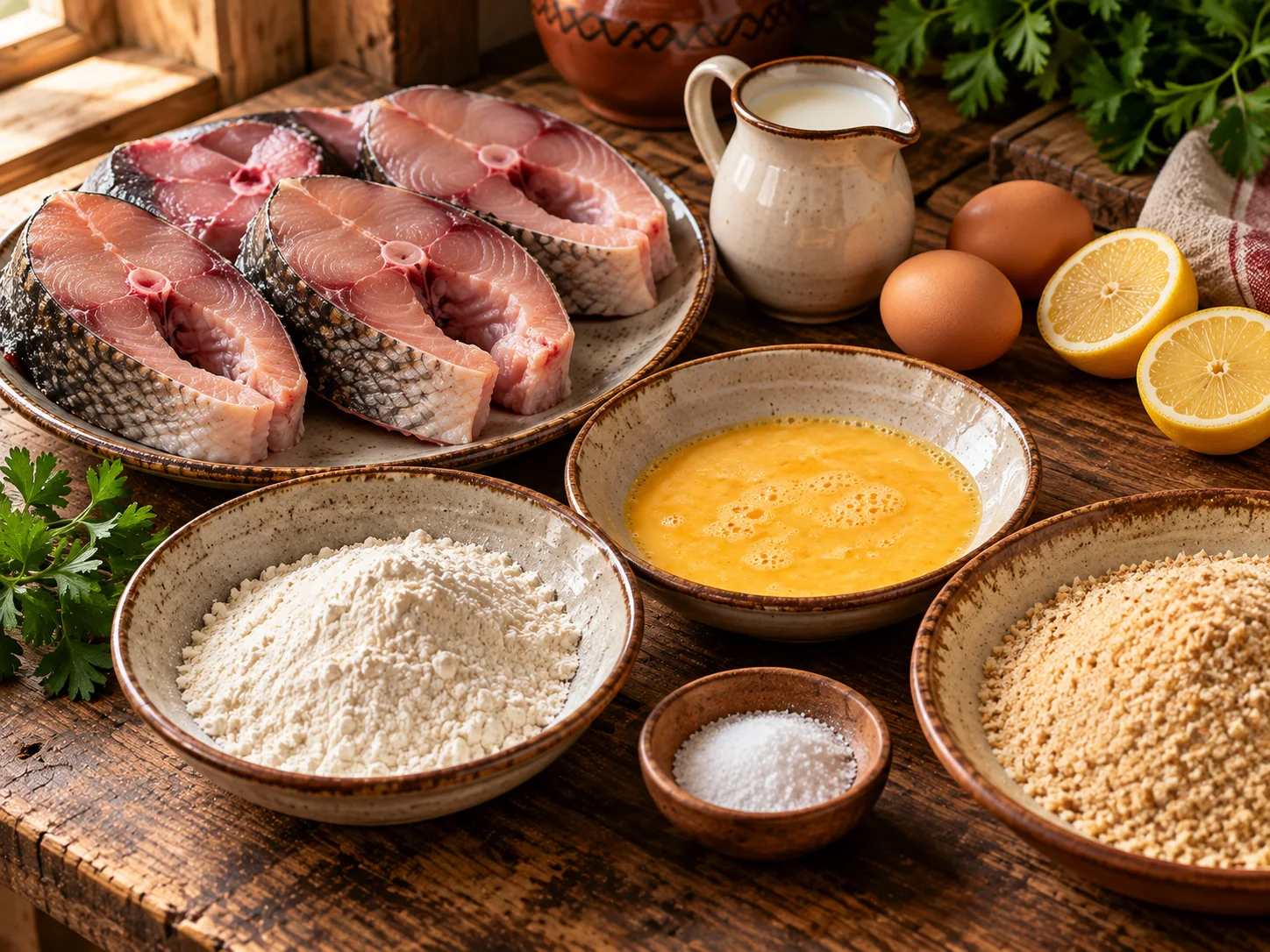
- 800g (about 1.75 lbs) carp, cleaned and cut into steaks roughly 2.5cm (1 inch) thick, skin on
- 500ml (2 cups) whole milk, for soaking
- 1 tablespoon (15ml) fresh lemon juice
- 1 teaspoon (5g) fine salt, plus more to taste
- 60g (about ½ cup) all-purpose flour
- 2 large eggs, beaten
- 90g (about ¾ cup) plain dry breadcrumbs
- Freshly ground black pepper, to taste
- 55ml (about ¼ cup) neutral oil, such as canola or sunflower, for frying
- Lemon wedges and chopped fresh parsley, to serve
Instructions
- Soak the carp: Rinse the carp steaks and pat them dry. Place them in a shallow dish, pour over the milk so the fish is fully submerged, cover, and refrigerate overnight, 8–12 hours. This step is what tames the fish’s naturally earthy, “muddy” flavor.6
- Season the fish: Drain the carp and discard the milk. Pat the steaks thoroughly dry with paper towels, then rub them with the lemon juice and salt. Let them sit for 10–15 minutes.
- Set up the dredging station: Arrange three shallow dishes: one with the flour, seasoned with a little salt and pepper; one with the beaten eggs; and one with the breadcrumbs.
- Coat the steaks: Pat the carp dry once more. Dredge each steak in flour, shaking off the excess, dip it in the beaten egg, then press it into the breadcrumbs to coat evenly on all sides. Rest the coated steaks on a rack for 5 minutes so the crumbs set.
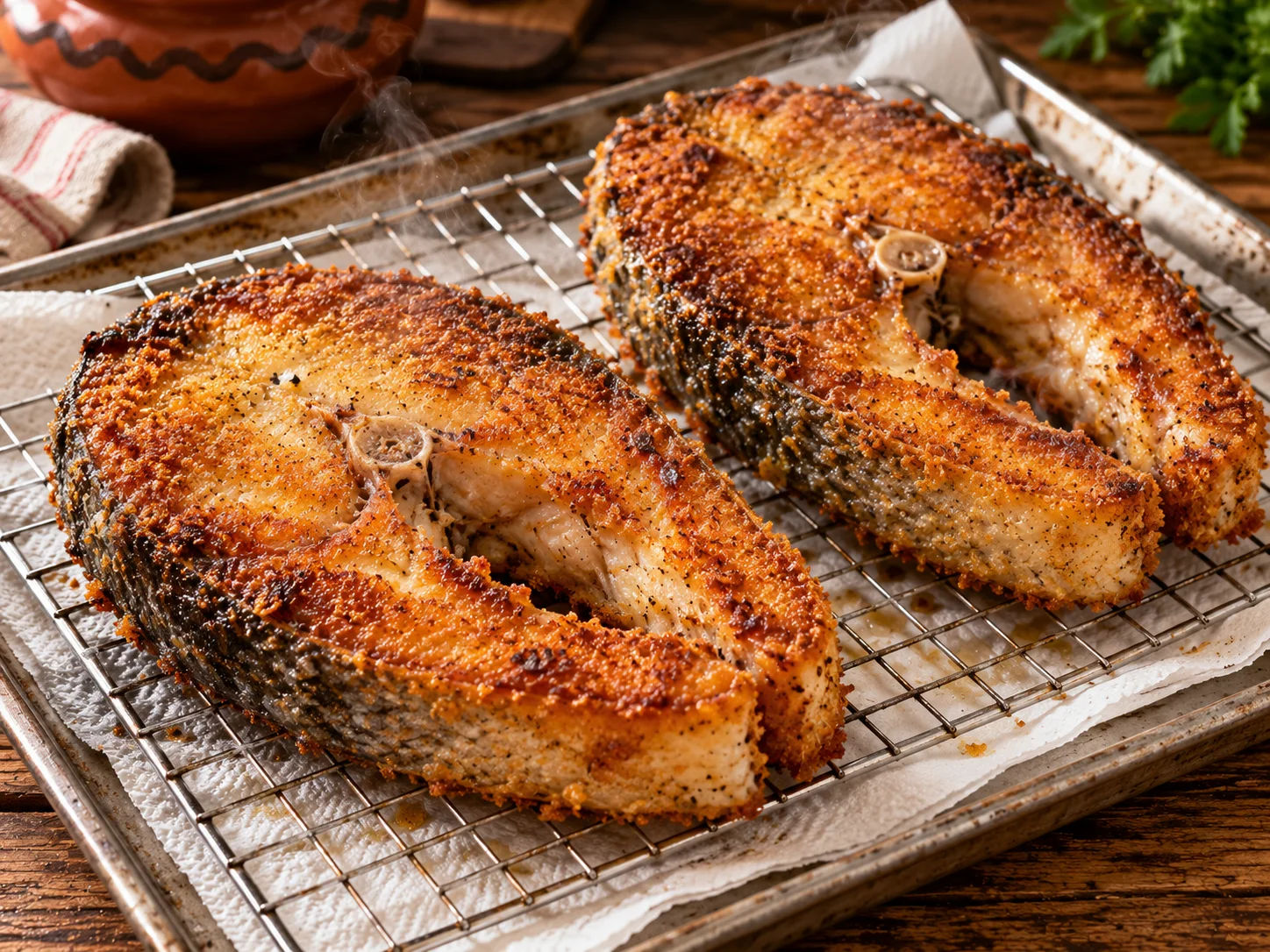
- Fry: Heat the oil in a large skillet over medium heat until it shimmers. Fry the steaks in batches, without crowding the pan, for 4–5 minutes per side, until the crust is deep golden brown and the fish flakes easily with a fork.
- Drain and serve: Transfer the fried carp to a plate lined with paper towels to drain briefly. Serve hot, with lemon wedges and a scattering of parsley.
Kitchen Tips
The earthy, “muddy” taste people associate with carp is tied to where the fish lives rather than to the species itself. Pond and lake carp have long had a reputation for a stronger, muddier flavor than carp raised in cleaner, well-managed water, and the problem is old enough that a Polish cookbook from 1843 already recommended remedies for it, including vinegar, before the fish went anywhere near the pan.1
Some cooks reach for an onion marinade instead of milk, or combine milk with a few crushed garlic cloves, and either works to the same end.7 Whichever method is used, the fish needs to be completely dry before it goes into the flour, or the coating will not hold and will slide off in the hot oil.5
Heat the oil well before the fish goes in. Coating that hits oil that isn’t hot enough soaks up grease instead of crisping, which is the most common reason home versions of this dish turn out heavy.5
Carp is a genuinely bony fish, bony enough that one Polish cultural publication calls eating it “a challenging task.”2 Warn guests unfamiliar with the dish to eat slowly and watch for small bones.
Don’t skip the resting time after seasoning and after coating; a few quiet minutes lets the salt and lemon penetrate the flesh and gives the breadcrumb layer a chance to set, so it clings to the fish instead of shedding in the oil.
Nutritional Information
Per serving (1 of 4)
- Calories: approximately 355–455 kcal
- Protein: ~33–38g
- Total fat: ~16–22g
- Saturated fat: ~2.8–3.5g
- Carbohydrates: ~17–23g
- Fiber: ~1g
- Sodium: ~450–650mg
- Cholesterol: ~160–195mg
Values are estimates, calculated ingredient by ingredient from USDA FoodData Central reference data and cross-checked against the Atwater energy formula, which agreed with the summed figures to within 3 percent.8 The range assumes that only part of the flour, egg, breadcrumbs, oil, and salt ends up on the fish, and that bones and skin make up 10 to 20 percent of the steaks. Most of the sodium comes from the salt and the breadcrumbs, and nearly all of the carbohydrate comes from the coating.
Storage and Reheating
Refrigerate leftover fried carp in an airtight container for up to 2 days. The crisp coating softens somewhat in storage, which is normal.
Reheat gently in a dry skillet or in an oven at around 180°C (350°F) for 8–10 minutes, until warmed through; this keeps the coating drier and crisper than a microwave, which tends to leave it soggy. Avoid leaving fried carp at room temperature for longer than about 2 hours, as with any cooked fish.
Traditional Karp Smażony

Ingredients
Ingredients (serves 4)
- 800g (about 1.75 lbs) carp, cleaned and cut into steaks roughly 2.5cm (1 inch) thick, skin on
- 500ml (2 cups) whole milk, for soaking
- 1 tablespoon (15ml) fresh lemon juice
- 1 teaspoon (5g) fine salt, plus more to taste
- 60g (about ½ cup) all-purpose flour
- 2 large eggs, beaten
- 90g (about ¾ cup) plain dry breadcrumbs
- Freshly ground black pepper, to taste
- 55ml (about ¼ cup) neutral oil, such as canola or sunflower, for frying
- Lemon wedges and chopped fresh parsley, to serve
Instructions
- Soak the carp: Rinse the carp steaks and pat them dry. Place them in a shallow dish, pour over the milk so the fish is fully submerged, cover, and refrigerate overnight, 8–12 hours. This step is what tames the fish’s naturally earthy, “muddy” flavor.
- Season the fish: Drain the carp and discard the milk. Pat the steaks thoroughly dry with paper towels, then rub them with the lemon juice and salt. Let them sit for 10–15 minutes.
- Set up the dredging station: Arrange three shallow dishes: one with the flour, seasoned with a little salt and pepper; one with the beaten eggs; and one with the breadcrumbs.
- Coat the steaks: Pat the carp dry once more. Dredge each steak in flour, shaking off the excess, dip it in the beaten egg, then press it into the breadcrumbs to coat evenly on all sides. Rest the coated steaks on a rack for 5 minutes so the crumbs set.
- Fry: Heat the oil in a large skillet over medium heat until it shimmers. Fry the steaks in batches, without crowding the pan, for 4–5 minutes per side, until the crust is deep golden brown and the fish flakes easily with a fork.
- Drain and serve: Transfer the fried carp to a plate lined with paper towels to drain briefly. Serve hot, with lemon wedges and a scattering of parsley.
Frequently Asked Questions
Why do Poles eat carp specifically, rather than another fish, at Christmas?
Historically it wasn’t specifically carp; freshwater fish of several kinds shared the Wigilia table before the Second World War. Carp’s current dominance dates to the postwar Communist period, when the government pushed mass carp farming as a cheap, reliable protein source and access to other freshwater fish narrowed.1
Why was a live carp traditionally kept in the bathtub?
The custom is understood to have started as a way to keep the fish fresh before home refrigeration was common.3
What’s the difference between karp smażony and karp po żydowsku?
Karp smażony is coated and pan-fried, served hot with a crisp crust. Karp po żydowsku, “Jewish-style carp,” is instead simmered with sweet seasonings and served cold, often set in its own jelly.1 Both are traditional Wigilia dishes.
Why does carp sometimes taste muddy, and how do you fix it?
The flavor comes from where the fish is raised rather than the species itself; carp from murkier ponds picks up a stronger earthy taste than carp from cleaner water.1 An overnight soak in milk, or a marinade of onion or garlic, draws much of that flavor out before cooking.7
Is it true people keep the carp’s scales for luck?
Yes. It’s a tradition in Poland, Slovakia, and Czechia: a scale saved from the Christmas Eve carp and kept in a wallet or purse is meant to bring good luck in the year ahead.3
Can karp smażony be made with a different fish?
Yes, and many households already do, since not everyone enjoys carp’s flavor or wants to deal with its bones. Cod, pike-perch, and haddock are documented modern substitutes prepared with the same milk soak, flour-egg-breadcrumb coating, and pan-frying method.5
What do Poles traditionally serve alongside fried carp?
Common modern accompaniments include mashed potatoes, sauerkraut, and beet salad.5 Nineteenth-century recipes instead paired the fried fish with freshly grated horseradish, simmered cabbage, and mushrooms.1
Further Reading & Sources
The recipe is a compilation based on the published recipes listed here; these links are provided for readers who want to explore further.
- Kasprzyk-Chevriaux, Magdalena. “Polish Food 101 – Carp.” Culture.pl (11 August 2014).
- Oleksiak, Wojciech. “How to Survive a Polish Christmas.” Culture.pl (24 November 2016).
- O’Brien, Sam. “Christmas Eve Carp.” Gastro Obscura, Atlas Obscura.
- Kasprzyk-Chevriaux, Magdalena. “The 12 Dishes of Polish Christmas.” Culture.pl (December 2013, updated December 2022).
- Laura. “Fried Polish Christmas Carp Recipe (Karp Wigilijny).” PolishFeast (16 December 2025).
- Aleksandra. “Christmas Carp (Pan-Fried Carp).” Everyday Delicious (7 January 2024).
- Polonist Test Kitchen. “Christmas Fried Carp.” The Polonist (17 October 2019, updated 5 June 2023).
- U.S. Department of Agriculture. FoodData Central: “Fish, carp, raw” (FDC ID 171952); “Wheat flour, white, all-purpose” (FDC ID 169761); “Egg, whole, raw, fresh” (FDC ID 171287); “Bread crumbs, dry, grated, plain” (FDC ID 174928); “Oil, canola” (FDC ID 172336); “Salt, table” (FDC ID 173468).
Disclaimer
The information in this article is provided for educational and informational purposes only. Heritage Healthy Kitchen makes no representations or warranties regarding the accuracy or completeness of any content on this site. Nutritional values are estimates only and will vary depending on the specific ingredients, brands, and measurements used. This content is not intended as dietary, medical, or professional nutritional advice. Always consult a qualified healthcare provider regarding any dietary needs or health conditions. Heritage Healthy Kitchen is not responsible for any outcomes resulting from the use of recipes or information published on this site.
Cook by Occasion
This recipe is part of our Wigilia menu.
You Might Also Like
More heritage recipes from our kitchen


Leave a Reply