
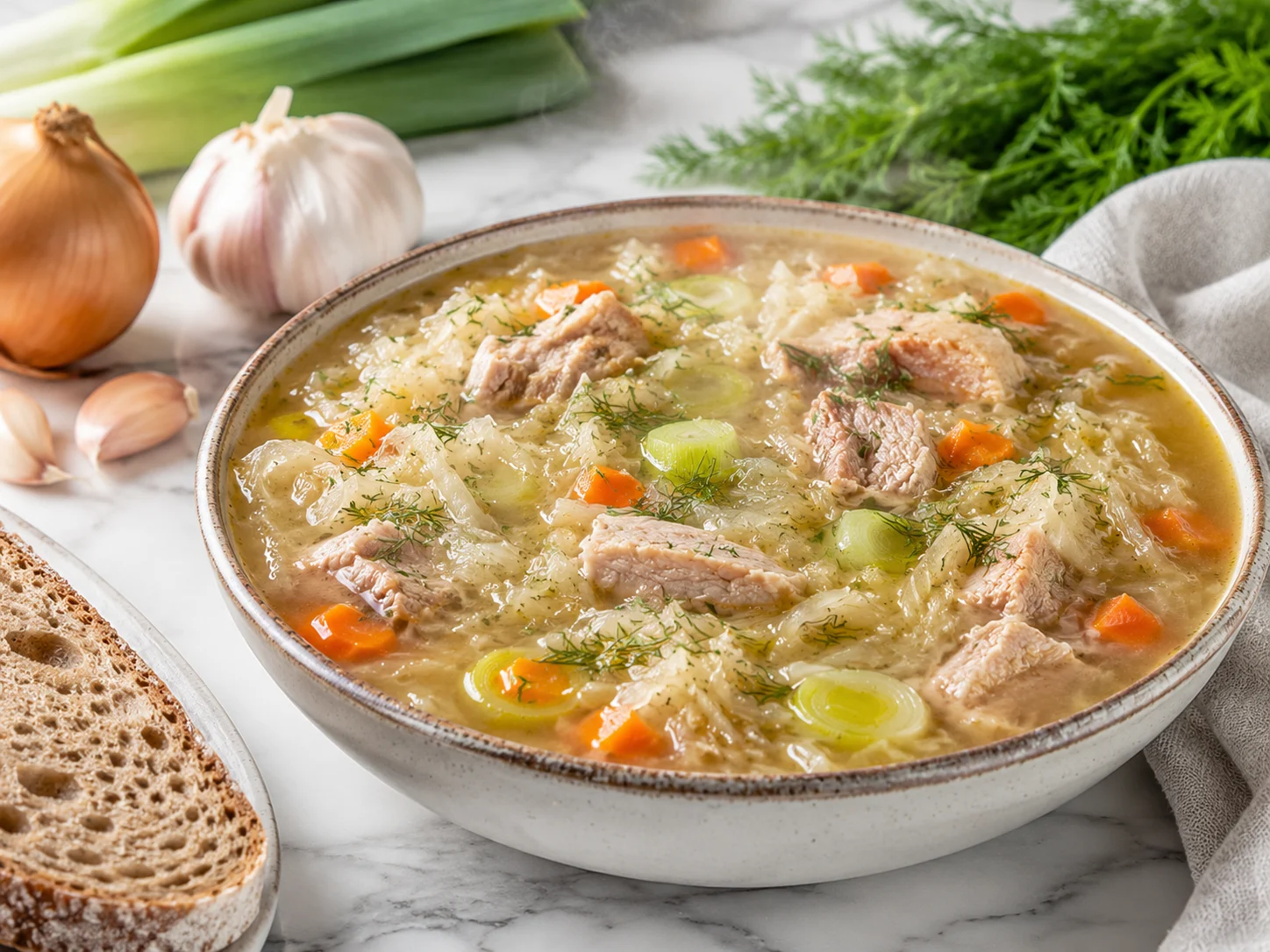
Serves: 6 | Two variants included: Leaner Turkey Kapuśniak and Vegetarian Kapuśniak | Difficulty: Easy
Quick Overview
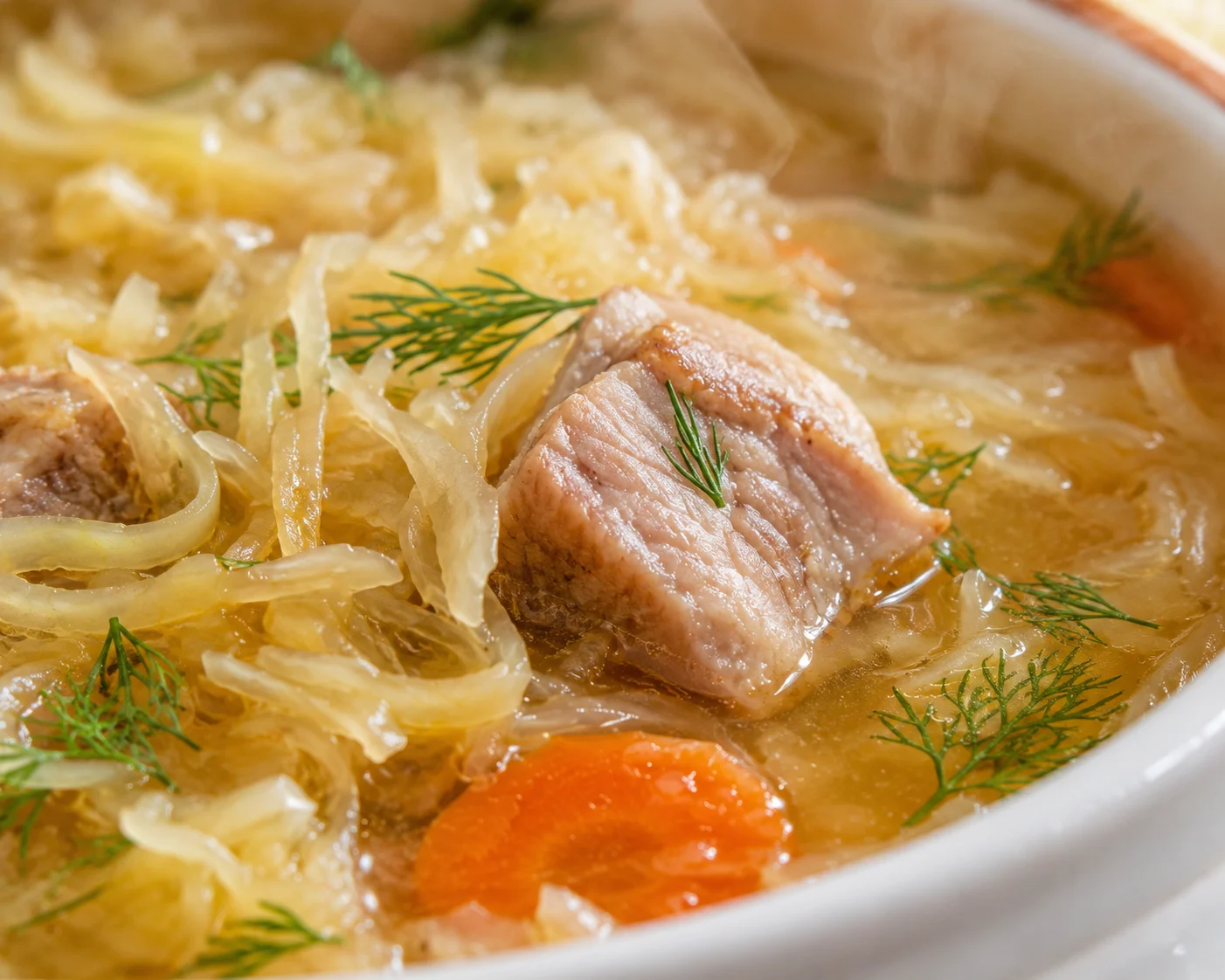
- Choose a path: leaner turkey in place of pork ribs and bacon, or a fully vegetarian version built on mushrooms and white beans
- Build the same aromatic base as the traditional recipe, with only a pinch of added salt
- Simmer with root vegetables and potatoes until tender
- Stir in the sauerkraut at the same full quantity as the traditional recipe. That part never changes
- Taste and adjust sourness with reserved sauerkraut juice, exactly as in the traditional version
- Serve hot, ideally with rye bread
What This Version Changes — and What It Keeps
Both versions keep the sauerkraut at the same quantity as the traditional recipe, along with the caraway, marjoram, bay leaf, and allspice that give kapuśniak its characteristic aroma. The method stays the same too: build an aromatic base, simmer with root vegetables and potatoes, then finish with the sauerkraut and a splash of its juice.
What changes is the protein and the salt. The leaner version replaces pork ribs and bacon with turkey and cuts added salt to a pinch, using smoked paprika for the smokiness bacon used to provide. The vegetarian version removes meat entirely, building its body from mushrooms and white beans — a swap with more history behind it than it might first appear to have, explained below.
Why These Swaps Work
Turkey in place of pork ribs and bacon is the biggest change in the leaner version. Chicken and turkey carry relatively low saturated fat compared with red meats such as beef, lamb, and pork, per Harvard Health Publishing’s chief medical editor, and saturated fat is the type most closely tied to heart attack and stroke risk.¹ Plain turkey works better here than turkey bacon, though: a Cleveland Clinic dietitian’s comparison found a 2-ounce serving of turkey bacon actually carries more sodium than the same amount of pork bacon, over 1,900 milligrams versus roughly 1,300, despite having less saturated fat.² Since sodium reduction is the goal, turkey bacon would work against it. Smoked paprika fills in for the smokiness bacon would otherwise add, without the sodium.
Cutting added salt addresses sodium directly, on top of the protein swap. The American Heart Association sets 2,300 milligrams a day as the upper limit for most adults, with an ideal target closer to 1,500, and notes that cutting sodium by even 1,000 milligrams a day measurably improves blood pressure.³ Sauerkraut and broth already carry plenty of sodium on their own, so both versions add only a pinch of salt at the stove.
Mushrooms and white beans do the work meat did in the vegetarian version, each for a different reason. Mushrooms carry a savory depth called umami that makes them a convincing meat substitute, and they arrive naturally low in sodium and fat.⁴ White beans supply the protein and heartiness a mushroom-only broth would lack. Substituting plant protein like beans for red meat can help lower blood cholesterol, a recognized heart disease risk factor, and the fiber helps a meal feel filling for longer.⁵
Neither version touches the sauerkraut, and that’s deliberate. Fermented foods are where much of the genuine interest in this dish’s health profile comes from: the live cultures in unpasteurized sauerkraut can support a more diverse gut microbiome when eaten regularly.⁶ Cutting it back to save on sodium would remove the ingredient doing the most nutritional work, so both versions keep it at the traditional recipe’s full amount and manage sodium elsewhere.
Healthy Kapuśniak Recipes
Both recipes developed independently by Heritage Healthy Kitchen. Sources for further reading are listed at the end of this article.
Variant One: Leaner Turkey Kapuśniak
Prep time: 20 minutes | Cook time: 1 hour 15 minutes | Serves: 6
Ingredients
- 600g (1.3 lb) boneless, skinless turkey thighs, cut into chunks
- 1 tbsp olive oil
- 1 large onion (200g), finely diced
- ½ leek, sliced
- 2 garlic cloves, crushed
- 3 medium carrots (150g), diced
- 1 parsley root (100g), diced
- ⅓ celery root (100g), diced
- 4 bay leaves
- 6 allspice berries
- 1 tbsp dried marjoram
- ½ tsp caraway seeds
- 1 tsp smoked paprika
- 2 liters (8 cups) low-sodium chicken or turkey broth
- 3 medium potatoes (450g), peeled and cubed
- 300g (10.5 oz) sauerkraut, drained and roughly chopped, juice reserved
- A pinch of salt, black pepper, to taste
- 2 tbsp fresh parsley, chopped, for serving

Instructions
- Brown the turkey. Season the turkey chunks lightly with pepper. Heat the oil in a large pot over medium-high heat and brown the turkey on all sides, about 5 minutes. Remove and set aside.
- Build the aromatics. In the same pot, add the onion and leek and cook until softened, about 5 minutes. Stir in the garlic, marjoram, caraway seeds, and smoked paprika, and cook for 1 minute until fragrant.
- Simmer the broth. Return the turkey to the pot along with the carrots, parsley root, celery root, bay leaves, and allspice. Pour in the broth, bring to a boil, then reduce to a low simmer. Cook for 25 minutes, until the turkey is tender.
- Add the potatoes. Add the cubed potatoes and continue simmering for 15 minutes, until they begin to soften.
- Stir in the sauerkraut. Add the chopped sauerkraut and simmer for a further 20–25 minutes, until it has softened and the broth has taken on its characteristic tang.
- Season and adjust. Taste the soup and add a pinch of salt and pepper as needed. If a sharper sourness is wanted, stir in some of the reserved sauerkraut juice a little at a time.
- Serve. Ladle into bowls, making sure everyone gets a share of turkey, vegetables, and broth. Finish with chopped parsley.
Variant Two: Vegetarian Kapuśniak — Also a Traditional Version
This is not a modern substitution built to hit a macro target. A vegetable-and-dried-mushroom kapuśniak has long been part of Polish cooking, made without meat during Lent and at other fasting periods.⁷ ⁸ The white beans are the one addition that is not strictly traditional. They are here to give the soup enough protein to work as a satisfying main course rather than a side.
Prep time: 20 minutes (plus 20 minutes to soak dried mushrooms) | Cook time: 1 hour 15 minutes | Serves: 6
Ingredients
- 30g (1 oz) dried wild mushrooms, rinsed
- 300ml (1¼ cups) warm water, for soaking
- 300g (10.5 oz) fresh cremini or button mushrooms, sliced
- 1 tbsp olive oil
- 1 large onion (200g), finely diced
- ½ leek, sliced
- 2 garlic cloves, crushed
- 2 medium carrots (120g), diced
- 1 parsley root (100g), diced
- ⅓ celery root (100g), diced
- 4 bay leaves
- 6 allspice berries
- 1 tbsp dried marjoram
- ½ tsp caraway seeds
- 2 liters (8 cups) low-sodium vegetable stock, or homemade unsalted stock
- 3 medium potatoes (450g), peeled and cubed
- 600g (about 3½ cups) cooked white beans (cannellini or navy), no salt added, drained and rinsed
- 300g (10.5 oz) sauerkraut, drained and roughly chopped, juice reserved
- A pinch of salt, black pepper, to taste
- 2 tbsp fresh parsley, chopped, for serving
Instructions
- Soak the dried mushrooms. Cover the dried mushrooms with the warm water and let sit for 20 minutes. Lift them out, chop roughly, and strain the soaking liquid through a fine sieve to remove any grit. Reserve the liquid.
- Build the aromatics. Heat the oil in a large pot over medium heat. Add the onion and leek and cook until softened, about 5 minutes. Stir in the garlic, marjoram, and caraway seeds, and cook for 1 minute until fragrant.
- Cook the mushrooms. Add the fresh and soaked dried mushrooms to the pot and cook for 8–10 minutes, until they release their liquid and it mostly evaporates.
- Simmer the broth. Add the carrots, parsley root, celery root, bay leaves, and allspice. Pour in the vegetable stock and the reserved mushroom soaking liquid. Bring to a boil, then reduce to a low simmer and cook for 20 minutes.
- Add the potatoes. Add the cubed potatoes and continue simmering for 15 minutes, until they begin to soften.
- Stir in the sauerkraut. Add the chopped sauerkraut and simmer for a further 20 minutes, until it has softened and the broth has taken on its characteristic tang.
- Add the beans. Stir in the white beans and simmer for a final 5 minutes, just to warm them through. Longer cooking will start to break them down.
- Season and adjust. Taste the soup and add a pinch of salt and pepper as needed. If a sharper sourness is wanted, stir in some of the reserved sauerkraut juice a little at a time.
- Serve. Ladle into bowls and finish with chopped parsley.
Kitchen Tips
For the turkey version, thigh meat holds up better than breast during the longer simmer. Turkey breast is leaner still, but it can turn stringy after 25 minutes of cooking; thigh meat stays tender.
For the vegetarian version, don’t skip straining the mushroom soaking liquid. Dried mushrooms often carry grit that settles into the water, and that liquid is worth keeping for its concentrated flavor.
In both versions, add the beans or the last portion of sauerkraut juice close to serving time rather than at the start. Beans turn mealy with extended simmering, and sauerkraut’s sourness is easier to judge once the rest of the soup is fully seasoned.
A low-sodium or homemade unsalted stock matters more than it might seem. Standard store-bought broth can carry several hundred milligrams of sodium per cup on its own, which would undo much of the sodium reduction these recipes are built around.
Nutritional Comparison
The table below sets both lighter versions against the traditional pork rib and bacon recipe covered in the companion Traditional Kapuśniak article on this project, which serves as the reference point. This article itself offers two versions: turkey and vegetarian.
Per serving (1 of 6 servings)
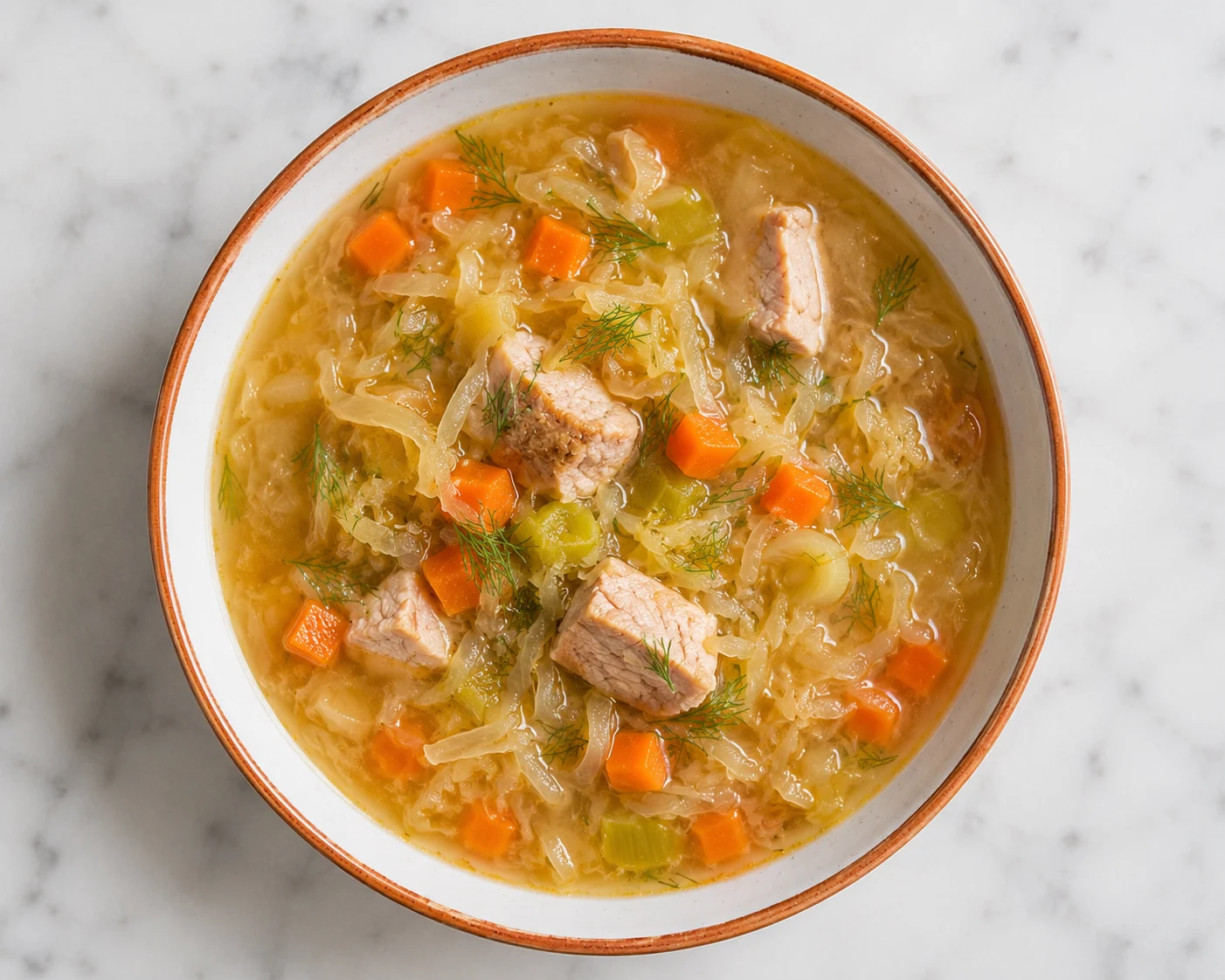
| Nutrient | Traditional Kapuśniak (reference) | Turkey Version | Vegetarian Version |
|---|---|---|---|
| Calories | ~380–465 kcal | ~240–290 kcal | ~270–335 kcal |
| Protein | ~22–27g | ~18–22g | ~13–16g |
| Total fat | ~22–27g | ~8–10g | ~3–4g |
| Carbohydrates | ~24–29g | ~24–30g | ~50–61g |
| Dietary fiber | ~5–6g | ~5–6g | ~12–14g |
| Sodium | ~635–775mg | ~420–515mg | ~395–485mg |
Nutritional values are estimates calculated from the specific ingredient quantities in each recipe, using standard reference values. They will vary depending on the exact cut of turkey, the brand of beans and stock, and how much added salt is used.
The two lighter versions cut sodium and fat for different reasons. Turkey trims calories, fat, and sodium while keeping protein close to the traditional level. The vegetarian version cuts fat the most and adds by far the most fiber, but its carbohydrate count rises well above the traditional recipe’s, mainly from the beans and potatoes that also supply most of that fiber.
Storage and Reheating
Both versions keep in the refrigerator for up to 4 days in an airtight container, the same as the traditional recipe. Reheat gently on the stovetop over medium-low heat until hot throughout.
The turkey version freezes well for up to 3 months, ideally without the potatoes, which turn grainy after thawing. The vegetarian version freezes less predictably because of the beans, which can go slightly mealy after freezing and reheating; it is better suited to refrigerator storage and eating within the 4-day window.
Healthy Kapuśniak

Ingredients
Ingredients
- 600g (1.3 lb) boneless, skinless turkey thighs, cut into chunks
- 1 tbsp olive oil
- 1 large onion (200g), finely diced
- ½ leek, sliced
- 2 garlic cloves, crushed
- 3 medium carrots (150g), diced
- 1 parsley root (100g), diced
- ⅓ celery root (100g), diced
- 4 bay leaves
- 6 allspice berries
- 1 tbsp dried marjoram
- ½ tsp caraway seeds
- 1 tsp smoked paprika
- 2 liters (8 cups) low-sodium chicken or turkey broth
- 3 medium potatoes (450g), peeled and cubed
- 300g (10.5 oz) sauerkraut, drained and roughly chopped, juice reserved
- A pinch of salt, black pepper, to taste
- 2 tbsp fresh parsley, chopped, for serving
Instructions
- Choose a path: leaner turkey in place of pork ribs and bacon, or a fully vegetarian version built on mushrooms and white beans
- Build the same aromatic base as the traditional recipe, with only a pinch of added salt
- Simmer with root vegetables and potatoes until tender
- Stir in the sauerkraut at the same full quantity as the traditional recipe. That part never changes
- Taste and adjust sourness with reserved sauerkraut juice, exactly as in the traditional version
- Serve hot, ideally with rye bread
Frequently Asked Questions
Which version is actually healthier, the turkey or the vegetarian one?
It depends on what matters most. Turkey has more protein and less carbohydrate per serving. Vegetarian has less fat and considerably more fiber, but less protein and more carbohydrate. Neither is a strictly better choice; they suit different priorities.
Is the vegetarian version really traditional, or is that just marketing?
It’s genuine, with one caveat: the mushroom-and-vegetable-stock base is traditional,⁷ ⁸ but the white beans are this recipe’s own addition, included because a purely traditional Lenten kapuśniak is fairly light on protein for a modern main course. Someone wanting the historically exact version can simply leave the beans out and add extra potatoes or dried mushrooms instead.
Can I use canned beans instead of cooking dried ones?
Yes. Choose no-salt-added canned beans, then drain and rinse them in a colander before adding them to the pot. Rinsing removes a meaningful share of the sodium in canned beans.⁵ Dried beans cooked from scratch without salt give the most control over sodium if that’s a priority.
Can the turkey version use ground turkey instead of thigh chunks?
It can, though the texture changes noticeably — ground turkey breaks into small crumbles rather than holding together in pieces the way the traditional pork ribs do. If using ground turkey, brown it in the same step and skip the later step of returning whole pieces to the pot; just stir it in with the aromatics instead.
Why is the vegetarian version higher in carbohydrates than the traditional recipe?
White beans are a carbohydrate-rich food alongside being a protein source, and 600 grams of them across the pot adds meaningfully to the total. That carbohydrate comes bundled with a large amount of fiber, though, which is part of why beans behave differently in the body than a similar amount of carbohydrate from refined starch.
Can I combine the two versions, using both turkey and beans?
Yes, and some households do exactly that for a heartier soup. Use about half the turkey quantity and half the bean quantity from each recipe, and cook according to the turkey version’s timeline, adding the beans in the last 5 minutes as in the vegetarian recipe.
The Traditional Version
For the full pork rib and bacon version, along with the dish’s history and regional variations, the Traditional Kapuśniak article on this project covers that in detail.
Read the Traditional Kapuśniak recipe
Further Reading & Sources
The following sources were consulted for the nutritional information and health context in this article. Heritage Healthy Kitchen’s recipes were developed independently; these links are provided for readers who want to explore further.
- “Is Poultry a Good Source of Protein?” Harvard Health Publishing. health.harvard.edu/diet-and-nutrition/is-poultry-a-good-source-of-protein — comparison of saturated fat in poultry versus red meat, including pork.
- “Turkey Bacon: How Healthy Is It Really?” Cleveland Clinic Health Essentials, commentary from dietitian Laura Jeffers, MEd, RD, LD. health.clevelandclinic.org/turkey-bacon-how-healthy-is-it-really — sodium and saturated fat comparison between turkey bacon and pork bacon.
- “How Much Sodium Should I Eat Per Day?” American Heart Association. heart.org — recommended daily sodium limits and the effect of reducing intake on blood pressure.
- “Mushrooms Make Healthy Meal Magic.” Mayo Clinic Health System. mayoclinichealthsystem.org — mushrooms as a low-sodium, low-fat meat substitute and their umami flavor profile.
- “The Benefits of Beans and Legumes.” American Heart Association. heart.org — cholesterol and fiber benefits of substituting plant protein for red meat, and guidance on rinsing canned beans.
- “Fermented Foods Can Add Depth to Your Diet.” Harvard Health Publishing. health.harvard.edu/staying-healthy/fermented-foods-can-add-depth-to-your-diet — research on fermented foods, probiotics, and gut health.
- “Kapuśniak: Polish Sauerkraut Soup Recipe.” The Polonist. polonist.com/kapusniak-polish-sauerkraut-soup — traditional vegetarian variant built on vegetable and dried wild mushroom stock.
- “Traditional Polish Kapusniak Soup Recipe.” Anna in the Kitchen. annainthekitchen.com/traditional-kapusniak-recipe — Lenten fasting tradition behind the meatless version of the dish.
Disclaimer
The information in this article is provided for educational and informational purposes only. Heritage Healthy Kitchen makes no representations or warranties regarding the accuracy or completeness of any content on this site. Nutritional values are estimates only and will vary depending on the specific ingredients, brands, and measurements used. This content is not intended as dietary, medical, or professional nutritional advice. Always consult a qualified healthcare provider regarding any dietary needs or health conditions. Heritage Healthy Kitchen is not responsible for any outcomes resulting from the use of recipes or information published on this site.
You Might Also Like
More heritage recipes from our kitchen

Leave a Reply