
Quick Overview
- Brown the pork ribs, then build a broth base with onion, root vegetables, and spices
- Simmer the ribs and vegetables until tender, about 30 minutes
- Add potatoes and cook until they begin to soften
- Stir in the sauerkraut and simmer until the flavors come together
- Taste and adjust the sourness with reserved sauerkraut juice
- Finish with fresh parsley and serve hot with rye bread
What Kapuśniak Is
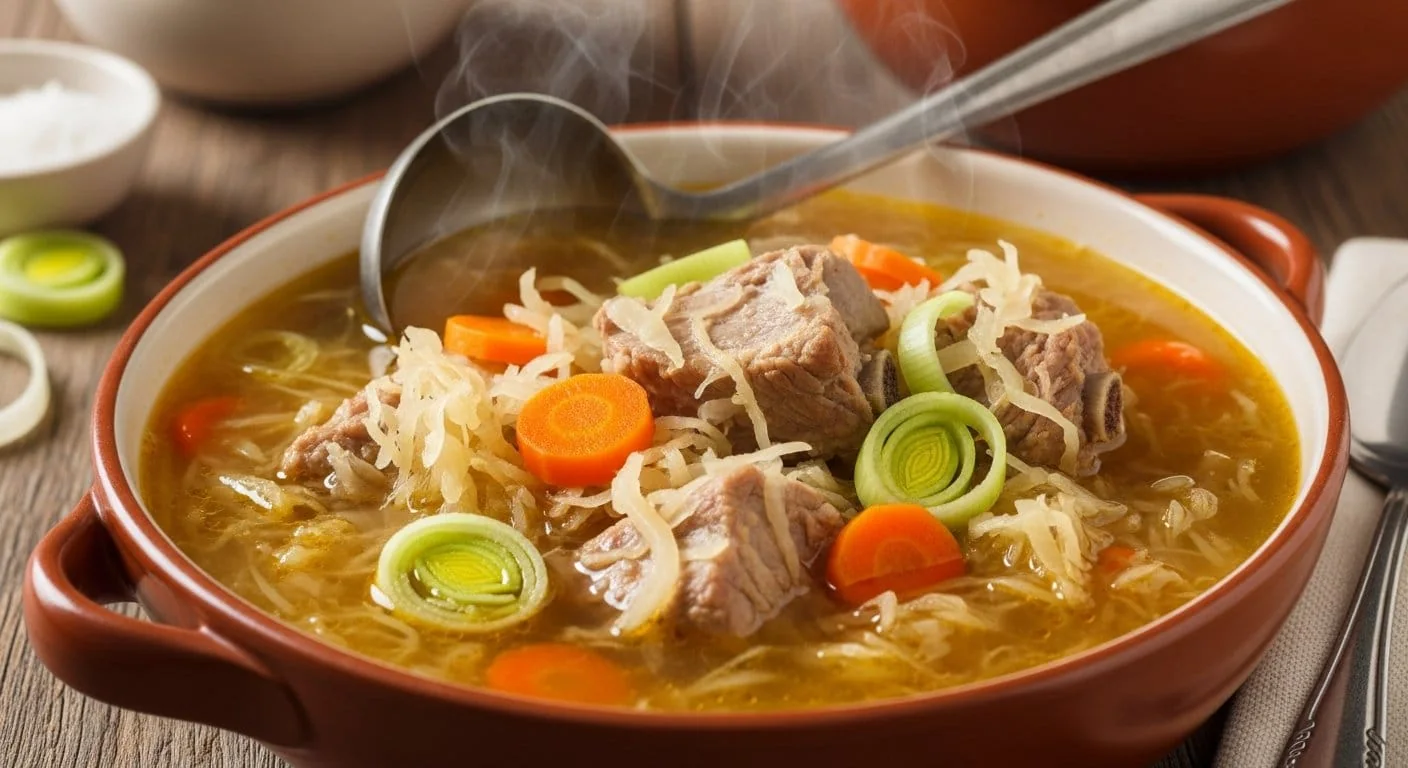
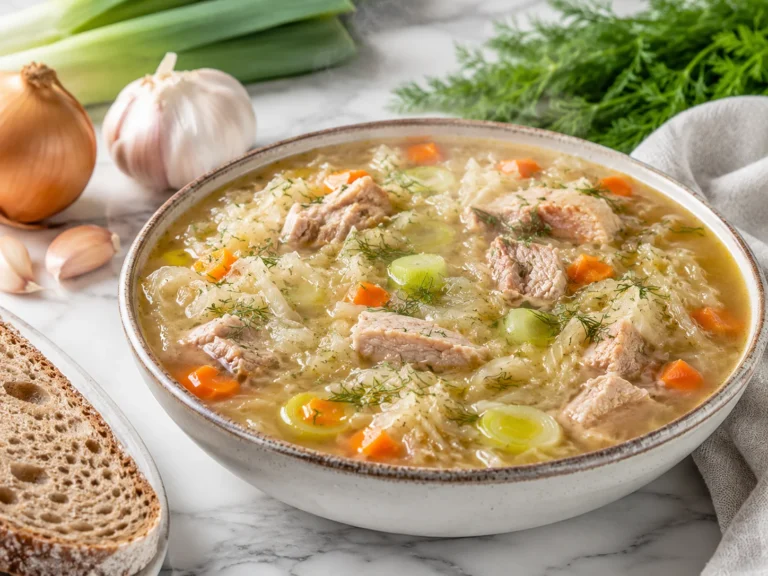
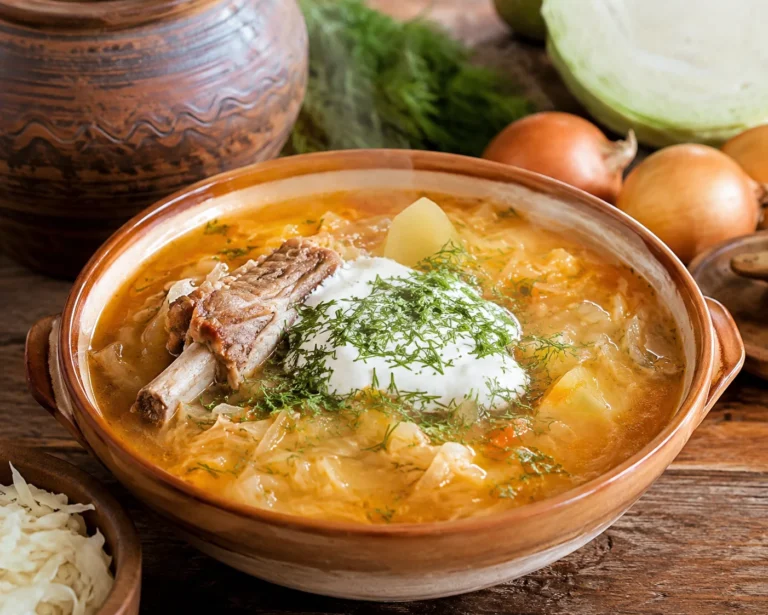
Kapuśniak is a Polish soup built on sauerkraut, pork, and potatoes, seasoned with marjoram and caraway. The name comes directly from kapusta, the Polish word for cabbage.³ It is thick rather than brothy, tangy rather than rich, and meant to be eaten with a hunk of rye bread close at hand.
The soup can be made from sauerkraut, fresh chopped cabbage, or a mix of both.³ A meaty version simmers pork ribs or smoked bacon into the broth, while a vegetarian version, built on vegetable and dried wild mushroom stock, is just as flavorful.³ Either way, the sourness of the fermented cabbage is the point, not something to tone down.
History and Cultural Roots
Sauerkraut itself is older in Europe than popular legend suggests. A persistent story credits the Mongol armies of the Golden Horde with bringing fermented cabbage west from Asia, but food historians Glenn Randall Mack and Asele Surina found no real evidence for that route. Sauerkraut production in Europe can be traced back to the early Western Roman Empire, and the Slavic peoples most likely arrived at fermented cabbage on their own, independent of any Asian source.¹
That independent discovery matters for how kapuśniak fits into Polish food history. Long before refrigeration, salting and fermenting cabbage was simply how a household kept a vegetable edible through a Central European winter.¹ Turning that preserved cabbage into a hot soup with whatever meat or bones were on hand was a natural next step, not a culinary invention that can be pinned to one place or century.
Cabbage was a mainstay of the rural Polish table well into the twentieth century, and it shows up constantly in the diaries and folklore collections that document what ordinary families actually ate. Ethnographer Oskar Kolberg recorded a Greater Poland household’s routine of cabbage and peas, or groats and potatoes, for the midday meal, with meat broth reserved for Sundays among those who could afford it.² Peasant memoirist Jan Słomka described a nearly identical pattern from Galicia: cabbage with groats as the first course of dinner, followed by barley or millet, day after day.² Meat was scarcer still in many households, since diarists from the period describe it as something usually sold rather than cooked, kept back for illness or a visiting guest.² Kapuśniak grew directly out of that world, where cabbage in some form appeared at the table far more often than meat did.
Because meatless versions of the soup were always part of the tradition, kapuśniak also had a place on Catholic fasting days. It was eaten without meat during Lent, and returned to its full pork rib and bacon form once the fast ended.⁷ That flexibility is a big part of why the dish never disappeared from Polish kitchens the way more elaborate, meat-dependent dishes sometimes did during lean periods.
Kapuśniak and Its Relatives
Kapuśniak is not the only Polish soup built on sauerkraut, and it is easy to confuse it with its closest relative. Kwaśnica, from the Tatra Mountain region of Podhale, uses sauerkraut and its brine as the entire liquid base, traditionally simmered with mutton rather than pork, and it skips the carrots and other root vegetables that give kapuśniak its rounder flavor.⁴ Kapuśniak is cooked all across Poland; kwaśnica belongs specifically to the highlands.⁴
Sauerkraut turns up in a whole family of Central and Eastern European soups that follow the same basic idea, including Slovak kapustnica and Czech zelňačka, each shaped by its own regional pantry.¹ Kapuśniak is Poland’s particular answer to a question that fermented cabbage seems to have prompted across the whole region: what do you do with it once winter sets in.
Traditional Kapuśniak Recipe
Recipe developed independently by Heritage Healthy Kitchen. Sources for further reading are listed at the end of this article.
Ingredients
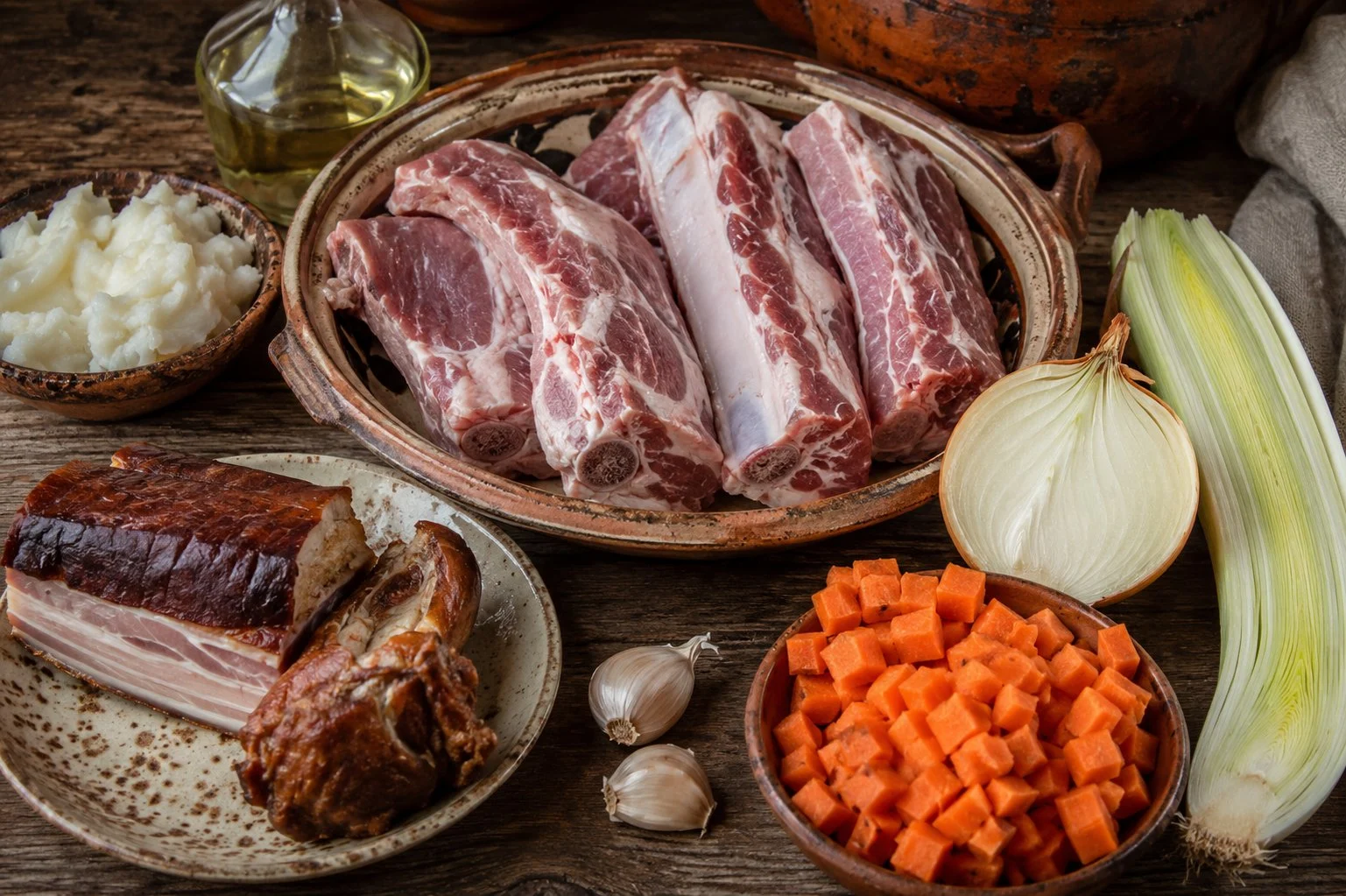
- 700g (1.5 lb) bone-in pork ribs, cut into 2–3 pieces
- 80g (3 oz) smoked bacon or smoked pork bones, optional, for depth
- 2 tbsp neutral oil or lard
- 1 large onion (200g), finely diced
- ½ leek, sliced
- 2 garlic cloves, crushed
- 2 medium carrots (120g), diced
- 1 parsley root, or an extra carrot (100g), diced
- ⅓ celery root (100g), diced
- 4 bay leaves
- 6 allspice berries
- 1 tbsp dried marjoram
- ½ tsp caraway seeds
- 2 liters (8 cups) water
- 3 medium potatoes (450g), peeled and cubed
- 300g (10.5 oz) sauerkraut, drained and roughly chopped, juice reserved
- Salt and black pepper, to taste
- 2 tbsp fresh parsley, chopped, for serving
Instructions
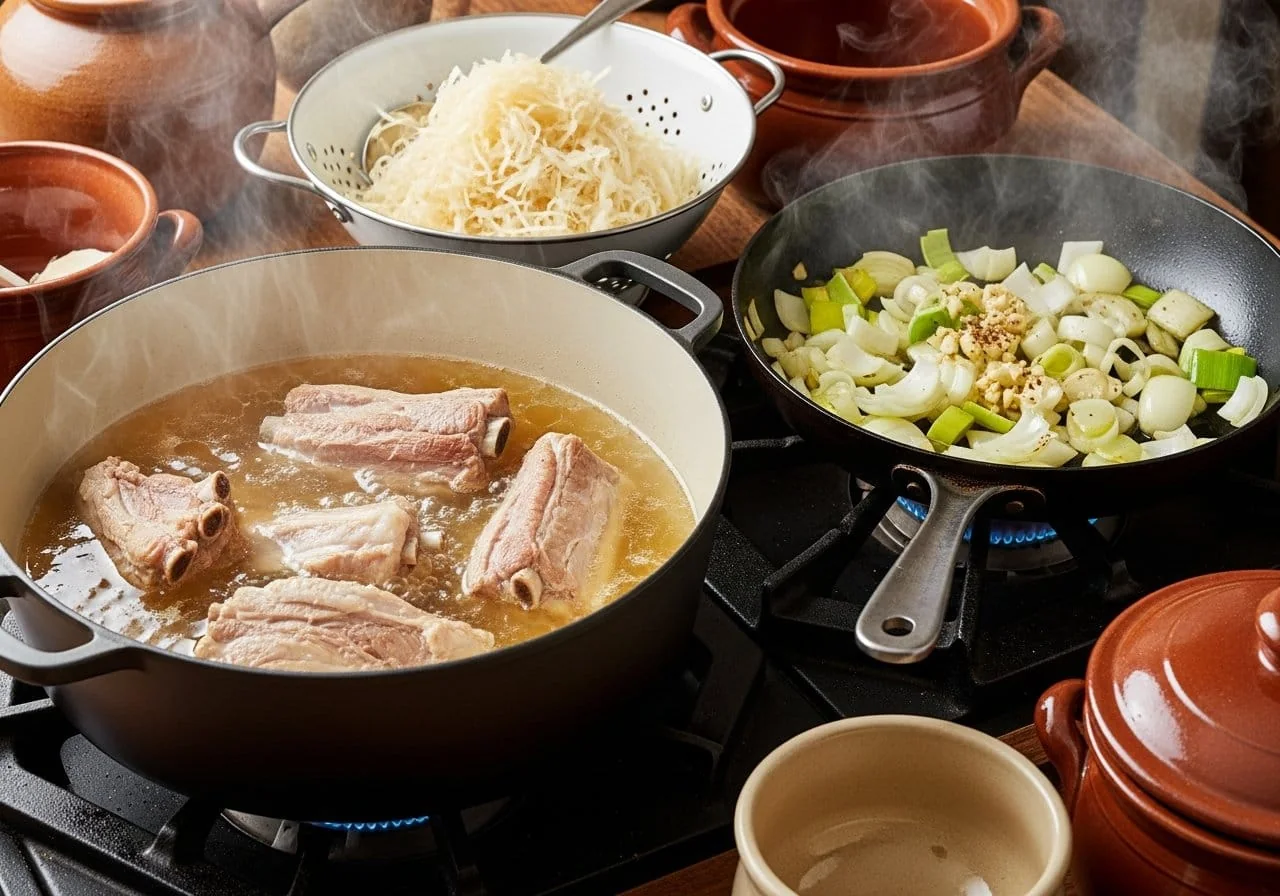
- Brown the ribs. Season the pork ribs with salt and pepper. Heat the oil in a large pot over medium-high heat and brown the ribs on all sides, about 5 minutes. Remove and set aside.
- Build the aromatics. In the same pot, add the onion and leek and cook until softened, about 5 minutes. Stir in the garlic, marjoram, and caraway seeds, and cook for 1 minute until fragrant.
- Simmer the broth. Return the ribs to the pot along with the smoked bacon, carrots, parsley root, celery root, bay leaves, and allspice. Pour in the water, bring to a boil, then reduce to a low simmer. Cook for 30 minutes, until the ribs are tender.
- Add the potatoes. Add the cubed potatoes and continue simmering for 15 minutes, until they begin to soften.
- Stir in the sauerkraut. Add the chopped sauerkraut and simmer for a further 25–30 minutes, until it has softened and the broth has taken on its characteristic tang.
- Season and adjust. Taste the soup and season with salt and pepper. If a sharper sourness is wanted, stir in some of the reserved sauerkraut juice a little at a time.
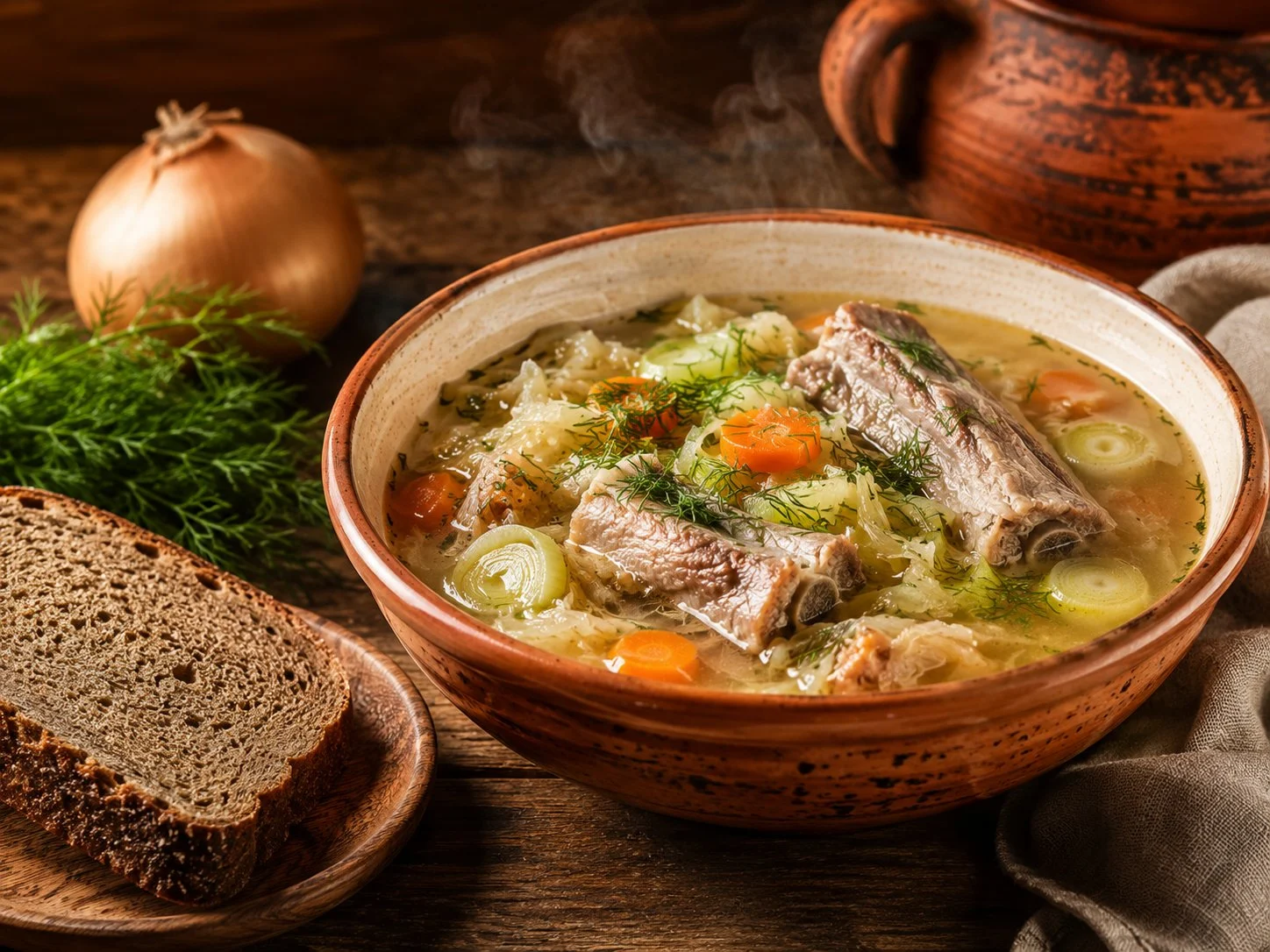
- Serve. Ladle into bowls, making sure everyone gets a share of meat, vegetables, and broth. Finish with chopped parsley and serve with rye bread.
Kitchen Tips and Pro Tips
Choose sauerkraut that was fermented with salt alone, not soured with vinegar. Naturally fermented sauerkraut has a rounder, more complex sourness, and it is what gives kapuśniak its characteristic depth rather than a flat, one-note tang.³
Add the sauerkraut juice gradually and taste as it goes in. Sauerkraut varies a great deal in sourness from batch to batch, so the amount of juice a recipe needs is never fixed. Adding it in stages avoids a soup that turns out sharper than intended.
Caraway seeds earn their place beyond flavor. The compounds in caraway have long been used to ease digestion, and small studies suggest caraway oil can help relax the digestive tract and ease bloating, which pairs naturally with a soup built on fermented cabbage.⁶ A light hand is enough; half a teaspoon carries the whole pot.
Let the marjoram and caraway seeds cook briefly in the fat with the garlic before any liquid goes into the pot. A minute in hot oil is enough to bring out their essential oils, and skipping that step leaves the finished soup tasting noticeably flatter.
Kapuśniak is one of those soups that improves overnight. The sourness mellows and the broth thickens slightly as the potatoes and sauerkraut continue to release starch and flavor, so a pot made a day ahead is often better than one served immediately.
Nutritional Information
Per serving (about 1½ cups, 1 of 6 servings)
- Calories: approximately 380–465 kcal
- Protein: approximately 22–27g
- Total fat: approximately 22–27g
- Carbohydrates: approximately 24–29g
- Dietary fiber: approximately 5–6g
- Sodium: approximately 635–775mg (varies significantly with bacon and added salt)
Nutritional values are estimates calculated from the specific ingredient quantities in this recipe, using standard reference values. They will vary depending on the exact cut of pork, the sauerkraut brand, and how much added salt is used.
Sauerkraut itself is notably low in calories and rich in fiber, vitamin C, and vitamin K, though it is also high in sodium, which is the main reason this soup needs little added salt.¹ Fermented foods in general have drawn growing research interest for their role in gut health, since the live cultures they contain can support a more diverse gut microbiome when eaten regularly.⁵
Storage and Reheating
Kapuśniak keeps well in the refrigerator for up to 4 days in an airtight container. The flavor typically improves on the second day, once the sauerkraut and potatoes have had time to soften further into the broth.
The soup freezes reasonably well, though the potatoes can turn slightly grainy after thawing. For the best texture, consider freezing the soup without potatoes and adding freshly cooked ones when reheating. Frozen kapuśniak keeps for up to 3 months.
Reheat gently on the stovetop over medium-low heat, stirring occasionally, until hot throughout. A hard boil is not necessary and can make the potatoes fall apart.
Kapuśniak

Ingredients
Ingredients
- 700g (1.5 lb) bone-in pork ribs, cut into 2–3 pieces
- 80g (3 oz) smoked bacon or smoked pork bones, optional, for depth
- 2 tbsp neutral oil or lard
- 1 large onion (200g), finely diced
- ½ leek, sliced
- 2 garlic cloves, crushed
- 2 medium carrots (120g), diced
- 1 parsley root, or an extra carrot (100g), diced
- ⅓ celery root (100g), diced
- 4 bay leaves
- 6 allspice berries
- 1 tbsp dried marjoram
- ½ tsp caraway seeds
- 2 liters (8 cups) water
- 3 medium potatoes (450g), peeled and cubed
- 300g (10.5 oz) sauerkraut, drained and roughly chopped, juice reserved
- Salt and black pepper, to taste
- 2 tbsp fresh parsley, chopped, for serving
Instructions
- Brown the ribs. Season the pork ribs with salt and pepper. Heat the oil in a large pot over medium-high heat and brown the ribs on all sides, about 5 minutes. Remove and set aside.
- Build the aromatics. In the same pot, add the onion and leek and cook until softened, about 5 minutes. Stir in the garlic, marjoram, and caraway seeds, and cook for 1 minute until fragrant.
- Simmer the broth. Return the ribs to the pot along with the smoked bacon, carrots, parsley root, celery root, bay leaves, and allspice. Pour in the water, bring to a boil, then reduce to a low simmer. Cook for 30 minutes, until the ribs are tender.
- Add the potatoes. Add the cubed potatoes and continue simmering for 15 minutes, until they begin to soften.
- Stir in the sauerkraut. Add the chopped sauerkraut and simmer for a further 25–30 minutes, until it has softened and the broth has taken on its characteristic tang.
- Season and adjust. Taste the soup and season with salt and pepper. If a sharper sourness is wanted, stir in some of the reserved sauerkraut juice a little at a time.
- Serve. Ladle into bowls, making sure everyone gets a share of meat, vegetables, and broth. Finish with chopped parsley and serve with rye bread.
Frequently Asked Questions
What is the difference between kapuśniak and kwaśnica?
Kwaśnica comes specifically from the Tatra Mountain region of Podhale, uses sauerkraut brine as its main liquid, and is traditionally made with mutton instead of pork, without the carrots and other root vegetables found in kapuśniak. Kapuśniak, by contrast, is cooked all over Poland and tends to have a rounder, more vegetable-forward flavor.⁴
Can I make a vegetarian version of kapuśniak?
Yes, and it is entirely traditional, not a modern substitution. Use a good vegetable stock, add a generous handful of dried wild mushrooms in place of the pork, and skip straight to the sauerkraut step.³ The sauerkraut still carries most of the flavor either way.
Is kapuśniak the same thing as bigos?
No. Bigos is a long-simmered stew built on cabbage and several kinds of meat, thick enough to eat with a fork. Kapuśniak is a soup, lighter in consistency and meant to be ladled into a bowl and eaten with a spoon, even though both dishes share sauerkraut as a core ingredient.
Why does kapuśniak taste better the next day?
The sauerkraut and potatoes continue releasing starch and flavor into the broth as the soup sits, which softens the sourness and thickens the texture slightly. Most Polish households consider a rested pot of kapuśniak the better version.
Can fresh cabbage be used instead of sauerkraut?
Yes, and older versions of the soup did exactly that, sometimes combining fresh cabbage with sauerkraut in the same pot. A soup made with only fresh cabbage will taste noticeably milder and will need a splash of something acidic, such as the sauerkraut brine on its own, to approximate the traditional sourness.
How sour should kapuśniak be?
There is no single correct answer. Sourness comes down to family habit and the strength of the sauerkraut being used, which is why the sauerkraut juice is added gradually and tasted along the way rather than measured out in a fixed amount.
What should kapuśniak be served with?
Rye bread is the standard accompaniment, ideally a dense, sourdough-style loaf that can stand up to a hearty soup. A dollop of sour cream on top is common in some households, though it is optional and changes the character of the broth slightly.
Looking for a Lighter Version?
Kapuśniak already leans in a healthy direction thanks to the fermented sauerkraut at its core, but the traditional pork rib and bacon combination adds a fair amount of saturated fat and sodium. The Healthy Kapuśniak recipe on this project explores a leaner version built on turkey or white beans, with less added salt and the full sauerkraut base intact. This healthy version is coming soon.
Further Reading & Sources
The following sources were consulted in researching the history, technique, and regional context of traditional Polish kapuśniak. Heritage Healthy Kitchen’s recipe was developed independently; these links are provided for readers who want to explore further.
- “Sauerkraut.” Wikipedia. en.wikipedia.org/wiki/Sauerkraut — history of sauerkraut production in Europe, its role in Polish and other Central European soups, and nutritional data.
- “Polish Peasant Food for Beginners.” Culture.pl. culture.pl/en/article/polish-peasant-food-for-beginners — documented accounts of rural Polish diets, including the centrality of cabbage to everyday meals.
- “Kapuśniak: Polish Sauerkraut Soup Recipe.” The Polonist. polonist.com/kapusniak-polish-sauerkraut-soup — ingredient guidance, meatless variation, and cultural framing of the dish.
- “Polish Kwasnica Soup Recipe.” Polish Foodies. polishfoodies.com/polish-kwasnica-soup-recipe — detailed comparison between kapuśniak and its highland relative, kwaśnica.
- “Fermented Foods Can Add Depth to Your Diet.” Harvard Health Publishing. health.harvard.edu/staying-healthy/fermented-foods-can-add-depth-to-your-diet — research on fermented foods, probiotics, and gut health.
- “Caraway: Nutrients, Benefits, and Uses.” Healthline, medically reviewed by Natalie Butler, R.D., L.D. healthline.com/nutrition/caraway — nutrient profile and digestive health research on caraway seeds.
- “Traditional Polish Kapusniak Soup Recipe.” Anna in the Kitchen. annainthekitchen.com/traditional-kapusniak-recipe — Lenten fasting tradition and cross-cultural sauerkraut soup context.
Disclaimer
The information in this article is provided for educational and informational purposes only. Heritage Healthy Kitchen makes no representations or warranties regarding the accuracy or completeness of any content on this site. Nutritional values are estimates only and will vary depending on the specific ingredients, brands, and measurements used. This content is not intended as dietary, medical, or professional nutritional advice. Always consult a qualified healthcare provider regarding any dietary needs or health conditions. Heritage Healthy Kitchen is not responsible for any outcomes resulting from the use of recipes or information published on this site.
You Might Also Like
More heritage recipes from our kitchen


Leave a Reply