

Traditional Kapuśniak Recipe: Sauerkraut Soup with Pork Ribs
Active time: ~30 minutes | Total time: ~1¾ hours | Serves: 6 | Difficulty: Easy
Quick Overview
- Brown the pork ribs and soften the onion and leek in the same fat with garlic, marjoram and caraway
- Simmer the ribs with diced root vegetables, bay leaves and allspice for about 30 minutes
- Add the potatoes and cook for 15 minutes
- Stir in the chopped sauerkraut and the fried onion and simmer for another 30 minutes
- Taste, then sharpen with the reserved sauerkraut juice if you like
- Serve hot with parsley and rye bread
What Kapuśniak Is
Kapuśniak is a Polish sauerkraut soup, and its name comes from kapusta, the Polish word for cabbage.¹ Pork ribs, potatoes and diced root vegetables simmer in a broth seasoned with marjoram, caraway, bay leaves and allspice, and the chopped sauerkraut goes in toward the end.¹˒² It can be made from sauerkraut, from fresh chopped cabbage, or from both.¹
The sourness is the point of the soup. Cooks reserve the sauerkraut juice and stir in a little more at the end if the pot needs a sharper edge.¹ A meatless version on a broth of vegetables and dried wild mushrooms is part of the tradition too.¹˒³
History and Cultural Roots
Cabbage fed the Polish countryside. Eaten as sauerkraut or boiled, often with peas, it was one of the staples of peasant cooking, and a Mazovian saying put it plainly: when there are peas and cabbage, we will not starve.⁴ The ethnographer Oskar Kolberg recorded a household in Greater Poland eating cabbage and peas, or groats and potatoes, for the midday meal, while meat broth was a Sunday dish for those who could afford it. Meat and eggs were usually meant for sale.⁴
Kapuśniak is built on the same staples, cabbage and potatoes. Polish cooks today make it with pork, usually ribs, with smoked bacon or smoked bones for depth.¹˒²˒⁵ During Lent, the soup was eaten without meat.³ One woman from the village of Majdan Modliborski, in the Lublin region, remembered kapuśniak with potatoes among the dishes of the fasting Christmas Eve supper of her youth.⁶
Kapuśniak is easy to confuse with kwaśnica, the sauerkraut soup of the Podhale region in the Tatra Mountains. Kwaśnica is traditionally made with mutton rather than pork, uses only sauerkraut, potatoes and meat, and has sauerkraut juice added to the pot, while kapuśniak can also take carrots and other vegetables.⁵˒⁷
Traditional Kapuśniak Recipe
This recipe was compiled by Heritage Healthy Kitchen from a comparison of published recipes; the sources are listed at the end of this article. Figures that are Heritage Healthy Kitchen’s own estimates rather than taken from a published source are marked as such.
The published recipes use 450g to 1kg of pork ribs, up to 200g of smoked bacon, 300 to 500g of sauerkraut, 230 to 600g of potatoes and 1.5 to 2 litres of water.¹˒²˒⁵ This version sits in the middle of that range and follows the order of the Polonist recipe: brown the ribs, simmer them with the root vegetables, then add potatoes and finally the sauerkraut.¹ The number of servings and the gram weights of the onion and roots are Heritage Healthy Kitchen estimates.

Ingredients
Serves 6
- 700g (1.5 lb) pork ribs, cut into pieces that fit in a soup bowl¹˒²˒⁵
- 80g (3 oz) smoked bacon, or 3–4 smoked pork bones (optional)¹˒²
- 2 tablespoons neutral oil or lard¹
- 1 medium onion (about 200g), finely diced
- ½ leek, chopped
- 2 garlic cloves, crushed
- 1 tablespoon dried marjoram¹˒²
- ½ teaspoon caraway seeds¹˒⁵
- 2 medium carrots (about 120g), diced
- 1 parsley root (about 100g), diced, or more celeriac¹
- ⅓ celeriac (celery root, about 100g), diced
- 4 bay leaves and 6 allspice berries¹
- 2 litres (about 8½ cups) water¹˒²
- 3 medium potatoes (about 450g), peeled and cubed
- 300g (10.5 oz) sauerkraut, fermented without vinegar¹
- Salt and black pepper, to taste
- 2 tablespoons chopped fresh parsley
Instructions
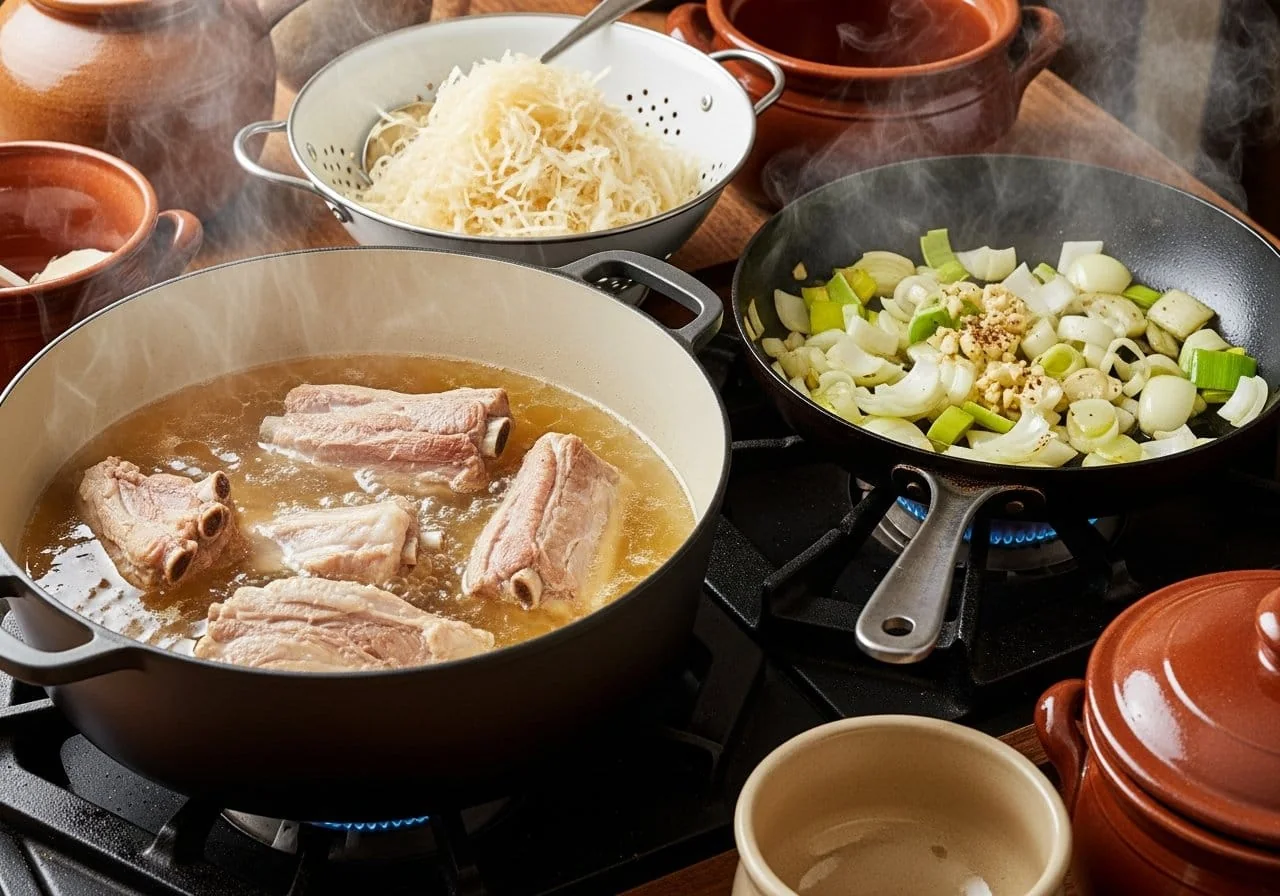
- Brown the ribs. Season the ribs with salt and pepper. Heat the oil in a frying pan and fry the ribs until golden on each side, then move them to a pot of at least 3 litres. Keep the pan unwashed.¹
- Fry the aromatics. In the fat left in the pan, fry the onion and leek until soft. Add the garlic, marjoram and caraway for the last moment of frying, then set the pan aside.¹
- Simmer the ribs. Add the carrots, parsley root, celeriac, bacon or smoked bones, bay leaves and allspice to the ribs. Pour in the water and simmer on low heat for about 30 minutes, until the ribs and vegetables are tender.¹
- Add the potatoes. Add the cubed potatoes and cook for about 15 minutes, until soft.¹
- Add the sauerkraut. Drain the sauerkraut, keeping the juice, and chop it roughly. Add it to the pot with the fried onion mixture and simmer on low heat for about 30 minutes, until the sauerkraut is soft.¹
- Season. Taste and season with salt and pepper. For a sharper soup, stir in some of the reserved juice.¹
- Serve. Ladle into bowls so everyone gets meat and vegetables, and sprinkle with parsley.¹

Kitchen Tips
Use real sauerkraut. The cabbage should be properly fermented, not soured with vinegar.¹
Taste the sauerkraut first. Some cooks rinse it before chopping,² others add it with all of its juice.⁵ If yours is very sour, rinse it; if it is mild, keep the juice and add it at the end.
Salt last. Sauerkraut and smoked bacon both bring salt, so season only after the sauerkraut has simmered, once you can taste the finished soup.¹˒²
A thicker soup is optional. Some cooks fry a spoonful of flour in fat, whisk in a little broth and boil it into the pot for the last 10 minutes; others skip it.²˒⁵
Meatless Kapuśniak for Lent
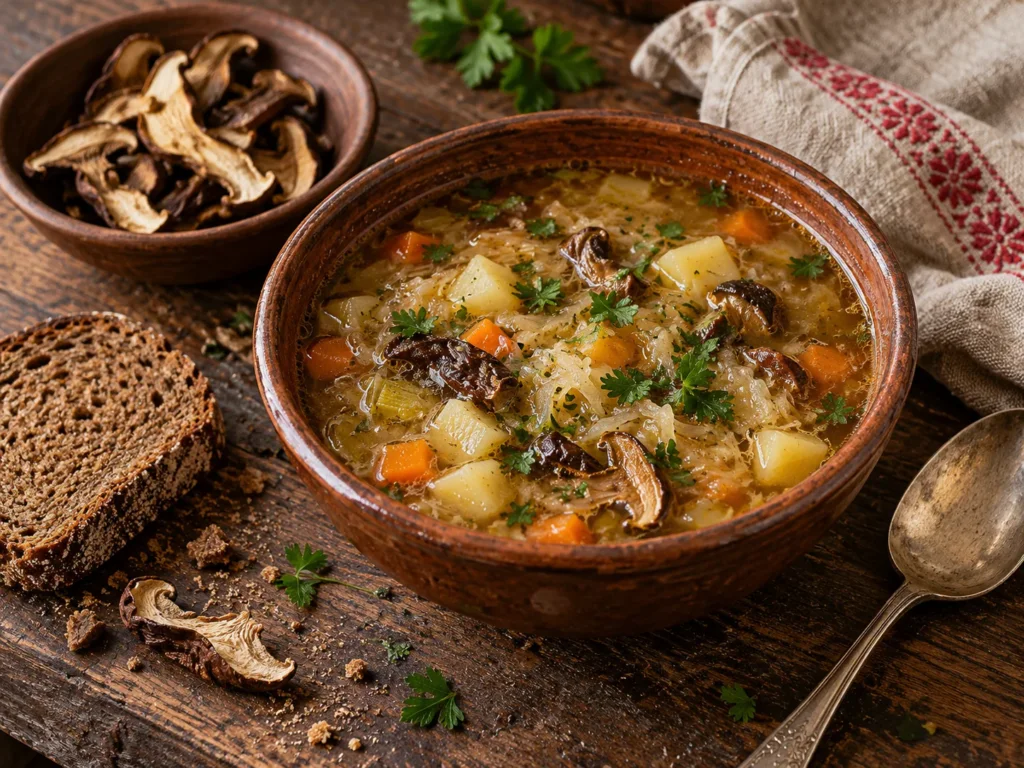
The meatless version leaves out the ribs and bacon and builds the broth from vegetables and dried wild mushrooms instead.¹˒³ Soak a small handful of dried mushrooms, about 20 to 30g (a Heritage Healthy Kitchen estimate), in warm water, chop them, and simmer them with the root vegetables in water or vegetable stock, adding the strained soaking liquid. Fry the onion and leek in vegetable oil rather than lard, then carry on with the potatoes and sauerkraut exactly as above.
Nutritional Information
Per serving (one sixth of the pot, with bacon)
- Calories: approximately 350–430 kcal
- Protein: approximately 19–23g
- Total fat: approximately 21–25g
- Saturated fat: approximately 7g
- Carbohydrates: approximately 24–29g
- Dietary fiber: approximately 5–6g
- Sodium: approximately 720–880mg
Nutritional values are estimates based on standard ingredient databases (USDA FoodData Central) and will vary with the ribs, the sauerkraut and how much salt you add. Without the bacon, a serving has about 340 kcal and 700mg of sodium.
Storage and Reheating
Cool the soup and refrigerate it within 2 hours, dividing a big pot into shallow containers so it cools faster.⁸ It keeps in the fridge for 3 to 4 days or in the freezer for 3 to 4 months.⁸ Reheat it on the stove until it is steaming hot all the way through.
Looking for a Lighter Version?
The Healthy Kapuśniak recipe keeps the sauerkraut, potatoes, roots and spices and swaps the pork ribs and bacon for skinless turkey thigh, with less oil and salt added only after tasting. A serving has about 250 kcal and 1g of saturated fat instead of about 390 kcal and 7g.
Traditional Kapuśniak

Ingredients
For the soup
- 700g (1.5 lb) pork ribs, cut into pieces
- 80g (3 oz) smoked bacon, or 3–4 smoked pork bones (optional)
- 2 tablespoons neutral oil or lard
- 1 medium onion (about 200g), finely diced
- ½ leek, chopped
- 2 garlic cloves, crushed
- 1 tablespoon dried marjoram
- ½ teaspoon caraway seeds
- 2 medium carrots (about 120g), diced
- 1 parsley root (about 100g), diced, or more celeriac
- ⅓ celeriac (about 100g), diced
- 4 bay leaves and 6 allspice berries
- 2 litres (about 8½ cups) water
- 3 medium potatoes (about 450g), peeled and cubed
- 300g (10.5 oz) sauerkraut, fermented without vinegar
- Salt and black pepper, to taste
- 2 tablespoons chopped fresh parsley
Instructions
- Season the ribs with salt and pepper, fry them in the oil until golden on each side and move them to a large pot.
- In the same pan, fry the onion and leek until soft, adding the garlic, marjoram and caraway at the end. Set aside.
- Add the carrots, parsley root, celeriac, bacon or smoked bones, bay leaves, allspice and water. Simmer on low heat for about 30 minutes.
- Add the cubed potatoes and cook for about 15 minutes, until soft.
- Drain and chop the sauerkraut, keeping the juice. Add it with the fried onion mixture and simmer for about 30 minutes.
- Taste and season with salt and pepper; stir in some of the reserved juice for a sharper soup.
- Ladle into bowls with meat and vegetables in each, and sprinkle with parsley.
Frequently Asked Questions
What is the difference between kapuśniak and kwaśnica?
Kwaśnica comes from Podhale in the Tatra Mountains and is traditionally made with mutton, with only sauerkraut, potatoes and meat; sauerkraut juice goes into the pot. Kapuśniak is usually made with pork and can include carrots and other vegetables.⁵˒⁷
Can I make kapuśniak without meat?
Yes. Leave out the ribs and bacon and use a broth of vegetables and dried wild mushrooms, as described in the meatless section above.¹˒³
Can I use fresh cabbage instead of sauerkraut?
Yes. Kapuśniak can be made from sauerkraut, from fresh chopped cabbage, or from a mix of both.¹
Should I thicken kapuśniak?
It’s up to you. Some recipes finish the soup with a spoonful of flour fried in fat; others leave it thin.²˒⁵
What do you serve with kapuśniak?
Rye or sourdough bread, and some cooks top each bowl with fried bacon, sour cream or chopped parsley.³
How long does kapuśniak keep, and can I freeze it?
In the fridge, 3 to 4 days; in the freezer, 3 to 4 months.⁸ Reheat it until steaming hot.
Further Reading & Sources
The recipe is a compilation based on the published recipes listed here; these links are provided for readers who want to explore further.
- Kron, Kasia. “Kapuśniak: Polish Sauerkraut Soup.” The Polonist, September 28, 2018, updated June 5, 2023. polonist.com
- “Kapuśniak z kiszonej kapusty.” Kwestia Smaku, October 27, 2016, updated April 25, 2026 (no author given). kwestiasmaku.com
- annainthekitchen (Anna). “Traditional Polish Kapusniak Soup Recipe.” Anna in the Kitchen, March 4, 2022, updated December 12, 2024. annainthekitchen.com
- Zakrzewski, Patryk. “Polish Peasant Food for Beginners.” Translated by MF. Culture.pl, April 19, 2017. culture.pl
- Ania. “Kapuśniak.” AniaGotuje.pl (no date given). aniagotuje.pl
- Kapusta, Stanisława. “Pośnik.” Oral history interview by Piotr Lasota, March 16, 2023, edited by Weronika Szwanc. Ośrodek „Brama Grodzka – Teatr NN”, Lublin. biblioteka.teatrnn.pl
- Klesta, Karolina. “Polish Kwasnica Soup Recipe.” Polish Foodies, October 29, 2021, updated June 6, 2024. polishfoodies.com
- “Leftovers and Food Safety.” USDA Food Safety and Inspection Service, updated July 31, 2020. fsis.usda.gov
Disclaimer
The information in this article is provided for educational and informational purposes only. Heritage Healthy Kitchen makes no representations or warranties regarding the accuracy or completeness of any content on this site. Nutritional values are estimates only and will vary depending on the specific ingredients, brands, and measurements used. This content is not intended as dietary, medical, or professional nutritional advice. Always consult a qualified healthcare provider regarding any dietary needs or health conditions. Heritage Healthy Kitchen is not responsible for any outcomes resulting from the use of recipes or information published on this site.
You Might Also Like
More heritage recipes from our kitchen



Leave a Reply