
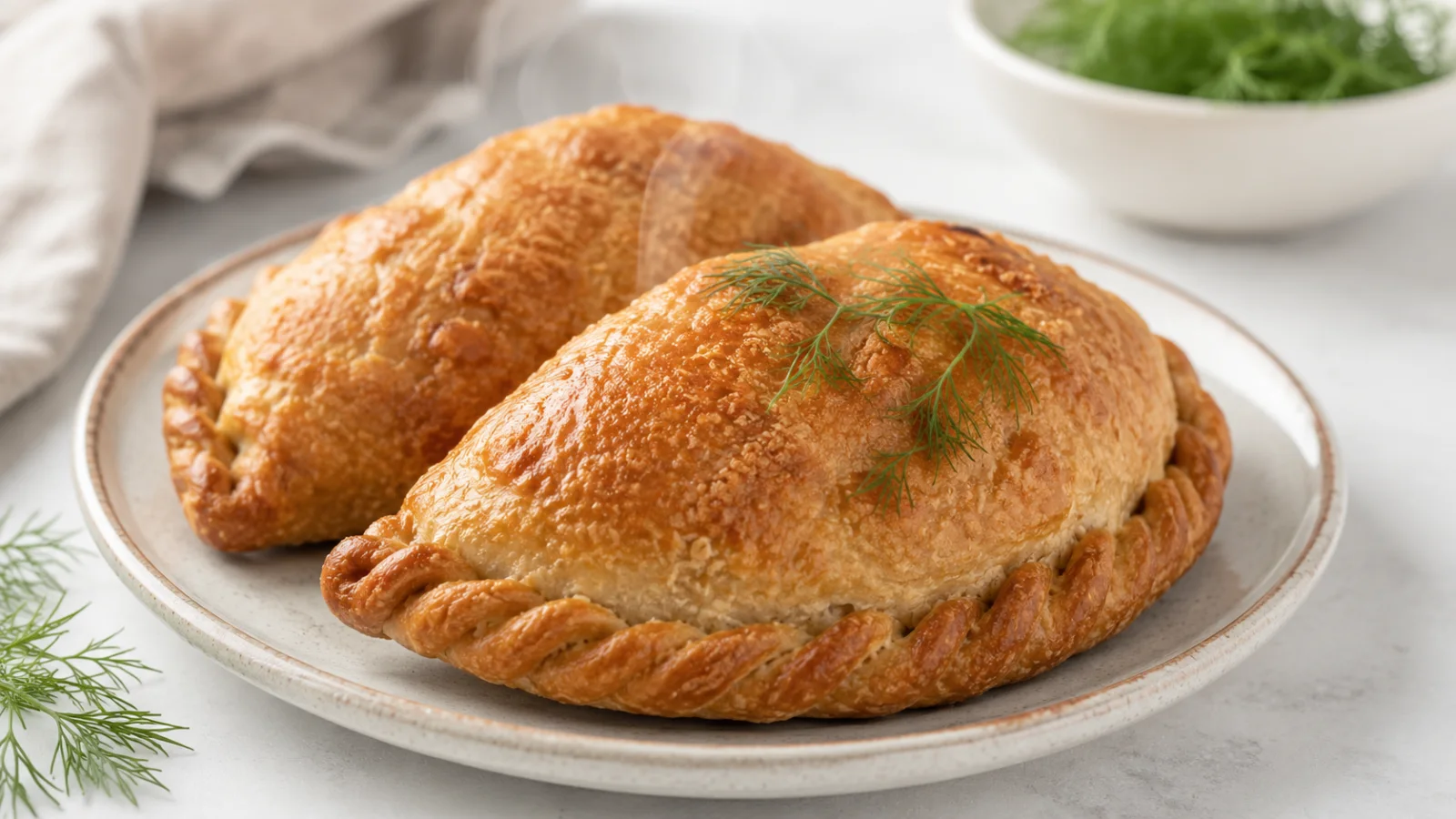
Active time: ~45 minutes | Total time: ~2 hours 30 minutes (with rising) | Serves: 6 (12 kibinai) per recipe | Difficulty: Medium
Quick Overview
- Make the traditional yeast dough with half whole-wheat flour, kefir and rapeseed oil
- Fill it with hand-cut chicken or turkey breast and onion, or with a mushroom filling
- Fold the rounds into half-moons and crimp the edges into a braided rim
- Bake until golden and serve hot
- Compare the numbers with the traditional lamb kibinai below
What This Version Changes — and What It Keeps
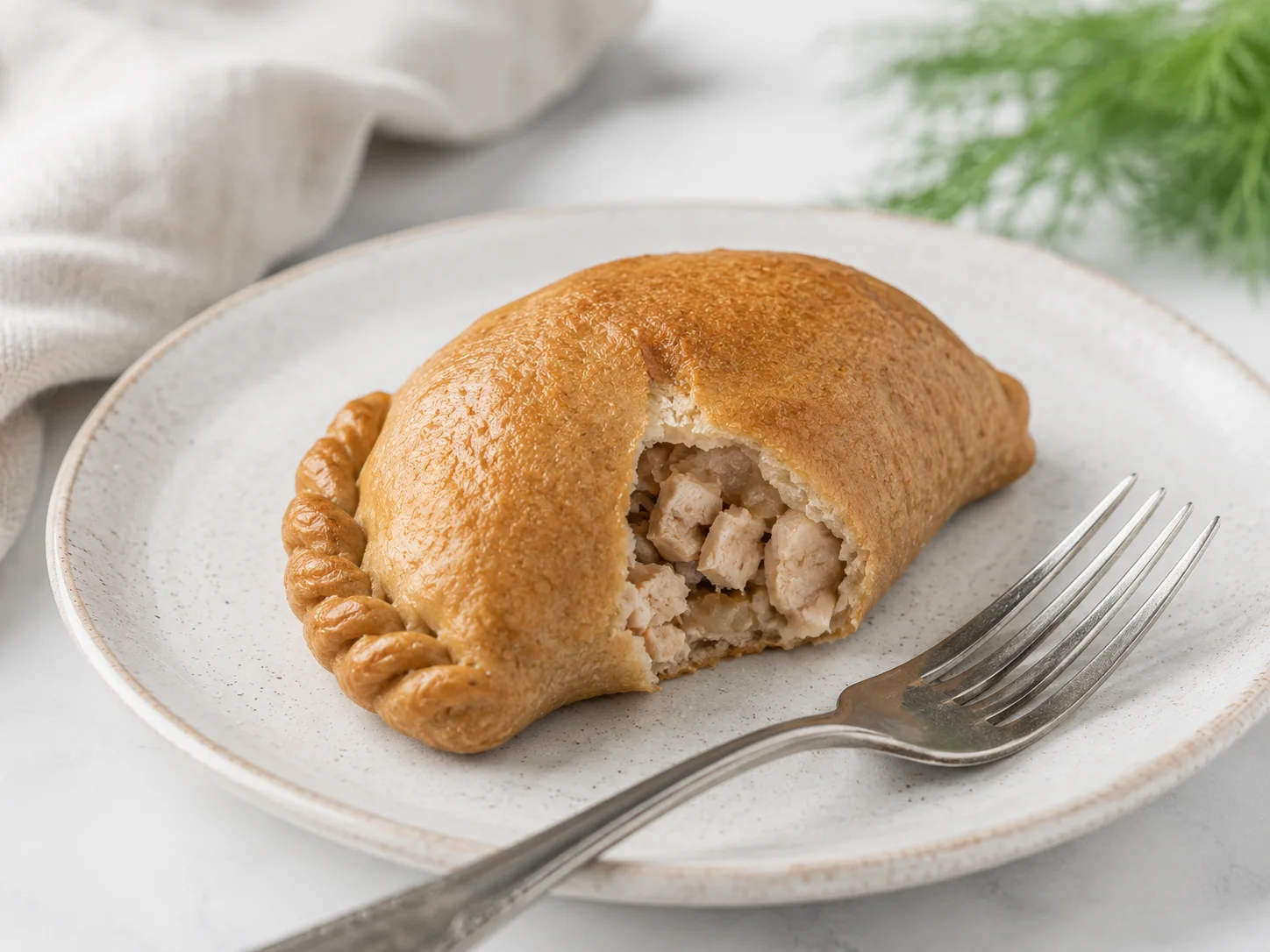
These healthy kibinai keep the shape and the method of the Traditional Kibinai recipe: a soft yeast dough rolled thin, folded over a raw filling, crimped and baked until golden.¹ Chicken is one of the fillings Lithuanian kitchens already use for kibinai, and a mushroom filling is common too, so neither version here is a new invention.²˒³˒⁴
What changes is the fat. Lamb shoulder gives way to chicken or turkey breast or to mushrooms, the butter in the dough to rapeseed oil, and the sour cream to low-fat kefir. Half the white flour becomes whole wheat. Together, these changes cut the saturated fat in a two-pie serving from about 17g to about 2g, as the nutrition comparison below shows.
Why These Swaps Work
Poultry instead of lamb. The Harvard T.H. Chan School of Public Health advises choosing fish, poultry, beans and nuts and limiting red meat, and it reports that eating poultry or plant proteins in place of red meat can lower the risk of several diseases.⁵ The American Heart Association lists lamb among foods high in saturated fat and advises lean meat and poultry without skin.⁶ Hand-cut breast meat keeps the chopped texture of the original, and the spoonfuls of broth in the filling matter even more here, because breast meat has little fat of its own.¹˒³
Half whole-wheat flour. Refining strips away the bran and germ, and with them more than half of wheat’s B vitamins and virtually all of its fiber.⁷ Refined flour is what makes light, airy breads and pastries,⁷ so this version uses whole wheat for only half of it, which still roughly doubles the fiber per serving, as the nutrition comparison below shows.
Rapeseed oil instead of butter. Butter is one of the main sources of saturated fat, and Harvard recommends replacing it with healthy oils such as olive or canola.⁸
Kefir instead of sour cream. Kefir is already one of the dairy ingredients a Karaim cook from Trakai lists for kibinai dough,³ so this version uses low-fat kefir in place of the sour cream. The American Heart Association counts cream among the foods high in saturated fat.⁶
Mushrooms for the meatless version. Mushrooms are low in calories and fat, and their glutamate gives them the savory taste called umami, which can reduce the need for added salt.⁹ That is why the mushroom filling uses a little less salt than the meat one.
Healthy Kibinai Recipes
This recipe was compiled by Heritage Healthy Kitchen from published recipes and the sources for the swaps, all listed at the end of this article. Figures that are Heritage Healthy Kitchen’s own estimates rather than taken from a published source are marked as such.
Both recipes use the dough of the traditional kibinai with the swaps above; the amounts of kefir and oil are Heritage Healthy Kitchen’s estimates. The mushroom filling follows published Lithuanian recipes for mushroom kibinai, which use about 500g of mushrooms and two onions, cooked down until dry.⁴˒¹⁰˒¹¹
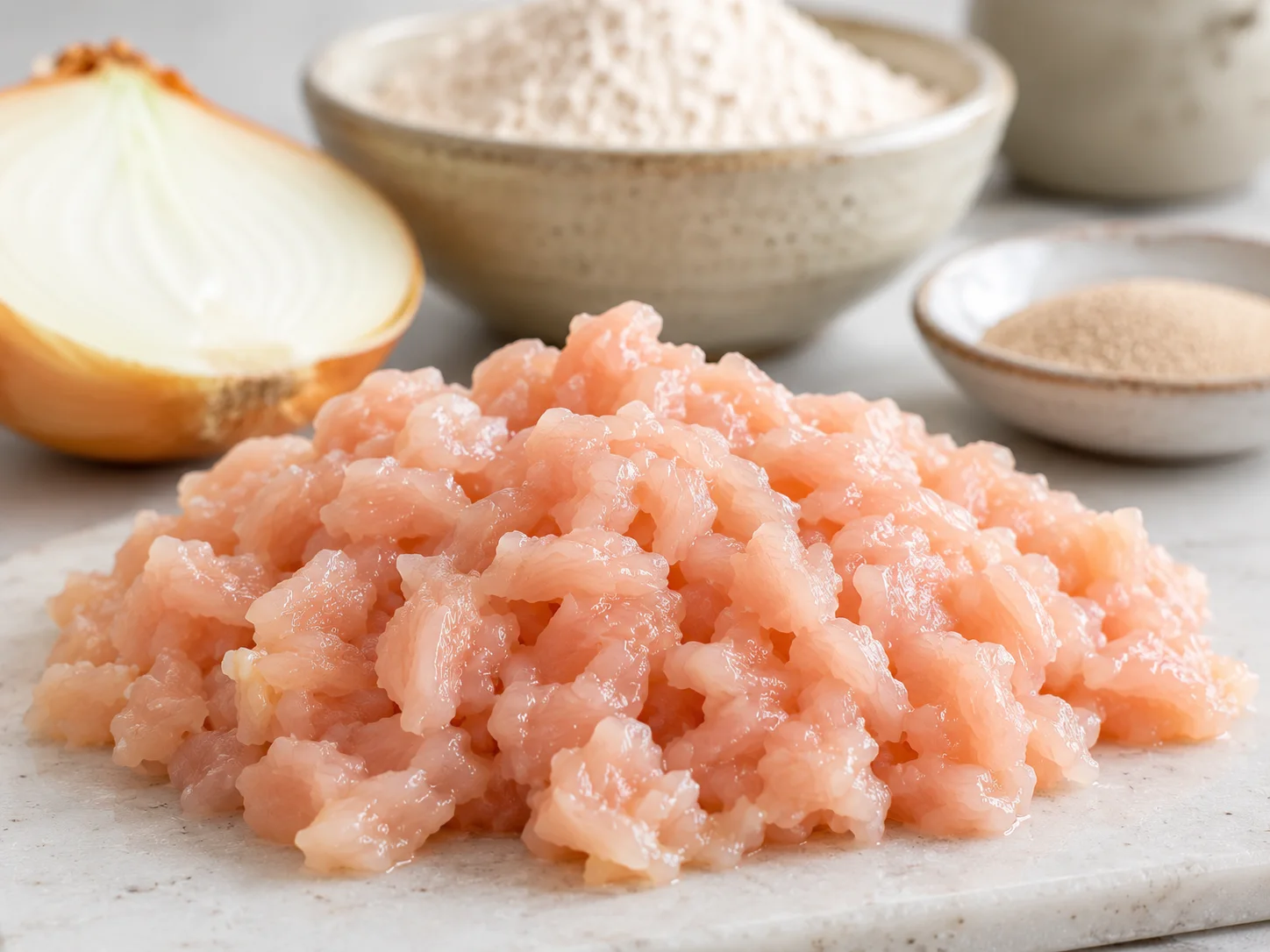
Ingredients
For the dough (both versions)
- 250g (about 2 cups) all-purpose flour¹
- 250g (about 2 cups) whole-wheat flour⁷
- 7g (2¼ teaspoons) instant yeast¹
- 1 teaspoon sugar¹
- 1 teaspoon salt¹
- 200ml (¾ cup plus 1 tablespoon) warm milk¹
- 100g (scant ½ cup) low-fat kefir³
- 3 tablespoons (40g) rapeseed (canola) oil⁸
- 1 large egg¹
- 1 more egg, beaten, for brushing¹
Chicken filling
- 500g (1.1 lb) boneless, skinless chicken or turkey breast²˒⁵
- 1 large onion (about 170g), finely chopped¹
- 1 teaspoon salt¹
- ½ teaspoon freshly ground black pepper¹
- 3–4 tablespoons chicken broth or cold water³
Mushroom filling
- 500g (1.1 lb) white or brown (cremini) mushrooms, or a mix with forest mushrooms⁴˒¹⁰˒¹¹
- 2 onions (about 300g), finely chopped⁴˒¹⁰˒¹¹
- 1–2 garlic cloves, finely chopped⁴˒¹¹
- 1 tablespoon rapeseed (canola) oil⁴˒⁸˒¹¹
- ¾ teaspoon salt⁹
- ¼ teaspoon freshly ground black pepper¹¹
- A small handful of chopped dill or parsley⁴˒¹¹
Instructions: Chicken Kibinai
- Make the dough. Whisk both flours with the yeast, sugar and salt in a large bowl. Add the warm milk, kefir, oil and egg, bring everything together and knead for 8–10 minutes, until smooth and elastic.¹
- Let it rise. Cover and leave in a warm place until roughly doubled, about 1 hour.¹
- Cut the chicken. Cut the chicken or turkey with a knife into very small dice rather than mincing it.¹
- Mix the filling. Combine the meat, onion, salt and pepper, add the broth or water and mix well. The filling should look moist.¹˒³
- Divide and roll. Punch down the dough, divide it into 12 equal pieces and roll each into a thin round 12–15cm (5–6 inches) across.¹
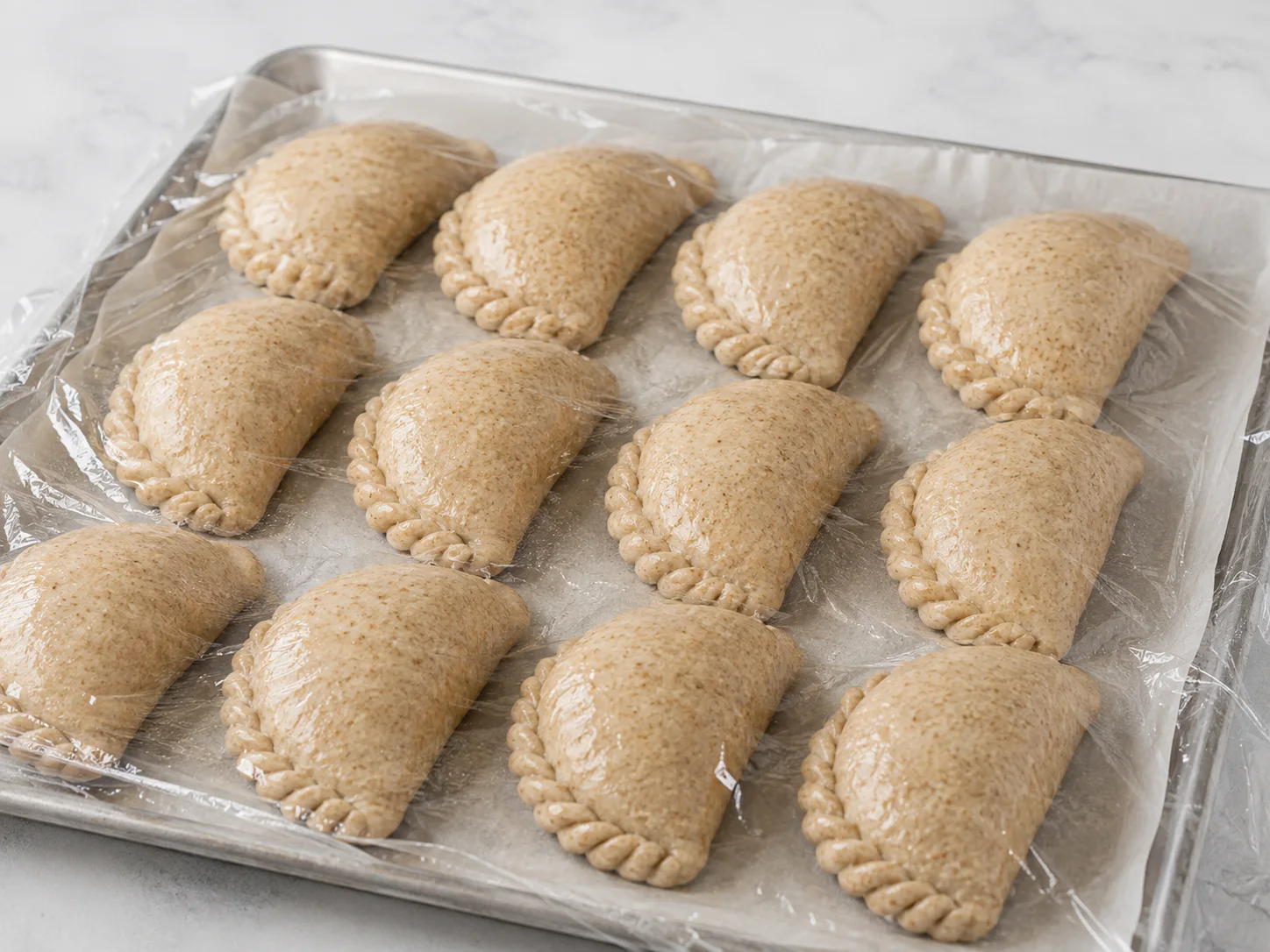
- Fill, fold and crimp. Place a heaped tablespoon of filling on one half of each round, fold it into a half-moon, press the edges together and pinch and twist them into a braided rim.¹
- Bake. Heat the oven to 200°C (390°F). Set the kibinai on a parchment-lined tray with space between them, brush with the beaten egg, prick one or two small holes in the top of each and bake for 30–40 minutes, until golden.¹
- Serve. Serve hot, with a cup of broth on the side.¹
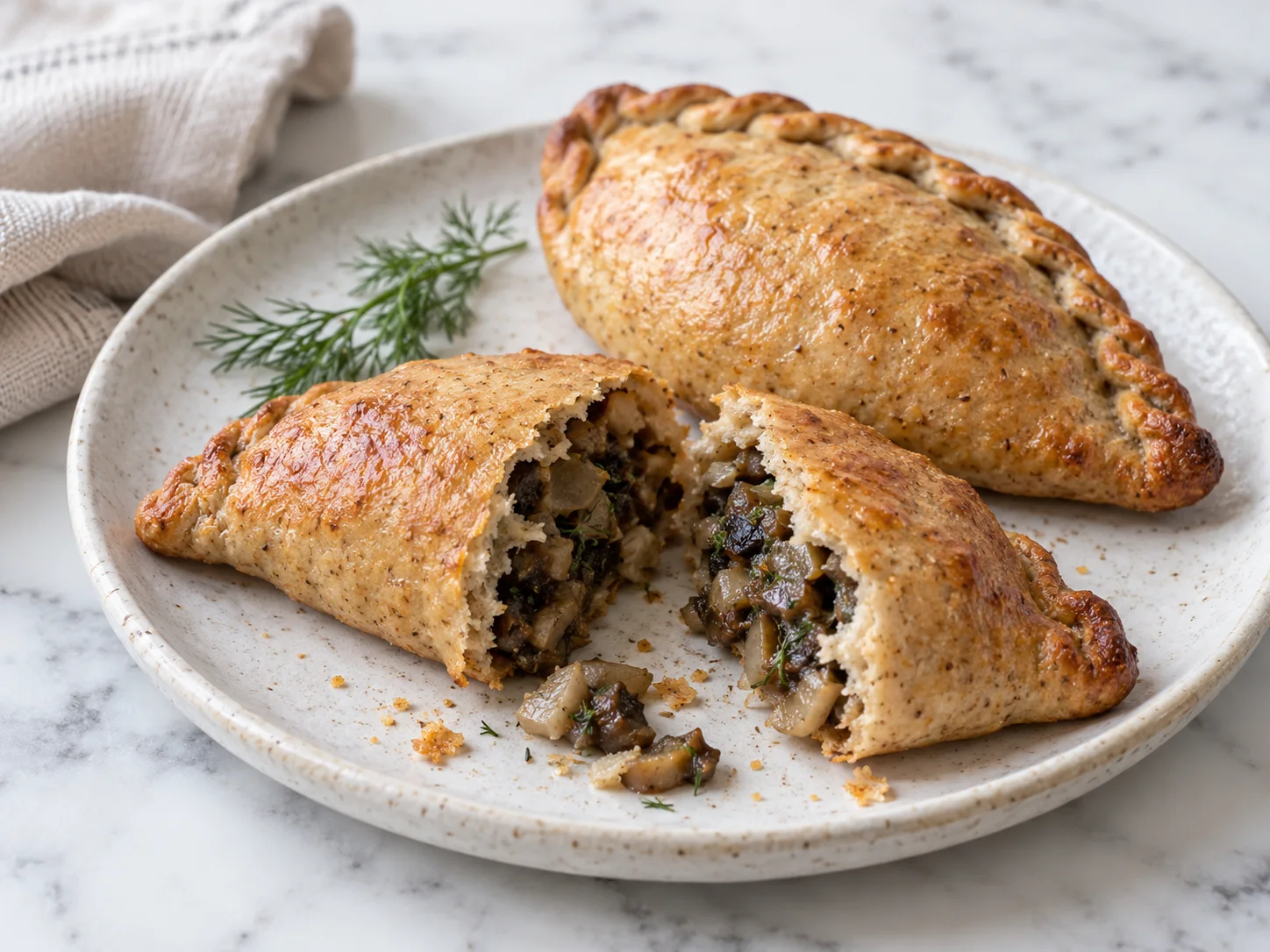
Instructions: Mushroom Kibinai
- Make the dough. Whisk both flours with the yeast, sugar and salt in a large bowl. Add the warm milk, kefir, oil and egg, bring everything together and knead for 8–10 minutes, until smooth and elastic.¹
- Let it rise. Cover and leave in a warm place until roughly doubled, about 1 hour.¹
- Cook the filling. Soften the onion in the oil in a wide pan over medium heat for about 5 minutes, add the garlic for a minute, then add the chopped mushrooms. Raise the heat and cook, stirring, until all their liquid has evaporated and they start to brown, 15–20 minutes. Season with the salt and pepper, stir in the herbs and let the filling cool completely.⁴˒¹¹
- Divide and roll. Punch down the dough, divide it into 12 equal pieces and roll each into a thin round 12–15cm (5–6 inches) across.¹
- Fill, fold and crimp. Place a heaped tablespoon of the cooled filling on one half of each round, without overfilling, fold it into a half-moon and crimp the edge into a braided rim.¹˒⁴
- Bake. Heat the oven to 200°C (390°F). Brush the kibinai with the beaten egg and bake on a parchment-lined tray for 25–35 minutes, until golden; the filling is already cooked.⁴˒¹¹
- Serve. Let the kibinai rest for 5–10 minutes, then serve warm.⁴
Kitchen Tips
Don’t skip the broth. Chicken breast is much leaner than lamb shoulder, so the filling needs its spoonfuls of broth or water to stay juicy in the oven.³
Cook the mushrooms dry. Any liquid left in the pan ends up in the pastry. Keep cooking until the pan is dry and the mushrooms brown, and let the filling cool before it goes into the dough.⁴˒¹¹
Let the dough rise fully. Whole-wheat flour makes a heavier dough than white flour,⁷ so give it the full hour.
Seal the edge well. As with the traditional pies, a tight braided crimp keeps the filling inside.¹
Nutritional Comparison
Per serving (1 of 6: 2 kibinai):
| Nutrient | Traditional (lamb) | This version: chicken | This version: mushroom |
|---|---|---|---|
| Calories | 625–765 kcal | 465–570 kcal | 430–525 kcal |
| Protein | 24–29g | 29–36g | 15–18g |
| Total fat | 31–38g | 12–14g | 12–15g |
| Saturated fat | 15–19g | 2–3g | about 2g |
| Carbohydrates | 63–77g | 61–75g | 66–80g |
| Dietary fiber | about 3g | 6–7g | 7–8g |
| Sodium | 745–910mg | 735–900mg | 625–765mg |
Nutritional values are estimates based on standard ingredient databases (USDA FoodData Central). They vary with the cut of meat, the mushrooms and the size of the pies; the broth served on the side is not included.
The chicken version has the most protein of the three, and both lighter versions roughly double the fiber of the traditional pies. A two-pie serving of the traditional kibinai carries more saturated fat than the American Heart Association’s suggested daily limit of about 13g; each lighter version stays at about 2–3g.⁶
Storage and Reheating
Keep baked kibinai in an airtight container in the fridge for up to 3 days and reheat them in a 180°C (350°F) oven until hot.²
To freeze, shape the kibinai but don’t bake them. Freeze them on a tray, transfer to a freezer bag, and bake from frozen, adding 8–10 minutes to the baking time.²
Healthy Kibinai with Chicken

Ingredients
For the dough
- 250g (about 2 cups) all-purpose flour
- 250g (about 2 cups) whole-wheat flour
- 7g (2¼ teaspoons) instant yeast
- 1 teaspoon sugar
- 1 teaspoon salt
- 200ml (¾ cup plus 1 tablespoon) warm milk
- 100g (scant ½ cup) low-fat kefir
- 3 tablespoons (40g) rapeseed (canola) oil
- 1 large egg
- 1 more egg, beaten, for brushing
For the filling
- 500g (1.1 lb) boneless, skinless chicken or turkey breast
- 1 large onion (about 170g), finely chopped
- 1 teaspoon salt
- ½ teaspoon freshly ground black pepper
- 3–4 tablespoons chicken broth or cold water
Instructions
- Mix both flours with the yeast, sugar and salt, add the warm milk, kefir, oil and egg and knead for 8–10 minutes until smooth.
- Cover and leave in a warm place until roughly doubled, about 1 hour.
- Cut the chicken or turkey into very small dice by hand and mix with the onion, salt, pepper and broth or water.
- Divide the dough into 12 pieces, roll each into a thin 12–15cm round, add a heaped tablespoon of filling, fold into a half-moon and crimp the edge into a braided rim.
- Brush with beaten egg, prick one or two small holes in the top and bake at 200°C (390°F) for 30–40 minutes, until golden.
- Serve hot, with a cup of broth on the side.
Healthy Mushroom Kibinai
Ingredients
For the dough
- 250g (about 2 cups) all-purpose flour
- 250g (about 2 cups) whole-wheat flour
- 7g (2¼ teaspoons) instant yeast
- 1 teaspoon sugar
- 1 teaspoon salt
- 200ml (¾ cup plus 1 tablespoon) warm milk
- 100g (scant ½ cup) low-fat kefir
- 3 tablespoons (40g) rapeseed (canola) oil
- 1 large egg
- 1 more egg, beaten, for brushing
For the filling
- 500g (1.1 lb) white or brown (cremini) mushrooms, or a mix with forest mushrooms
- 2 onions (about 300g), finely chopped
- 1–2 garlic cloves, finely chopped
- 1 tablespoon rapeseed (canola) oil
- ¾ teaspoon salt
- ¼ teaspoon freshly ground black pepper
- A small handful of chopped dill or parsley
Instructions
- Mix both flours with the yeast, sugar and salt, add the warm milk, kefir, oil and egg and knead for 8–10 minutes until smooth.
- Cover and leave in a warm place until roughly doubled, about 1 hour.
- Soften the onion in the oil, add the garlic, then the mushrooms, and cook until all the liquid has evaporated, 15–20 minutes. Season, add the herbs and cool completely.
- Divide the dough into 12 pieces, roll each into a thin 12–15cm round, add a heaped tablespoon of filling, fold into a half-moon and crimp the edge.
- Brush with beaten egg and bake at 200°C (390°F) for 25–35 minutes, until golden.
- Rest for 5–10 minutes and serve warm.
Frequently Asked Questions
Are chicken kibinai traditional?
Chicken is one of the fillings Lithuanian kitchens use for kibinai, and Karaims fill them with chicken too, though less often than with beef or lamb.²˒³ The whole-wheat dough with oil and kefir is this article’s adaptation.
Can I use only whole-wheat flour?
You can, but the pies will bake denser.⁷ Half and half is the middle ground this recipe uses.
Can I use ground chicken?
Hand-cutting is the traditional method, because grinding presses the juices out of the meat, and lean breast meat needs every bit of them.¹˒³
Why does the mushroom filling need so long in the pan?
Mushrooms release a lot of water. It has to evaporate completely, or the filling turns the pastry soggy.⁴˒¹¹
Can I add cheese to the mushroom filling?
Some published recipes suggest mixing a little grated hard cheese into the mushrooms.⁴ It adds saturated fat, so use a small amount.
Can I freeze them?
Yes. Freeze the shaped, unbaked pies and bake them from frozen, adding 8–10 minutes.²
Further Reading & Sources
The recipe is a compilation based on the published recipes listed here; these links are provided for readers who want to explore further.
Traditional base and published recipes
- “Traditional Kibinai Recipe: Meat Hand Pies with Lamb.” Heritage Healthy Kitchen, the traditional recipe this version is based on, with its own list of sources. heritagehealthykitchen.com
- Ieva. “Lithuanian Kibinai – Lithuanian Meat Pies With Pork.” Taste of Lithuania, June 9, 2026. tasteoflithuania.com
- Vaičiūtė, Jurga. “Pas svetinguosius karaimus – ne tik kibinų: ką dar gardaus jie deda ant stalo?” [At the hospitable Karaims’ table: not only kibinai]. 15min.lt, October 31, 2021. 15min.lt
- Janikūnienė, Vaida. “Kibinai su grybais – karaimų tradicija su lietuviško miško aromatu. Šis receptas tikrai nenuvils” [Kibinai with mushrooms]. Derlingas.lt, December 22, 2025. derlingas.lt
- Violeta. “Kibinai su grybais” [Kibinai with mushrooms]. LaMaistas.lt, no date given. lamaistas.lt
- Ilonytė, Samanta. “Kibinai su grybais: trapūs, kvapnūs ir sotūs” [Kibinai with mushrooms]. Panele.lt, July 8, 2026. panele.lt
Sources for the swaps
- “Protein.” The Nutrition Source, Harvard T.H. Chan School of Public Health. nutritionsource.hsph.harvard.edu
- “Saturated Fats.” American Heart Association. heart.org
- “Whole Grains.” The Nutrition Source, Harvard T.H. Chan School of Public Health. nutritionsource.hsph.harvard.edu
- “Fats and Cholesterol.” The Nutrition Source, Harvard T.H. Chan School of Public Health. nutritionsource.hsph.harvard.edu
- “Mushrooms.” The Nutrition Source, Harvard T.H. Chan School of Public Health. nutritionsource.hsph.harvard.edu
Disclaimer
The information in this article is provided for educational and informational purposes only. Heritage Healthy Kitchen makes no representations or warranties regarding the accuracy or completeness of any content on this site. Nutritional values are estimates only and will vary depending on the specific ingredients, brands, and measurements used. This content is not intended as dietary, medical, or professional nutritional advice. Always consult a qualified healthcare provider regarding any dietary needs or health conditions. Heritage Healthy Kitchen is not responsible for any outcomes resulting from the use of recipes or information published on this site.
You Might Also Like
More heritage recipes from our kitchen


Leave a Reply