
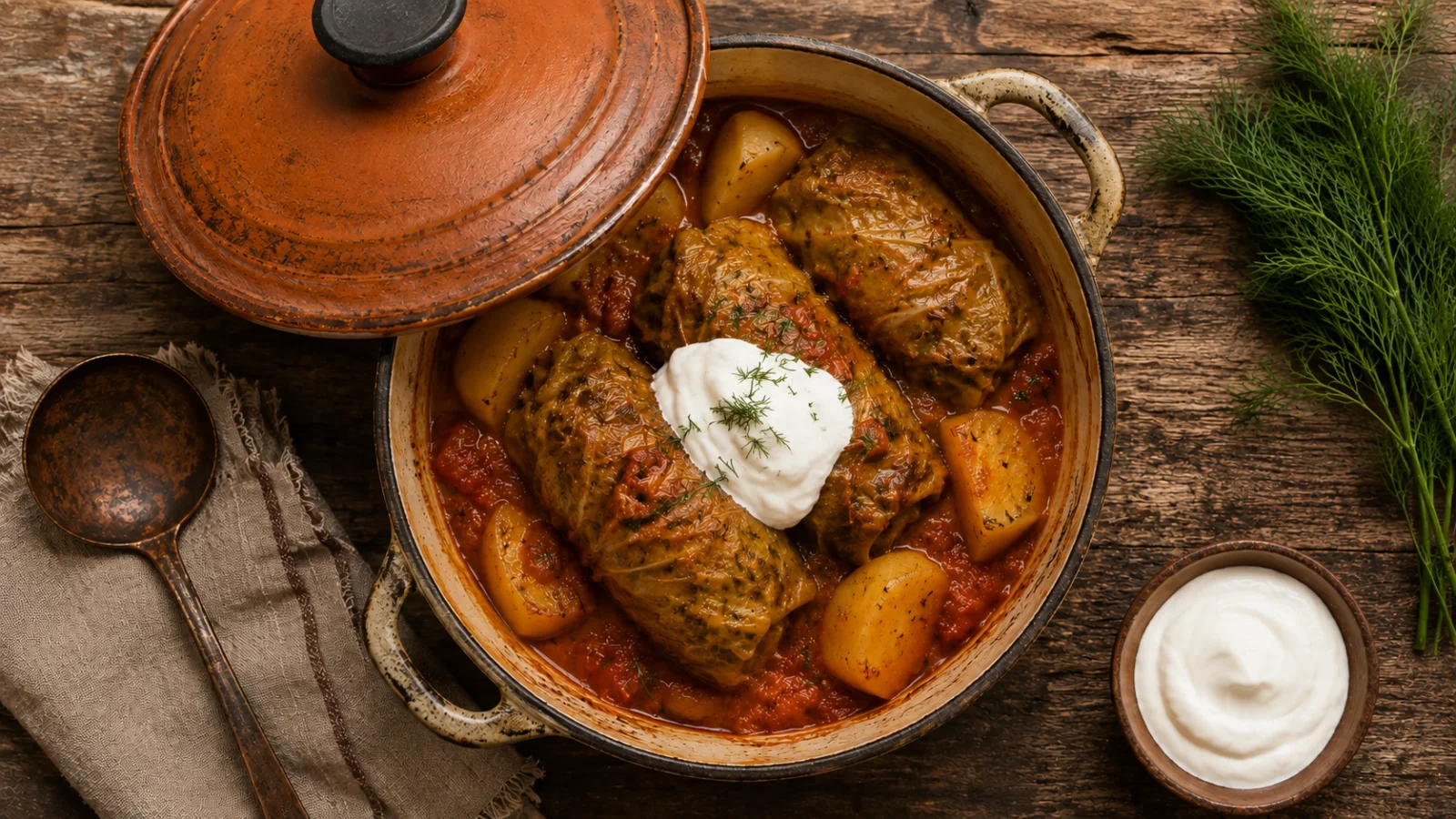
Active time: ~1 hour 15 minutes | Total time: ~2 hours 15 minutes | Serves: 6 (14–16 rolls) | Difficulty: Medium
Quick Overview
- Simmer a whole cabbage and peel off the softened leaves
- Mix ground pork with uncooked rice, salt and pepper
- Roll the filling in the leaves, and sear the rolls if you like
- Layer the rolls with potatoes, carrots and onion and pour over a tomato-stock sauce
- Simmer for about an hour and serve with sour cream and dill
What Balandėliai Are
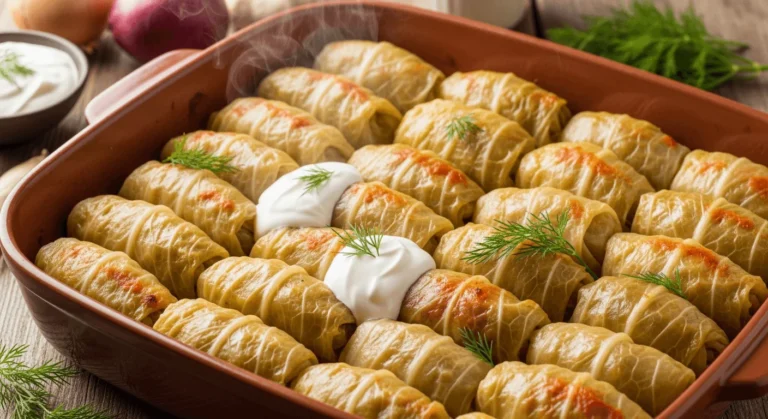
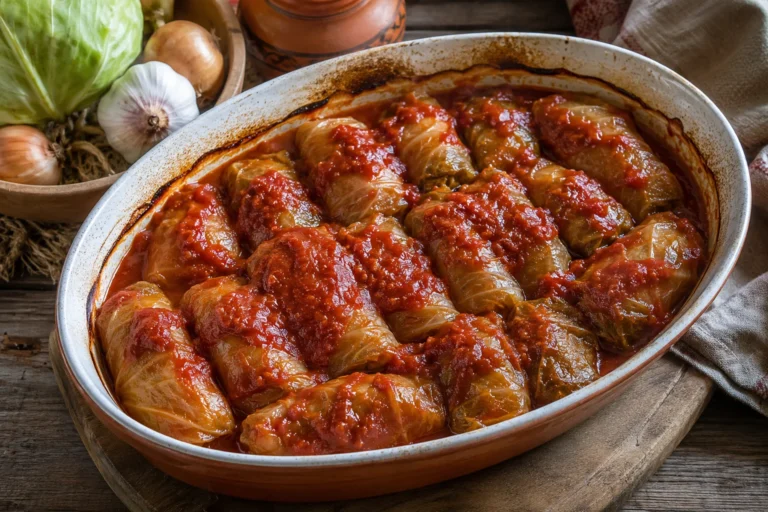
Balandėliai are Lithuanian stuffed cabbage rolls: softened cabbage leaves wrapped around a filling of ground pork and rice and simmered in a thin tomato sauce.¹ The name translates as “little pigeons” or “little doves.”¹ Cabbage rolls with ground meat are popular in every region of Lithuania.² In the Lithuanian version the potatoes usually cook in the same pot as the rolls, and the plate is finished with a generous spoonful of sour cream.¹
History and Cultural Roots
Stuffed cabbage is made across Europe and the Middle East under many names: chou farci in France, malfouf in Middle Eastern cooking, gołąbki in Poland, krautwickel in Germany, and further versions in Ukraine, Hungary and Romania.¹ Balandėliai are Lithuania’s own member of that family, and each Lithuanian household makes them a little differently.¹
Nobody has a settled explanation for why a dish of cabbage and meat is named after birds.¹ In everyday Lithuanian the same word is also used for affectionate couples in love who can’t keep their hands off each other, which has prompted the popular guess that the name describes the rolls packed snugly together in the pot. It remains a guess.¹
Traditional Balandėliai Recipe
This recipe was compiled by Heritage Healthy Kitchen from a comparison of published recipes; the sources are listed at the end of this article. Figures that are Heritage Healthy Kitchen’s own estimates rather than taken from a published source are marked as such.
The published Lithuanian recipes all use about 500g of ground pork for six servings. Most put the rice into the filling uncooked, though one uses cooked rice. Some add grated carrot and onion to the filling, or celery, sweet pepper and fresh herbs. The rolls simmer for 30 minutes to about an hour.¹˒³˒⁴ This version follows the most detailed of them, with the potatoes cooked in the pot.
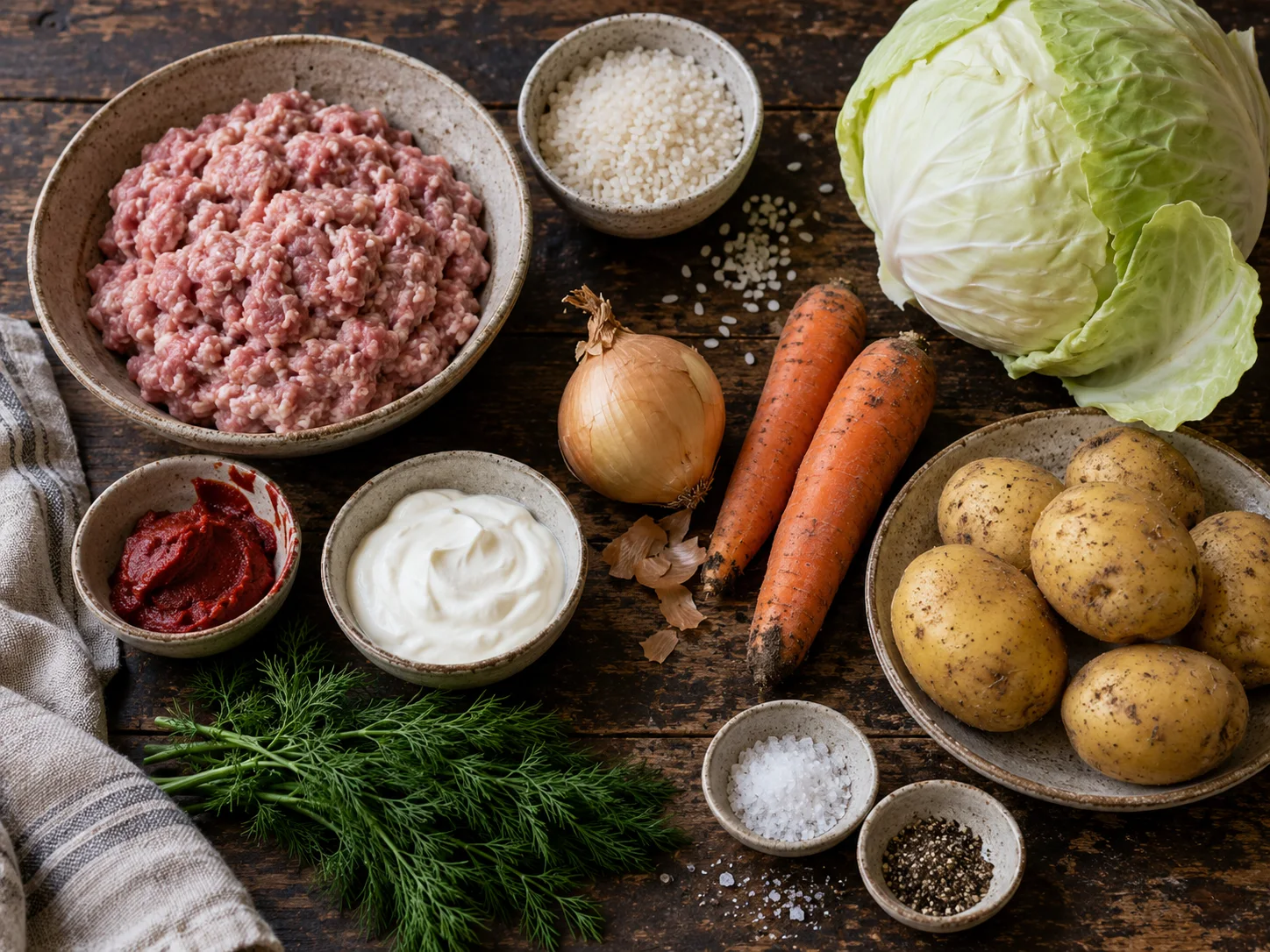
Ingredients
For the filling
- 500g (1.1 lb) ground pork (traditionally a fattier mince, about 20% fat)¹˒³˒⁴
- 100g (½ cup) white rice, uncooked¹˒³
- 1 teaspoon salt¹
- ¼ teaspoon freshly ground black pepper¹
- Optional: ½ teaspoon ground caraway seeds or 1 teaspoon dried parsley¹
For rolling
- 1 large head of white or green cabbage¹
- 2 tablespoons all-purpose flour (for the optional searing)¹
- 1–2 tablespoons neutral oil or butter (for the optional searing)¹
For the pot
- 2 carrots, coarsely grated¹˒³
- 1 yellow onion, thinly sliced¹
- 750g (1.5 lb) potatoes, peeled and halved or quartered (not overly floury ones, which fall apart)¹
- 500ml (2 cups) chicken or beef stock¹˒³
- 2 tablespoons tomato paste¹˒³
- 2 tablespoons sour cream, plus more to serve¹˒³
- Fresh dill, to serve¹˒³
Instructions
- Soften the cabbage. Remove any damaged outer leaves. Set the whole head stalk side down in a large pot, pour boiling water over it to cover at least two-thirds, and simmer over low-medium heat for 10 minutes. Turn the head over, cut the outer leaves free at the stalk and lift them out. Return the head to the water for a few minutes at a time and keep separating leaves until the inner ones are too small to roll. You need 14–16 leaves.¹
- Trim the leaves. Once the leaves are cool enough to handle, run a sharp knife flat along the thick central stalk of each one so it is no thicker than the rest of the leaf. If the leaves still feel stiff, return them to the boiling water for 5–7 minutes.¹
- Make the filling. In a large bowl, mix the ground pork, rice, salt and pepper, with the caraway or parsley if using, until evenly combined.¹
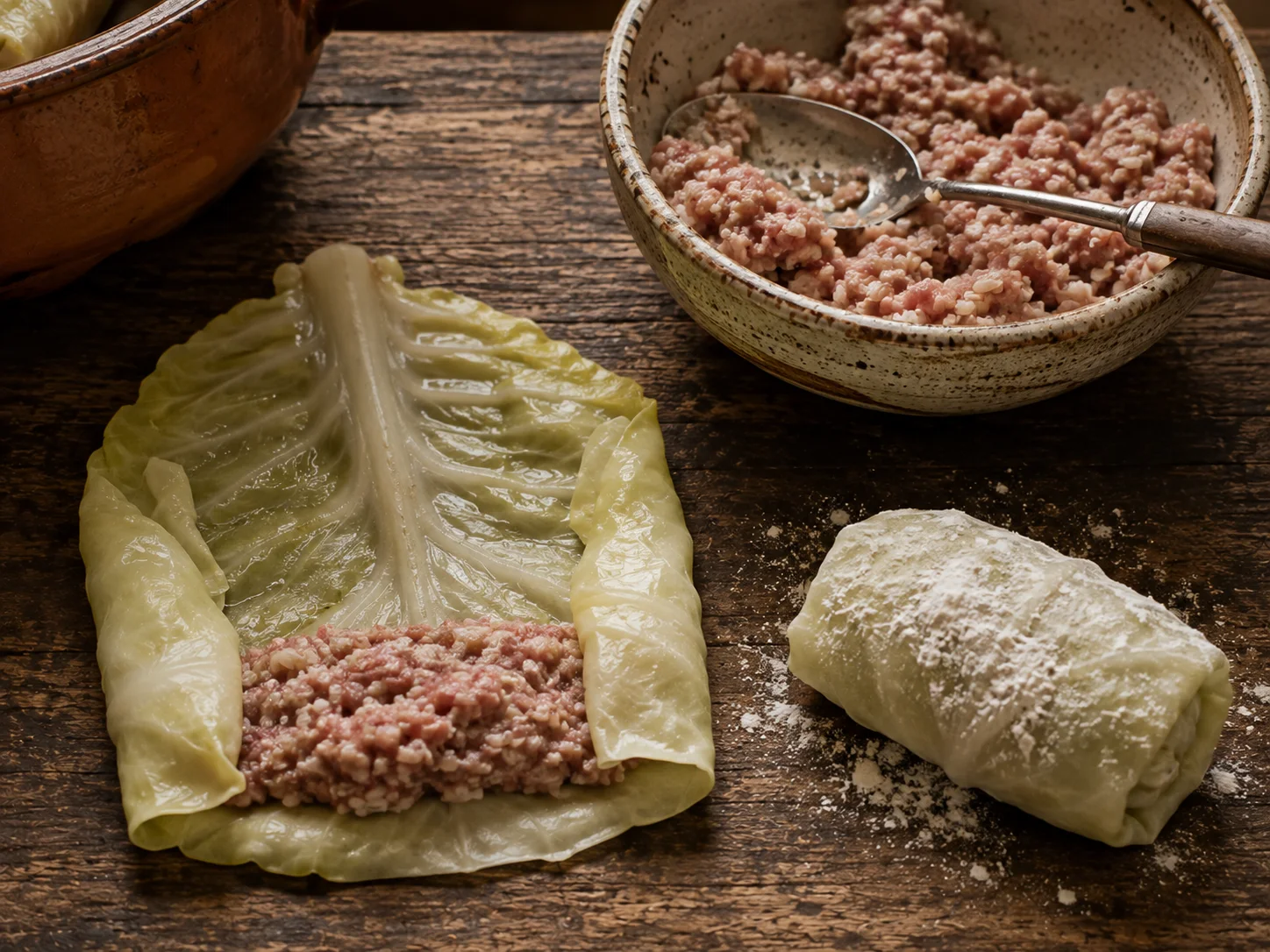
- Roll. Lay a leaf flat, spoon some filling onto it and roll it up like a burrito: fold one side over the filling, fold in the sides, then roll it into a parcel.¹
- Sear (optional). Spray or brush the rolls lightly with water, roll them in flour and brown them on both sides in the oil or butter in a large frying pan over medium heat.¹ Many families skip this step and put the rolls straight into the pot.¹
- Layer the pot. Scatter a third of the carrots and onion over the bottom of a large pot. Pack in a layer of rolls, filling the gaps with potatoes. Add another third of the carrots and onion, a second layer of rolls and potatoes, and finish with the rest of the carrots and onion.¹
- Add the sauce. Mix the stock with the tomato paste and pour it over the rolls; they should be about two-thirds submerged, so add a little more stock if your pot needs it. Dot the top with the sour cream.¹
- Simmer. Cover, bring to a boil over medium-high heat, then lower the heat and simmer for about 50–60 minutes, until the cabbage and potatoes are tender.¹˒³
- Serve. Serve 2–3 rolls per portion with a few potatoes, a few spoonfuls of the tomato sauce, a spoonful of sour cream and some fresh dill.¹
Kitchen Tips
Choose a fresh, young cabbage. Young leaves separate more easily, bend without tearing and cook faster. Green cabbage has thinner, softer leaves than white; an older white cabbage takes much longer to soften.¹
Don’t skip trimming the stalks. The thick part of the stalk does not soften in the time it takes the filling to cook, and it makes the rolls hard to close.¹
Pack the pot tightly. Rolls that sit snugly side by side have no room to unroll as they simmer.¹
Rice, cooked or not. Uncooked rice works, as in the recipe above. Par-boiled rice makes a more tender filling, and leftover cooked rice can go in too, but use about half the amount.¹
For a lighter pot, use a leaner pork mince of 10–12% fat and skip the searing, as many Lithuanian families do, and top the plate with plain Greek yogurt instead of sour cream; by Heritage Healthy Kitchen’s estimate, that cuts about a quarter of the calories and more than half of the saturated fat in a serving.¹˒⁵

Nutritional Information
Per serving (1 of 6: about 2–3 rolls with potatoes and sauce, including 2 tablespoons of sour cream to serve)
- Calories: approximately 510–625 kcal
- Protein: approximately 21–26g
- Total fat: approximately 26–32g
- Saturated fat: approximately 10–12g
- Carbohydrates: approximately 49–60g
- Dietary fiber: approximately 7–8g
- Sodium: approximately 555–680mg
Nutritional values are estimates based on standard ingredient databases (USDA FoodData Central). They vary with the fat content of the pork, the saltiness of the stock and how much sour cream goes on the plate.
Storage and Reheating
Cool the rolls to room temperature, then keep them in the fridge in an airtight container, or in the pot itself, for up to 4 days. Reheat them on the stove or in the microwave, adding a splash of water if most of the sauce is gone.¹
Traditional Balandėliai

Ingredients
For the filling
- 500g (1.1 lb) ground pork (traditionally a fattier mince, about 20% fat)
- 100g (½ cup) white rice, uncooked
- 1 teaspoon salt
- ¼ teaspoon freshly ground black pepper
- Optional: ½ teaspoon ground caraway seeds or 1 teaspoon dried parsley
For rolling
- 1 large head of white or green cabbage
- 2 tablespoons all-purpose flour (for the optional searing)
- 1–2 tablespoons neutral oil or butter (for the optional searing)
For the pot
- 2 carrots, coarsely grated
- 1 yellow onion, thinly sliced
- 750g (1.5 lb) potatoes, peeled and halved or quartered (not overly floury ones, which fall apart)
- 500ml (2 cups) chicken or beef stock
- 2 tablespoons tomato paste
- 2 tablespoons sour cream, plus more to serve
- Fresh dill, to serve
Instructions
- Simmer the whole cabbage head for 10 minutes, then keep peeling off the softened outer leaves, returning the head to the water as needed, until you have 14–16 leaves.
- Shave the thick central stalk of each leaf flat with a knife.
- Mix the pork, uncooked rice, salt and pepper (and caraway or parsley, if using), spoon some onto each leaf and roll it up like a burrito.
- Roll the rolls in flour and brown them on both sides in a little oil or butter.
- Layer the rolls and potatoes in a large pot between thirds of the grated carrot and sliced onion.
- Pour over the stock mixed with tomato paste until the rolls are two-thirds covered, dot with sour cream, bring to a boil, cover and simmer on low heat for 50–60 minutes.
- Serve 2–3 rolls per portion with potatoes, sauce, sour cream and dill.
Frequently Asked Questions
Why are they called “little pigeons”?
Nobody knows for certain. Balandėliai means “little pigeons” or “little doves,” and the word is also used for couples in love, so one popular guess is that it describes the rolls nestled together in the pot.¹
Do the rolls have to be seared before they go into the pot?
No. Many Lithuanian families put them straight into the pot. Coating them in flour and searing them gives color and a little more flavor, and the flour thickens the sauce slightly.¹
Can I use other meat?
Yes. Chicken, veal, beef or turkey all appear in Lithuanian kitchens, though pork is the most popular.¹
Which cabbage works best?
White or green cabbage, as fresh and young as possible, and a medium to large head so the leaves are big enough to roll. Savoy cabbage is not typical.¹
Why is my cabbage still tough?
Usually the thick part of the stalk was not trimmed, or the cabbage was old. Old white cabbage takes much longer to soften, so the rolls may need a longer simmer.¹
How are balandėliai different from Polish gołąbki or Ukrainian holubtsi?
All three are pork-and-rice cabbage rolls simmered in sauce. What marks the Lithuanian dish is the potatoes cooked in the same pot, with sour cream served on top.¹ For how gołąbki and holubtsi differ from each other, see our holubtsi vs gołąbki guide.
Further Reading & Sources
The recipe is a compilation based on the published recipes listed here; these links are provided for readers who want to explore further.
- Ieva. “Balandėliai: Lithuanian Cabbage Rolls.” Taste of Lithuania, February 20, 2024. tasteoflithuania.com
- Česėkaitė, Ditė. “Vasario 16-ąją prisiminkime tautinę virtuvę” [On February 16, let us remember the national cuisine]. Alkas.lt, February 16, 2021. alkas.lt
- Nicholson, Beata. “Balandėliai nuostabieji” [Wonderful cabbage rolls]. Beatos virtuvė, May 29, 2008. beatosvirtuve.lt
- Dovile (from Gaspadinė.lt). “Receptas. Balandėliai” [Recipe: cabbage rolls]. tv3.lt, February 3, 2022. tv3.lt
- Cleveland Clinic, with Julia Zumpano, RD, LD. “Is Yogurt Good for You?” Health Essentials, November 9, 2020. clevelandclinic.org
Disclaimer
The information in this article is provided for educational and informational purposes only. Heritage Healthy Kitchen makes no representations or warranties regarding the accuracy or completeness of any content on this site. Nutritional values are estimates only and will vary depending on the specific ingredients, brands, and measurements used. This content is not intended as dietary, medical, or professional nutritional advice. Always consult a qualified healthcare provider regarding any dietary needs or health conditions. Heritage Healthy Kitchen is not responsible for any outcomes resulting from the use of recipes or information published on this site.
You Might Also Like
More heritage recipes from our kitchen

Leave a Reply