

Part of our Heritage Kitchen Glossary – short guides to the ingredients and techniques behind Eastern European cooking.
The short answer
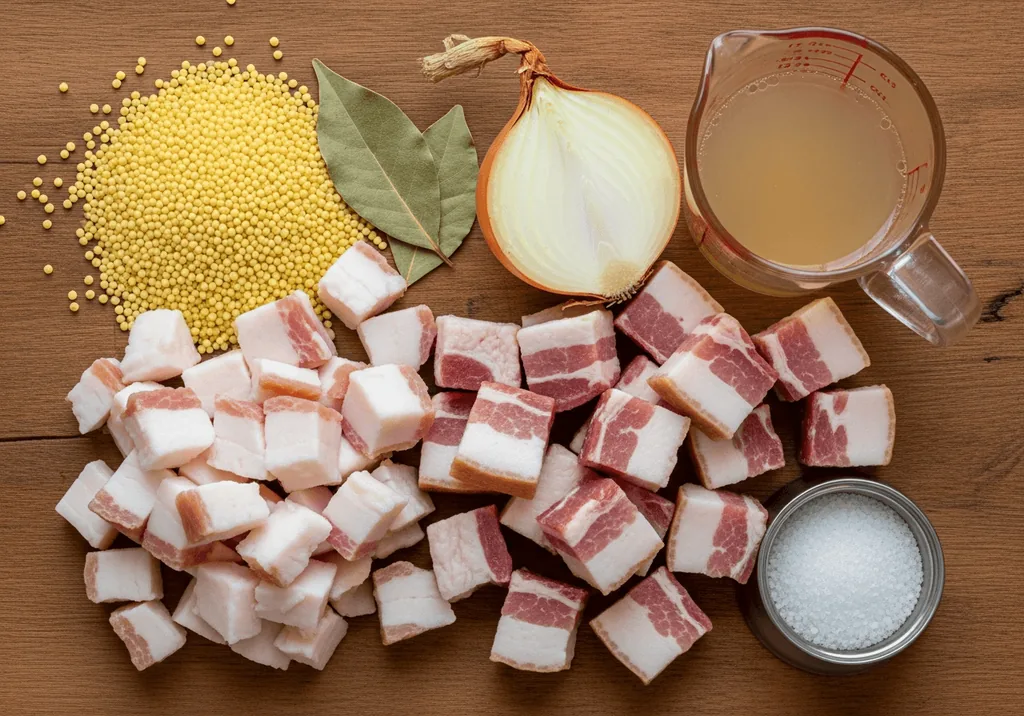
Salo is salted pork fat. It can be plain or have streaks of meat running through it, and some cooks also use smoked salo. Shkvarky are cracklings: small cubes of salo fried in a dry pan until golden and crisp, then lifted out of the fat that has run out of them. In the recipes on this site, salo usually goes into the pot as the cooking fat, and shkvarky go on top of the finished dish.
Salo in the pot
In kulish, the millet “field porridge,” salo goes in at the end. The Ukrainian ethnographic handbook Ukrainska mynuvshyna describes the finished pot being stirred through with salo fried with onion and garlic, and notes that kulish was especially valued with salo, a piece of meat or a fish. One published recipe for four, made without meat, takes 100g of salo, fried until golden and the fat has run. Any salo will do, plain or with streaks of meat, and some cooks add a little smoked salo alongside the plain one for its flavor. Salo is already salted, so taste the pot before adding more salt.
Shkvarky on top
Banosh, the cornmeal porridge of the Ukrainian Carpathians, is cooked in sour cream and usually served with crumbled bryndza (a salty sheep’s milk cheese), crisp cracklings or fried mushrooms, often with all three. Published recipes differ on the cracklings: in one they are optional, in another they are made from 300g of salo for a pot that serves two.
Cracklings go into cabbage rolls too. In the Teplyk and Bar communities of Vinnytsia region, holubtsi are filled with mashed potato and fried onion, often with cracklings. Deruny, the potato pancakes, are eaten hot from the pan, usually with sour cream, though cheese, cracklings and ryazhenka, a fermented milk, turn up beside them as well.
Where you will meet it on this site
Salo is fried with onion and garlic and stirred into our Traditional Kulish, and cracklings top our Traditional Banosh. The potato holubtsi of Vinnytsia region are described in our Traditional Holubtsi, and cracklings are among the toppings for Traditional Deruny.
Lighter versions
Salo is cured pork fat, and the NHS lists lard, bacon and fatty cuts of meat among the foods high in saturated fat. Our Traditional Kulish ends with a lighter way to make it: 40g of salo instead of 100g, with the onion fried in a tablespoon of sunflower oil, so there is still salo in the pot, just less of it. Healthy Banosh cooks the cornmeal in milk, tops it with fried mushrooms and onion, and leaves the cracklings as an option.
Frequently Asked Questions
What is salo?
Salo is salted pork fat, plain or with streaks of meat. Some cooks also use smoked salo. In kulish and banosh it is fried before it goes into the dish.
What is the difference between salo and shkvarky?
Salo is the salted pork fat itself. Shkvarky, or cracklings, are what is left when small cubes of salo are fried in a dry pan until golden and crisp and lifted out of the rendered fat.
How do you make shkvarky?
Cut salo into small cubes and fry them in a dry frying pan over medium heat until golden and crisp. Lift the cracklings out of the rendered fat and keep them warm until serving.
What dishes use salo and shkvarky?
Salo fried with onion and garlic is stirred into kulish, the millet field porridge. Cracklings top banosh, go into potato-filled holubtsi in parts of Vinnytsia region and are served with deruny.
Can you cook these dishes without salo?
Yes. For kulish, fry the onion and garlic in sunflower oil instead of salo. Banosh with bryndza and fried mushrooms, and no cracklings, is also a traditional way to serve it.
Further Reading & Sources
This entry draws on the sources below and on the recipes it links to elsewhere on this site. They are listed for readers who want to go further.
- Lidiia Artiukh. “Povsiakdenna i sviatkova yizha i napoi” [Everyday and festive food and drink]. Ukrainska mynuvshyna: iliustrovanyi etnohrafichnyi dovidnyk; reprinted on Pani Stefa, 5 April 2017 (in Ukrainian). panistefa.com
- Yevhen Klopotenko. “Spravzhnia kozatska kasha: retsept kulisha iz kvashenymy tomatamy ta motsareloiu” [A real Cossack porridge: kulish with fermented tomatoes and mozzarella]. klopotenko.com, 3 April 2022 (in Ukrainian). klopotenko.com
- Solomiia Tsurenko. “Kozatskyi kulish, yak hotuiut na Poltavshchyni” [Cossack kulish as it is cooked in Poltava region]. Novyny.live, 20 September 2023 (in Ukrainian). novyny.live
- Yevhen Klopotenko. “Avtentychnyi karpatskyi banosh na smetani” [Authentic Carpathian banosh in sour cream]. klopotenko.com, 17 January 2024 (in Ukrainian). klopotenko.com
- Yevhen Klopotenko. “Banosh z brynzoiu ta shkvarkamy” [Banosh with bryndza and cracklings]. klopotenko.com, 3 October 2022 (in Ukrainian). klopotenko.com
- Antonina Mnikh. “Vinnytski holubtsi: korolivski, khrinovi i z hychky” [Vinnytsia holubtsi: royal, horseradish and beet-leaf]. Ukrinform, 22 June 2024 (in Ukrainian). ukrinform.ua
- “Deruny.” Authentic Ukraine, no author or date given. authenticukraine.com.ua
- Yevhen Klopotenko. “Deruny z yablukom i tomatnym sousom” [Deruny with apple and tomato sauce]. klopotenko.com, no publication date given, updated 10 September 2026 (in Ukrainian). klopotenko.com
- NHS. “How to eat less saturated fat.” nhs.uk, page last reviewed 19 June 2023. nhs.uk
Leave a Reply