

Part of our Heritage Kitchen Glossary – short guides to the ingredients and techniques behind Eastern European cooking.
The short answer
Salo is cured pork back fat, cut into thick slabs and rubbed with salt, often with garlic, rather than cooked down right away. Shkvarky are what happens when you fry that fat, or a piece of pork belly, until the fat melts out and the solid pieces shrink into small, golden, crackling bits. One is raw. The other is what a hot pan does to it. In everyday Ukrainian kitchens the two are treated as a matched pair, the way flour and bread are related without being the same thing.
Salo: the slab you don’t necessarily cook
What sets salo apart from bacon or lard elsewhere in Europe is that it’s often eaten as it is: thinly sliced, laid on dark rye bread, rubbed with a clove of raw garlic. It sits closer to cured charcuterie than to a cooking fat you’d render before use. Salted salo keeps for weeks without refrigeration, which made it a dependable way to carry protein and calories through winters when fresh meat spoiled within days and there was no fridge to save it.
Ukraine isn’t the only kitchen with a name for this. Poland has slonina, Slovakia and the Czech lands have slanina, Hungary has szalonna, all describing roughly the same cured pork fat, sliced thin and eaten with bread, onion and something sharp to cut the richness. The versions differ more in cure and seasoning than in the basic idea. A region without much olive oil or dairy-free cooking fat leaned on the pig, and salted its fat the way other places salted fish.
Shkvarky: the crackling that comes from frying it
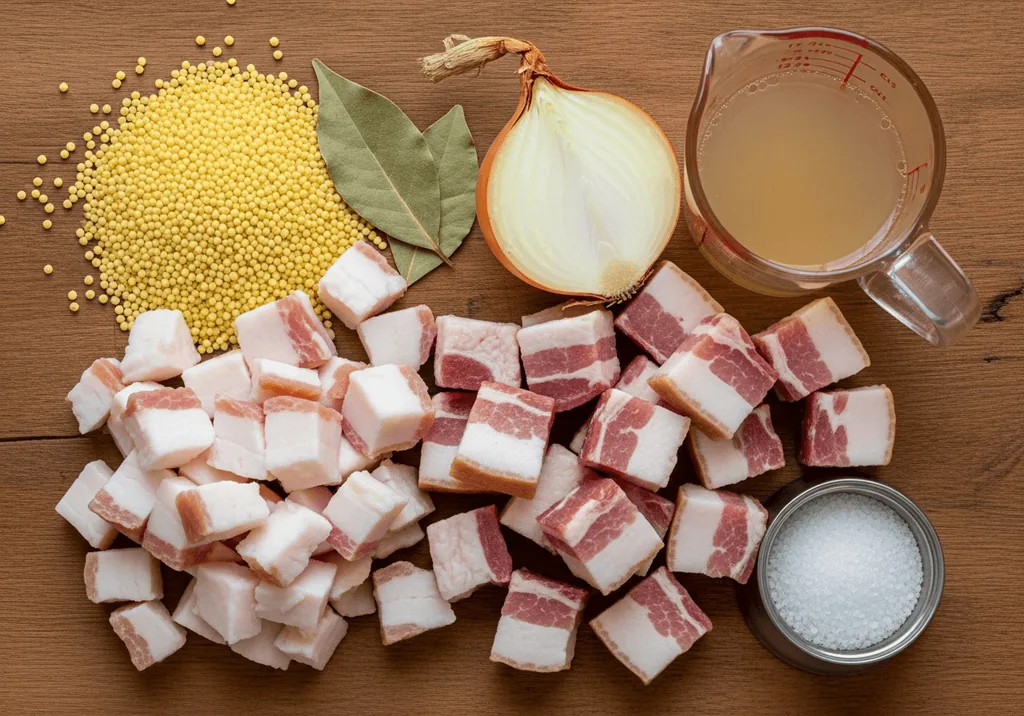
Dice salo, or a fattier cut like pork belly, and fry it slowly in a dry pan. Two things separate out: a pool of clear rendered fat, and small crisp brown pieces left behind once the fat has cooked out of them. Those pieces are shkvarky. They do double duty in the traditional kitchen: scattered over a finished dish for crunch and salt, and rendered down to cook the rest of the meal in, much the way schmaltz gets produced in the Ashkenazi kitchen next door, just starting from pork instead of poultry.
Where you will meet it on this site
Shkvarky sits right on top of a bowl of Traditional Banosh, the Hutsul cornmeal porridge, alongside bryndza cheese and melted butter, giving an otherwise soft, creamy dish its crunch. In Traditional Kulish, diced salo is rendered first and the millet cooks directly in that fat, the same fat that Cossack-era military ration records show was measured out by the kilogram because it stretched further than fresh meat. The same pairing of grain, fried onion and pork cracklings shows up historically in Traditional Ukrainian Holubtsi, where shkvarky filled the cabbage rolls long before rice and ground meat became standard. It’s also the traditional finishing touch wherever a savory Ukrainian dish needs a crisp, salty edge, including a fresh batch of Traditional Ukrainian Deruny straight out of the pan.
Lighter versions, and what changes
Salo and shkvarky are concentrated saturated fat and salt, so the healthy adaptations on this site don’t try to reproduce them exactly. Healthy Banosh cuts the pork by half and fills out the rest of the topping with sauteed mushrooms, which keep the dish’s savory weight without doubling down on the fat. The same logic carries over to the frying itself: Healthy Ukrainian Deruny uses a light hand with oil instead of rendered pork fat, keeping the crisp edge the dish is known for with a fraction of what salo would bring to the pan.
Further Reading & Sources
This entry draws on the sources below and on the recipes it links to elsewhere on this site. They are listed for readers who want to go further.
- “Traditional Foods.” Internet Encyclopedia of Ukraine. encyclopediaofukraine.com — cured pork fat among the staples of the Ukrainian table.
- “Hutsuls.” Internet Encyclopedia of Ukraine. encyclopediaofukraine.com — the Carpathian cooking where salo and cracklings do much of the work.
- “Best Cossack Traditional Dishes.” Etnocook. etnocook.com — salo as field provisions that keep without refrigeration.
Leave a Reply