
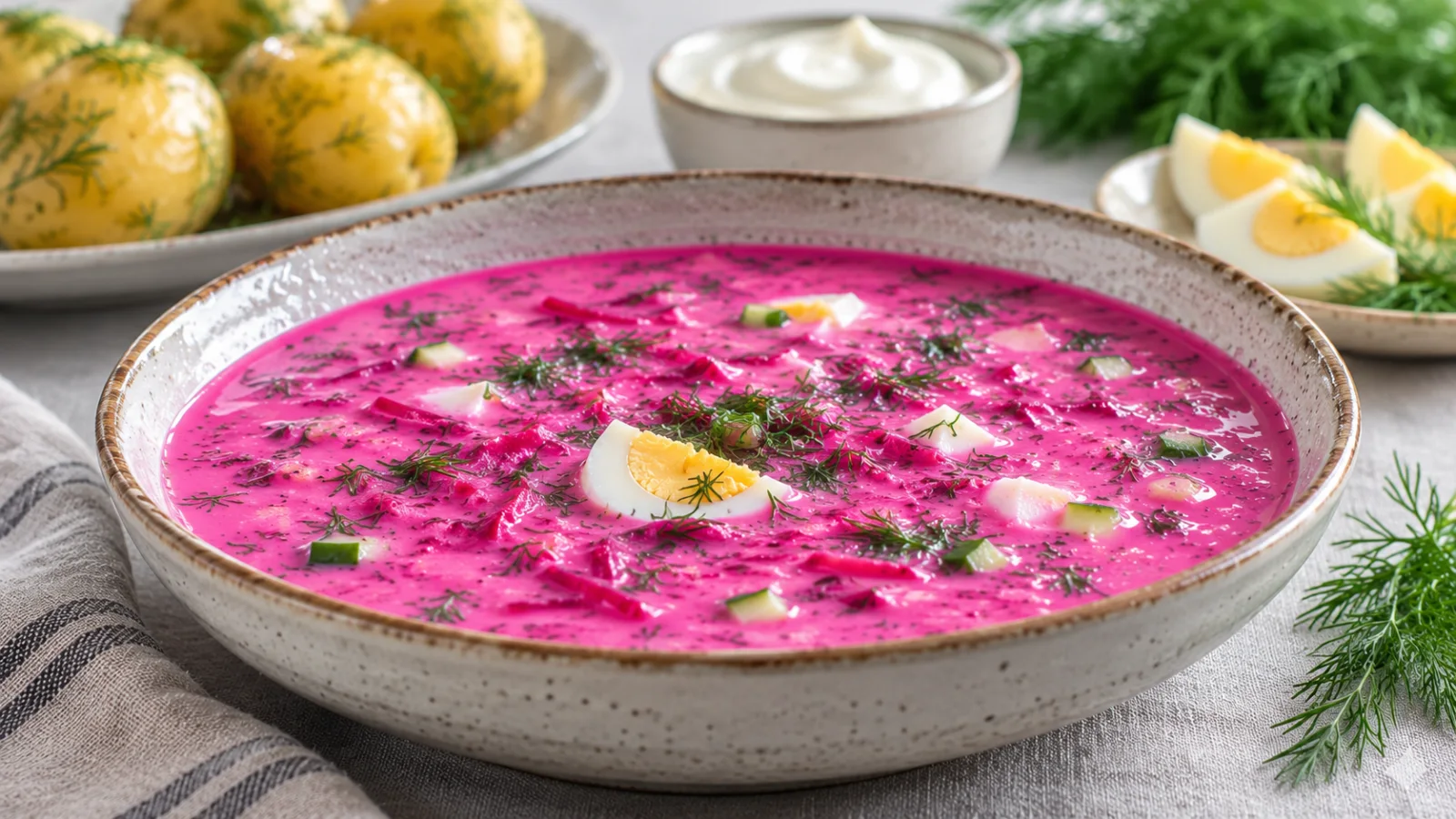
Active time: about 25 minutes, plus time for the beets to cool | Chill time: 1 hour minimum | Serves: 4 | Difficulty: Easy
Quick Overview
- Use low-fat kefir instead of whole-milk kefir for a real cut in saturated fat
- Cut the added salt by half and brighten the soup with fresh lemon juice
- Boil the potatoes with their skins on instead of peeling them, for extra fiber
- Serve a smaller potato portion and add more cucumber in its place
- The beets, dill, scallions, eggs, and the hot-potato tradition all stay exactly the same
What This Version Changes — and What It Keeps
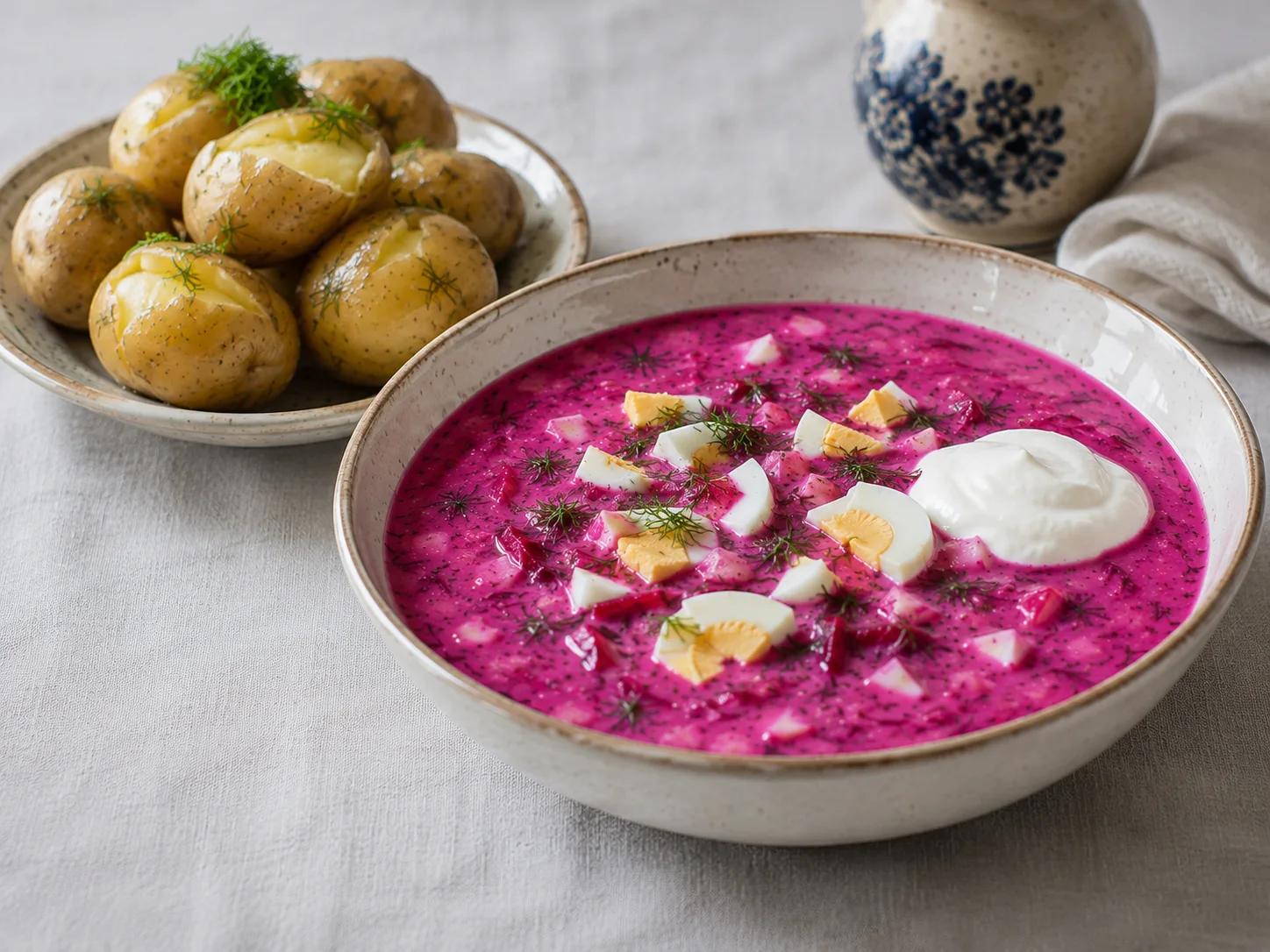
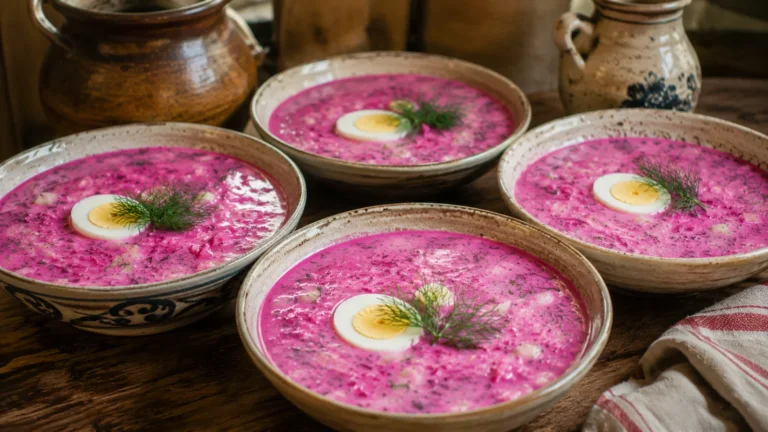
The core of the dish doesn’t move: grated beets stirred into a chilled, tangy kefir base, brightened with cucumber, dill, and scallions, and topped with hard-boiled egg. The soup is still served cold with a plate of hot potatoes on the side, and it’s still meant to be eaten the same way, alternating spoonfuls or dipping the potato straight in.
Three swaps do the actual work here: a lower-fat kefir base, a meaningful cut to the added salt balanced with fresh lemon juice, and a smaller, skin-on potato portion alongside a bit more cucumber. None of them change how the soup looks, tastes, or comes together in the kitchen.
Why These Swaps Work
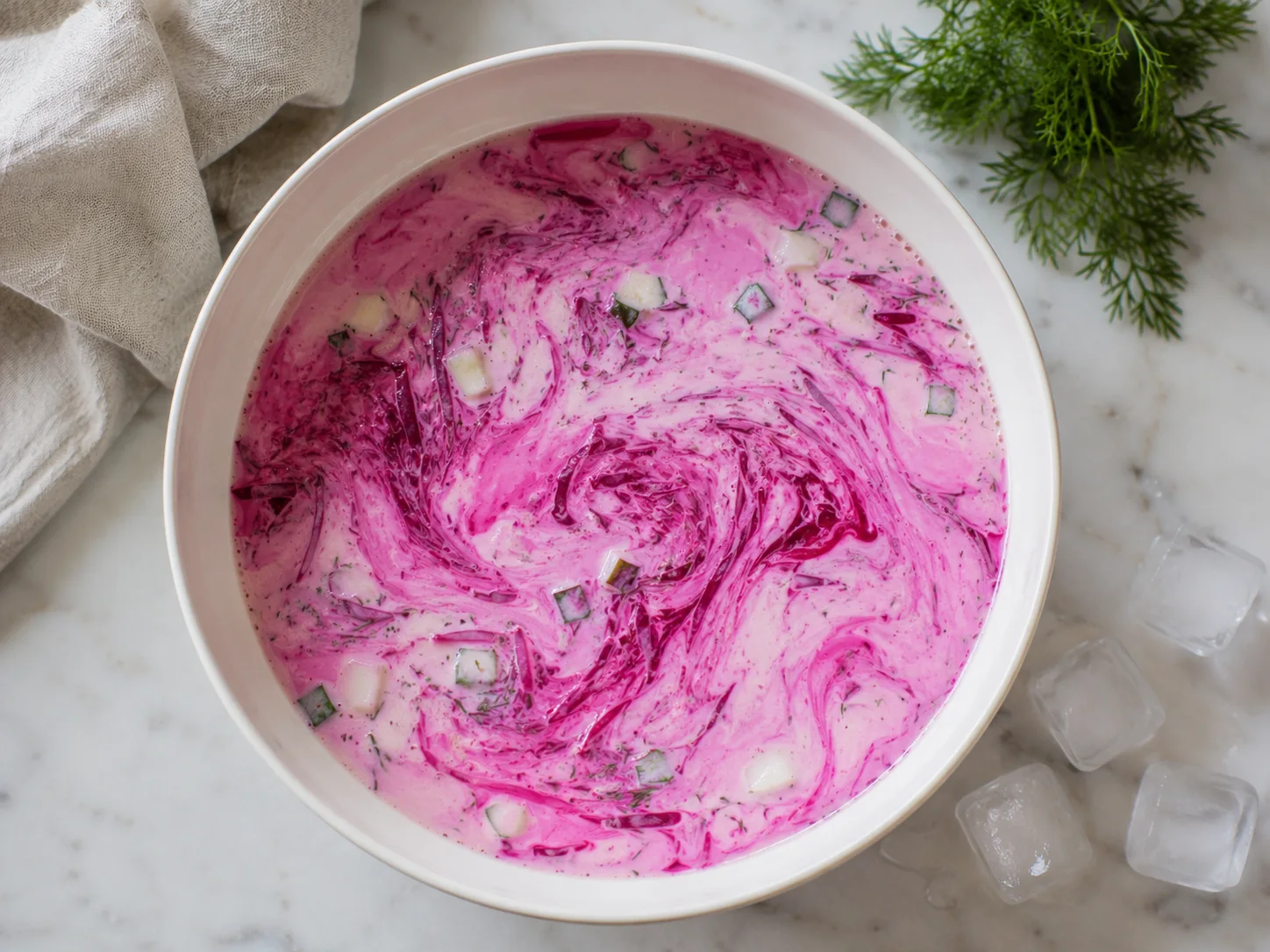
Switching to low-fat kefir removes a real share of saturated fat while keeping the same protein content and the same roughly dozen active probiotic strains that kefir gets from fermentation, not from the fat percentage of the milk.⁵ A cup of whole milk carries about 4.5 grams of saturated fat, and the American Heart Association recommends keeping total saturated fat under roughly 13 grams a day on a 2,000-calorie diet, so a full liter of whole-milk kefir can use up a large share of that budget in one bowl.³ The picture on dairy fat specifically has gotten more complicated in recent research, which suggests fermented dairy may not carry quite the same cardiovascular risk as other saturated fat sources, but the straightforward calorie and fat savings still make the lower-fat version the more cautious choice.³
Cutting the added salt by half and finishing the soup with lemon juice keeps the flavor balanced while meaningfully lowering sodium. Taste buds generally can’t detect a salt reduction of up to about 30 percent, and citrus activates some of the same taste receptors as sodium, so a splash of lemon juice can cover a bigger cut than most people expect.²
Keeping the potato skins on and trimming the portion slightly, while adding more cucumber, shifts part of the plate toward fiber and non-starchy vegetables. This works because the recipe already calls for small waxy potatoes, whose skin is thin and tender enough to eat as-is, the same way new potatoes are traditionally served in this region; a large, thick-skinned baking potato wouldn’t work the same way. Most of a potato’s modest fiber content sits in that peel, so scrubbing instead of peeling and eating the skin along with the flesh recovers something that would otherwise go in the compost, and a study across three large cohorts found that replacing a serving of boiled or baked potato with a serving of a non-starchy vegetable was linked to a lower risk of developing high blood pressure.¹ The extra fiber matters in the aggregate too, since most people eat well under the 25 to 35 grams recommended daily.⁴
Healthy Recipe
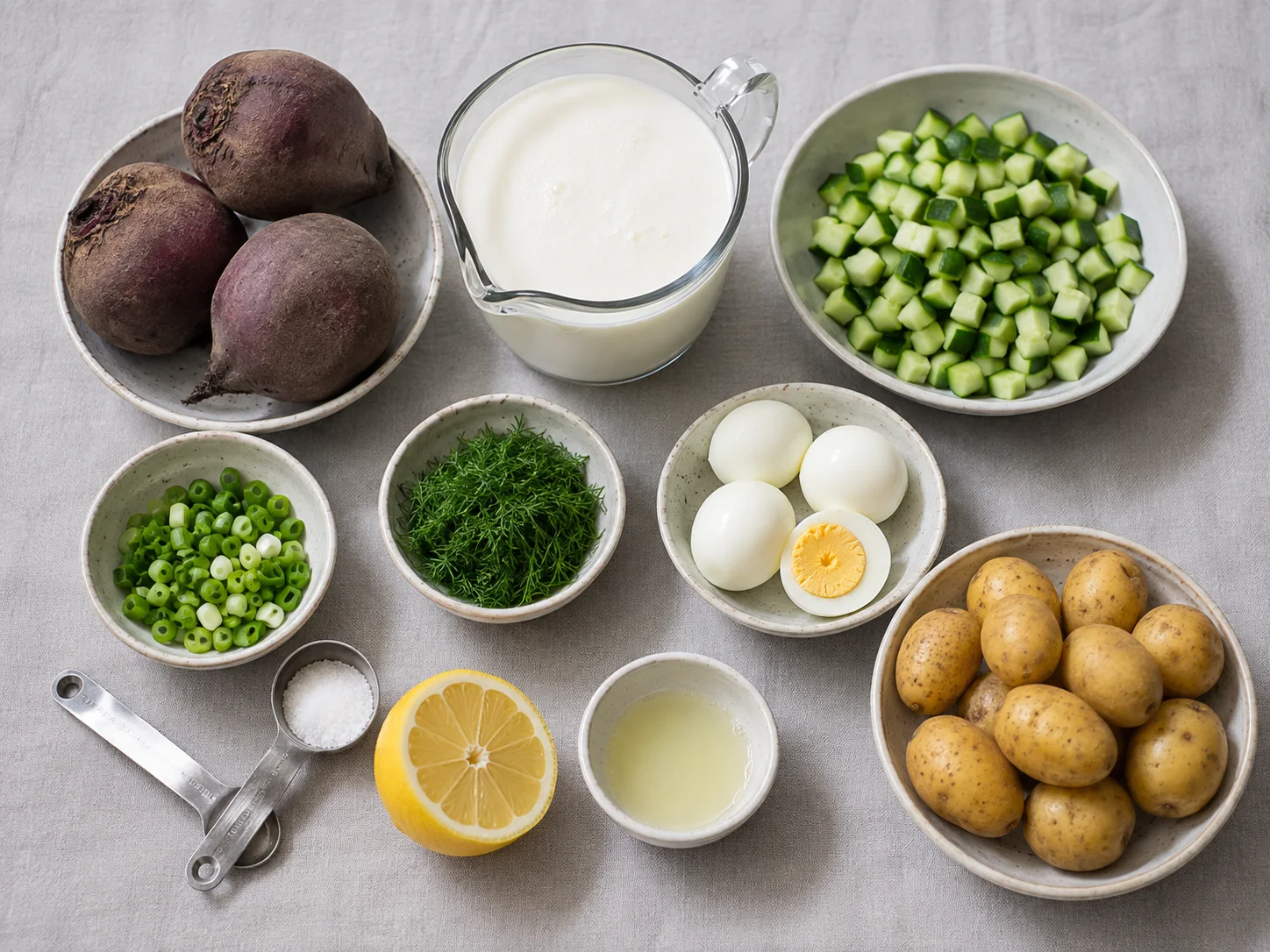
Ingredients (Serves 4)
- 500 g (1.1 lb) beets, about 3 medium, unpeeled
- 1 liter (4 cups) low-fat (1%) plain kefir, well chilled
- 400 g (14 oz) cucumber, about 2 large, diced
- 4-5 scallions (about 30 g/1 oz), thinly sliced
- 1 small bunch fresh dill (about 25 g/0.9 oz), finely chopped, plus more for garnish
- 4 large eggs, hard-boiled
- 1/2 tsp salt, or to taste
- 1-2 tbsp fresh lemon juice
- Cold water, as needed to thin
- 600 g (1.3 lb) small, thin-skinned waxy potatoes, unpeeled and well scrubbed
- Plain low-fat Greek yogurt, for serving, optional
Instructions
- Boil the beets. Place the unpeeled beets in a pot, cover with water, and boil until a knife slides through easily, 35 to 45 minutes depending on size. Drain, cool, peel, and coarsely grate.
- Prepare the vegetables. While the beets cook, dice the cucumber, thinly slice the scallions, and finely chop the dill.
- Hard-boil the eggs. Simmer the eggs for about 9 minutes, then cool in ice water, peel, and chop. Set aside a few slices for garnish.
- Combine the soup. Stir the grated beets into the chilled kefir in a large bowl or pot. Add the cucumber, scallions, dill, and most of the chopped egg, then stir in the salt and lemon juice.
- Adjust and chill. Thin with a little cold water if the soup seems too thick, then refrigerate for at least 1 hour, or until well chilled. Taste and add a touch more lemon juice if it needs brightening.
- Boil the potatoes. Scrub the potatoes well and boil them whole, skin on, in unsalted water until tender, about 15 to 20 minutes for small potatoes.
- Serve. Ladle the cold soup into bowls, top with the reserved egg and a sprinkle of dill, and serve immediately with the hot potatoes on the side.
Nutritional Comparison
Šaltibarščiai with Potatoes, Per Serving (1 of 4 Servings)
| Nutrient | Traditional | This Version |
|---|---|---|
| Calories | ~430–530 kcal | ~350–430 kcal |
| Protein | ~19–24g | ~19–23g |
| Total fat | ~13–16g | ~8–9g |
| Carbohydrates | ~62–76g | ~55–67g |
| Dietary fiber | ~6–7g | ~6–7g |
| Sodium | ~790–965mg | ~515–630mg |
Nutritional values are estimates calculated from the specific ingredient quantities in this recipe, using standard reference values. They will vary depending on the exact kefir product used, the size of the eggs, and how much salt and lemon juice are added.
Fat shows the biggest swing, dropping by roughly 40 percent, with sodium down by about a third. Both moves came from real changes to the ingredients themselves, a different kefir and half the salt, not from shrinking the soup portion.
Protein barely moves, since kefir’s protein content doesn’t depend on its fat content, and fiber holds essentially steady. The skin-on, more-cucumber approach roughly offsets what the smaller potato portion loses, rather than adding a dramatic fiber boost.
Storage and Reheating
The soup keeps for up to 2 days in the refrigerator in an airtight container, the same as the traditional version. It isn’t suitable for freezing, since the kefir separates and the cucumber turns watery once thawed.
The soup is never reheated, since it’s meant to be eaten cold. Boil the potatoes fresh for each serving where possible, since a skin-on potato reheats a little less evenly than a peeled one.
Healthy Šaltibarščiai

Ingredients
Ingredients (Serves 4)
- 500 g (1.1 lb) beets, about 3 medium, unpeeled
- 1 liter (4 cups) low-fat (1%) plain kefir, well chilled
- 400 g (14 oz) cucumber, about 2 large, diced
- 4-5 scallions (about 30 g/1 oz), thinly sliced
- 1 small bunch fresh dill (about 25 g/0.9 oz), finely chopped, plus more for garnish
- 4 large eggs, hard-boiled
- 1/2 tsp salt, or to taste
- 1-2 tbsp fresh lemon juice
- Cold water, as needed to thin
- 600 g (1.3 lb) small, thin-skinned waxy potatoes, unpeeled and well scrubbed
- Plain low-fat Greek yogurt, for serving, optional
Instructions
- Boil the beets until tender, then cool, peel, and grate them
- Stir the grated beets into cold kefir along with cucumber, scallions, and dill
- Season with lemon juice and salt, then mix in most of the chopped hard-boiled egg
- Chill the soup until thoroughly cold
- Boil the potatoes skin-on separately to serve hot alongside the cold soup
- Ladle into bowls, garnish with reserved egg and dill, and serve immediately
Frequently Asked Questions
Does low-fat kefir taste different from whole-milk kefir?
It’s a little thinner and slightly less rich, but the tang and the probiotic content come through the same way. Once the beets, dill, and lemon are mixed in, most people don’t notice much of a difference.
Will cutting the salt in half make the soup taste bland?
Not with the lemon juice added. Citrus can cover a noticeable salt reduction without the soup tasting flat, and taste buds barely register cuts under about 30 percent in the first place.²
Why keep the potato skin on instead of peeling it?
Most of a potato’s fiber lives in the peel, so scrubbing instead of peeling keeps nutrients that would otherwise be thrown away.¹ This only works cleanly with small waxy potatoes, since their skin is thin and tender enough to eat without a second thought, the same way new potatoes are commonly served across the region already. A large, thick-skinned baking potato would be a different story.
Can Greek yogurt replace the sour cream garnish?
Yes, plain low-fat Greek yogurt has a similar tang and thick texture and works well as a topping if a garnish is wanted at all, though it isn’t part of the base recipe either way.
Does this version still contain the same probiotics as the traditional recipe?
Yes. Kefir’s roughly dozen active probiotic strains come from the fermentation process itself, not from the fat content of the milk, so switching to a low-fat kefir doesn’t reduce them.⁵
Is this version low in sodium?
It’s meaningfully lower than the traditional version, but at roughly 515 to 630mg per serving it’s still a real contributor to a day’s sodium intake, not a low-sodium dish outright.
Can these swaps be used individually, without making the whole recipe over?
Yes. The kefir swap, the salt-and-lemon adjustment, and the skin-on potato all work as standalone changes to the traditional recipe, without needing to adopt all three at once.
Looking for the Traditional Version?
This recipe is a set of targeted swaps on an already fairly light dish. For the full story behind šaltibarščiai, including its disputed Grand Duchy origins and the Vilnius festival held in its honor, along with the classic whole-milk version, see Heritage Healthy Kitchen’s Traditional Šaltibarščiai article.
Further Reading & Sources
The following sources were consulted in developing and verifying the health claims behind these swaps. Heritage Healthy Kitchen’s recipe was developed independently; these links are provided for readers who want to explore further.
- “Are Potatoes Healthy?” The Nutrition Source, Harvard T.H. Chan School of Public Health. nutritionsource.hsph.harvard.edu/potatoes — fiber content of potato skin, and a cohort study on replacing potato servings with non-starchy vegetables.
- “Take Action: How to Reduce Your Sodium Intake.” The Nutrition Source, Harvard T.H. Chan School of Public Health. nutritionsource.hsph.harvard.edu/salt-and-sodium — the roughly 30 percent salt-reduction threshold and the use of citrus to offset lower sodium.
- “Is low-fat or full-fat the better choice for dairy products?” Harvard Health Publishing, Harvard Medical School. health.harvard.edu — saturated fat content of dairy, AHA daily limits, and recent research on fermented dairy specifically.
- “Fiber.” The Nutrition Source, Harvard T.H. Chan School of Public Health. nutritionsource.hsph.harvard.edu/carbohydrates/fiber — recommended daily fiber intake and the typical shortfall in most diets.
- “Is Drinking Kefir Healthy for You?” Cleveland Clinic Health Essentials. health.clevelandclinic.org — kefir’s probiotic content and how it relates to the fermentation process rather than fat content.
Disclaimer
The information in this article is provided for educational and informational purposes only. Heritage Healthy Kitchen makes no representations or warranties regarding the accuracy or completeness of any content on this site. Nutritional values are estimates only and will vary depending on the specific ingredients, brands, and measurements used. This content is not intended as dietary, medical, or professional nutritional advice. Always consult a qualified healthcare provider regarding any dietary needs or health conditions. Heritage Healthy Kitchen is not responsible for any outcomes resulting from the use of recipes or information published on this site.
You Might Also Like
More heritage recipes from our kitchen

Leave a Reply