
Active time: ~40 minutes | Total time: ~50 minutes | Serves: 8 (about 32 spurgos) | Difficulty: Easy
Quick Overview
- Press curd cheese through a sieve and beat it with eggs and sugar
- Stir in flour and baking powder until the dough just holds its shape
- Roll walnut-sized balls with wet hands
- Fry them in oil at 165–175°C until golden all over
- Dust with powdered sugar and serve warm
What Spurgos Are
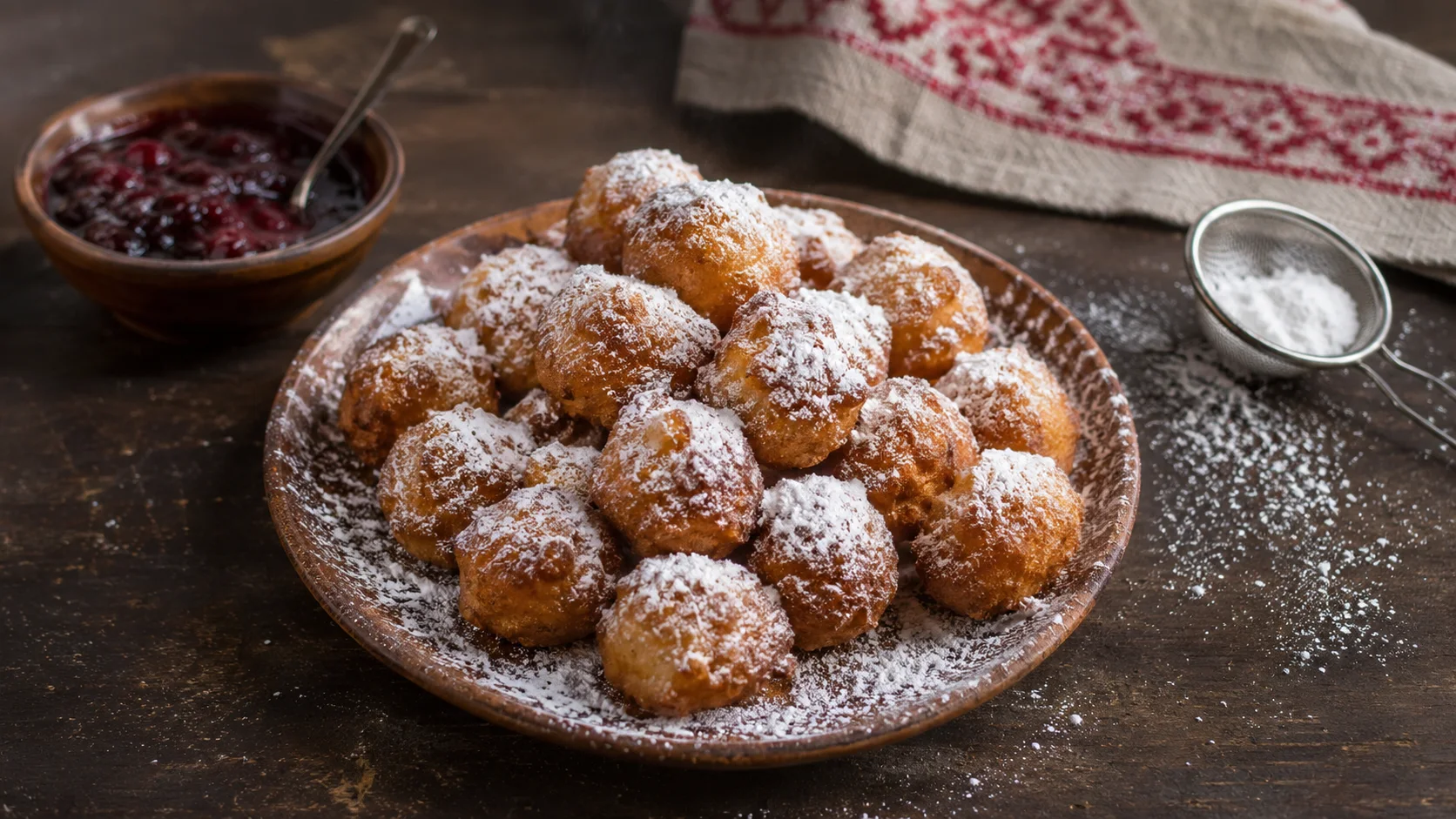
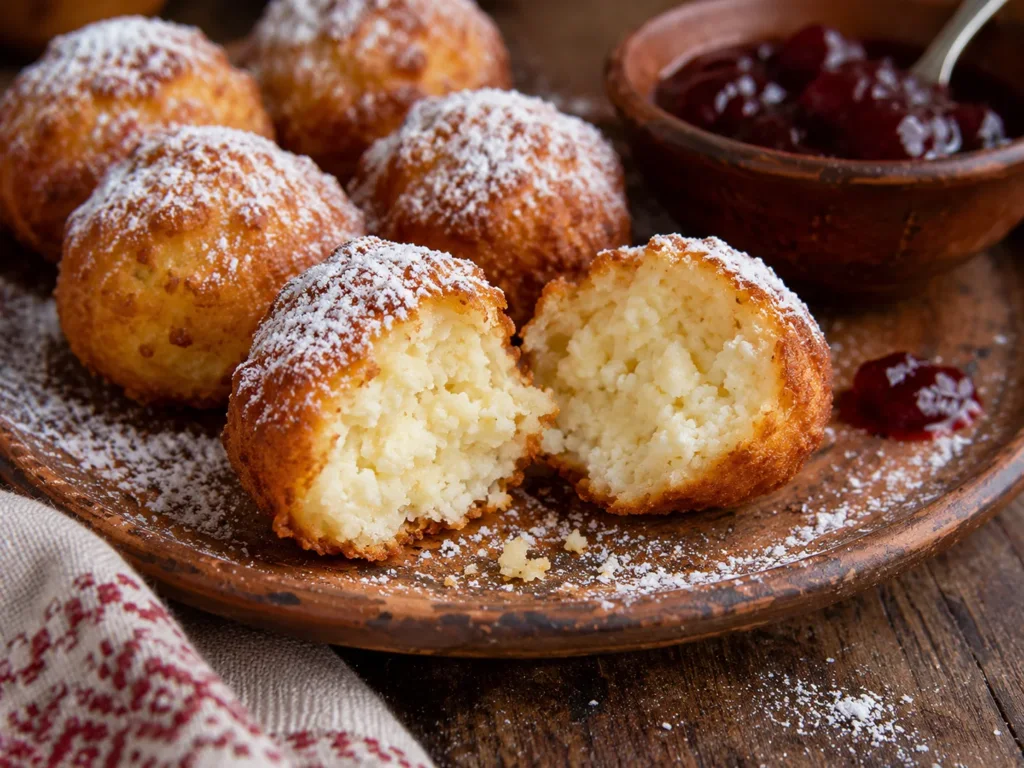
Spurgos is simply the Lithuanian word for doughnuts, but in Lithuania it usually means varškės spurgos: small balls of dough that are mostly curd cheese, held together with eggs and a little flour, fried and dusted with sugar.¹ Each one is about the size of a walnut, with a thin, lightly crisp golden crust and a soft, fluffy inside. They are best eaten warm, with jam on the side.²˒³ Families make them for holidays and special occasions,¹ and Lithuanian recipe writers like to call them a taste of childhood.³˒⁴
Lithuanian cooks also make a yeast version filled with jam, a close cousin of Polish pączki. Both recipes are below, the curd cheese one first.
History and Cultural Roots
Kaunas has a reputation as a doughnut city, and a recipe presented on Lithuanian television as an authentic interwar Kaunas one turns out to be a curd cheese dough, only a little stiffer than the one below.⁵
On the Užgavėnės Table
The big day for spurgos is Užgavėnės, the Lithuanian Shrovetide, on the Tuesday before Ash Wednesday. It closes the long meat-eating season that begins at Christmas, and the Lenten fast starts the next day.⁶ As Prof. L. Klimka explains, people saw winter off by eating their fill from the last of the stores. Pancakes rule the day, but spurgos are on his list of traditional Užgavėnės foods too, next to šiupinys (a porridge of grains and peas) and scrambled eggs.⁶˒⁷˒⁸ In Vilnius at the turn of the 20th century, the holiday table held pancakes, doughnuts, dumplings and angel wings.⁸
The custom traveled with Lithuanian emigrants. A 1998 Užgavėnės recipe column in a Lithuanian-American newspaper was named after spurgos,⁹ and in 2025 Lithuanian television was still presenting curd cheese spurgos as a good choice for the holiday.¹⁰
Traditional Spurgos Recipe
This recipe was compiled by Heritage Healthy Kitchen from a comparison of published recipes; the sources are listed at the end of this article. Figures that are Heritage Healthy Kitchen’s own estimates rather than taken from a published source are marked as such.
These are small spurgos, about 25–30g each, fried in oil at 165–175°C.²˒³ Some cooks use more eggs, up to 4 for 500g of curd,⁵˒¹¹ and some far less flour, from a few spoonfuls to about 100g, for a softer dough.⁴˒¹¹
Ingredients
Makes about 32 spurgos (our estimate), serves 8
- 500g (about 2 cups) Lithuanian curd cheese (varškė), ideally about 9% fat, or farmer cheese or quark²˒³˒⁵
- 2 eggs²˒³˒⁴
- 80g (about ⅓ cup) sugar²˒³
- 1 teaspoon vanilla sugar²˒³˒⁴
- A pinch of salt²˒³˒⁴
- 300g (about 2⅓ cups) all-purpose flour, plus up to 30g (¼ cup) more if the dough is too soft²˒³
- 1 teaspoon baking powder²˒³˒⁴
- 700ml–1 liter (3–4 cups) neutral oil, such as sunflower, for frying²˒³
- 25g (¼ cup) powdered sugar, for dusting²˒³˒⁴
Instructions
- Prepare the curd. Press the curd cheese through a sieve so the dough is smooth, with no lumps. If it is wet, let it drain for a while first.²˒⁴˒⁵
- Mix the base. Whisk the eggs with the sugar, vanilla sugar and salt for 2 to 3 minutes, then stir in the curd until smooth.²˒³˒⁵
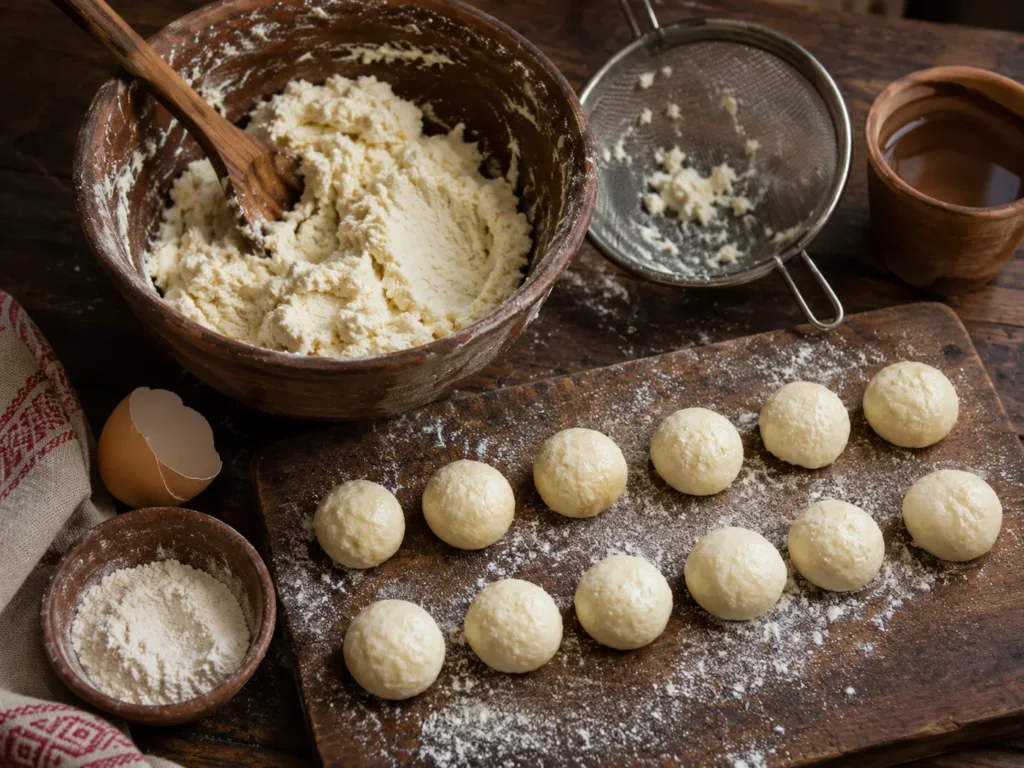
- Add the flour. Mix the flour with the baking powder and add it in portions, stirring only until you have a soft dough that is barely sticky and can be shaped with wet hands. Add the extra flour only if the dough won’t hold a shape.²˒³˒⁵
- Shape the balls. With wet hands, roll the dough into balls of about 25–30g each, roughly the size of a walnut. Keep them all about the same size.²˒³˒⁴
- Heat the oil. Heat the oil in a deep pot to 165–175°C (330–345°F). The oil should come no more than halfway up the pot.²˒³
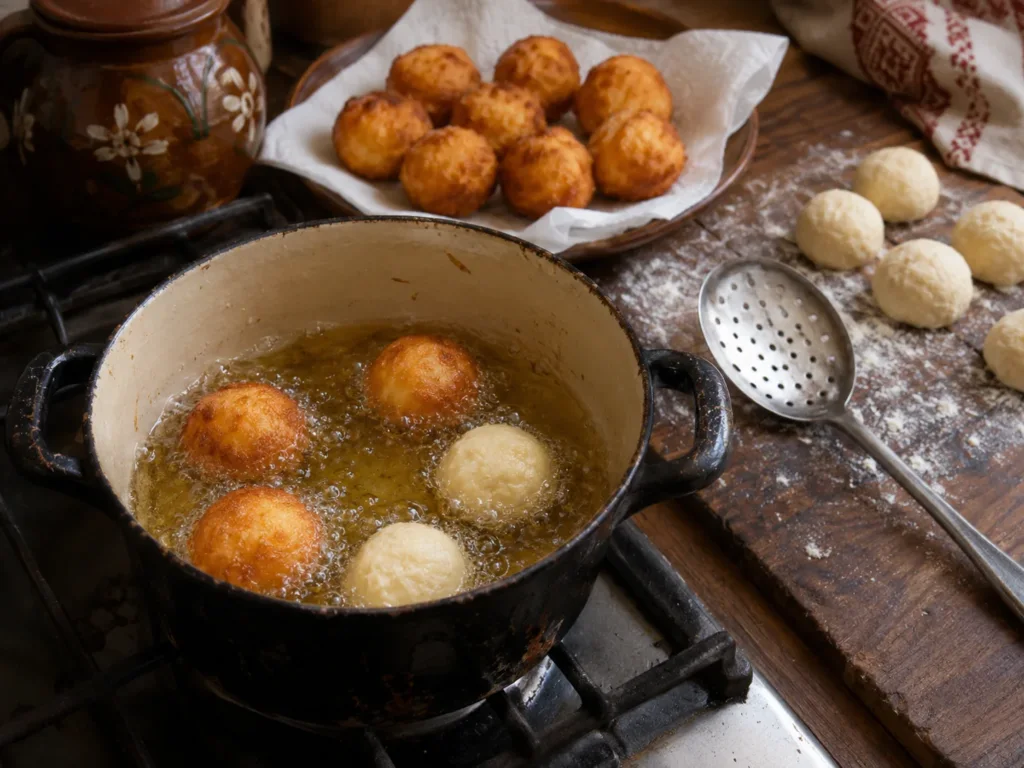
- Fry. Fry a few balls at a time for 4 to 7 minutes, turning them, until evenly golden all over. Cut the first one open to check the center: it should be fluffy, with no raw, sticky dough. With a thermometer, the center should reach at least 74°C (165°F).²˒³
- Drain and dust. Lift them onto paper towels to drain, then dust with powdered sugar.²˒³˒⁴
Yeast Spurgos with Jam
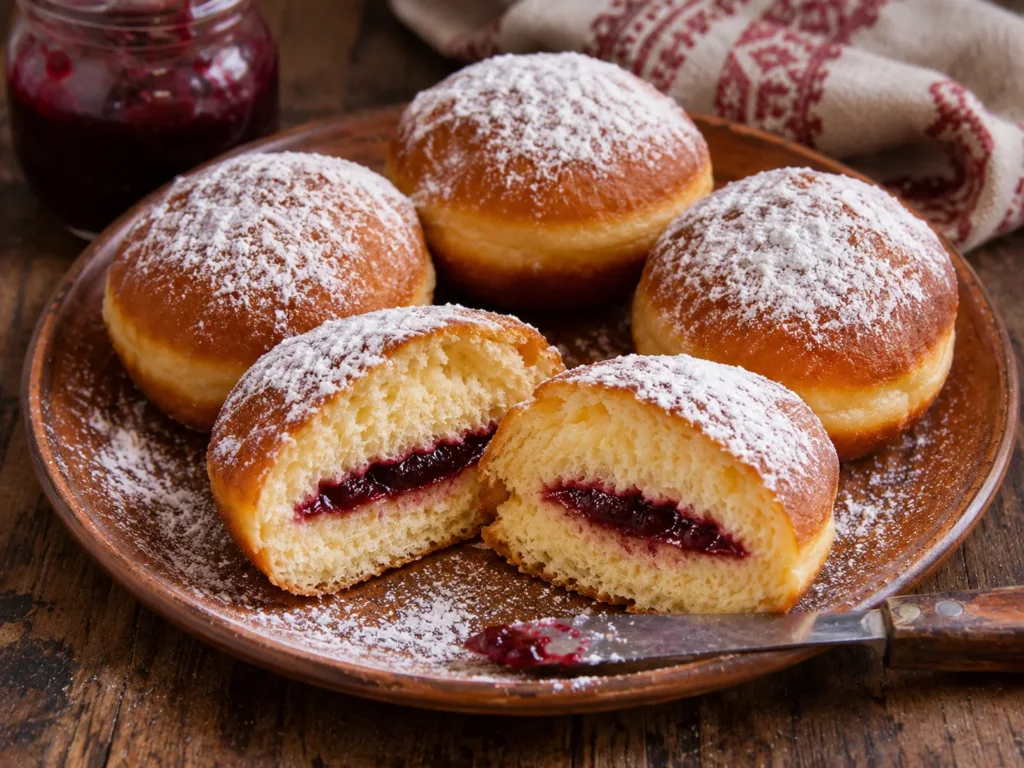
Yeast spurgos (mielinės spurgos, also called pampuškos or pončkos) take longer. An enriched dough rises twice, then rounds of it are sealed around a spoonful of jam and fried.⁹˒¹²˒¹³ Our Traditional Pączki recipe goes into the technique in more detail.
Makes about 16 doughnuts (our estimate)
- 500g (about 4 cups) all-purpose flour⁹˒¹²˒¹³
- 250ml (1 cup) whole milk, lukewarm⁹˒¹²˒¹³
- 70g (⅓ cup) sugar¹³
- 60g (4 tablespoons) butter, melted⁹˒¹³
- 2 eggs, beaten⁹
- 25g fresh yeast, or 7g (2¼ teaspoons) instant yeast (our conversion)¹²
- ½ teaspoon salt¹³
- 1 tablespoon rum (optional)⁹
- About 130g (6 tablespoons) thick jam, such as cherry, plum or raspberry¹²˒¹³
- 1 egg white, lightly beaten, for sealing¹³
- Neutral oil for frying, and powdered sugar for dusting⁹˒¹³
- Start the yeast. Dissolve the yeast in a few tablespoons of the lukewarm milk and let it stand for about 5 minutes.¹³
- Make the dough. Stir in the rest of the milk, the melted butter, the eggs and the rum. Mix the flour with the sugar and salt and add it gradually. The dough will be soft. Knead it until smooth.⁹˒¹³
- First rise. Cover the dough and leave it in a warm place until doubled, about 1 hour by our estimate.⁹˒¹³
- Cut and fill. Punch the dough down and roll half of it on a floured board to about 6mm (¼ inch). Cut 7.5cm (3-inch) rounds. Put a teaspoon of jam in the center of half the rounds, brush the edges with egg white, cover with a second round and press the edges together. Repeat with the rest of the dough.¹³
- Second rise. Cover with a towel and let the doughnuts rise until doubled, about 30 to 45 minutes by our estimate.¹³
- Fry. Heat 5cm (2 inches) of oil to 175°C (350°F). Lower the doughnuts in top side down and fry for about 4 minutes, turning them gently, until golden brown.¹³
- Drain and dust. Drain on paper towels and dust with powdered sugar.⁹˒¹³
Kitchen Tips
Watch the oil temperature. The most common problem with curd spurgos is a raw center under a brown crust, and the usual cause is oil that is too hot, at 180–190°C or above. The outside colors before the heat reaches the middle.³ Oil that is too cool has the opposite effect: the spurgos soak up fat.²
Keep them small. Large balls need longer than the crust can take, so stay at 25–30g and make them all the same size.²˒³
Don’t add too much flour. A stiff dough gives dense spurgos that cook unevenly, and long kneading makes them harder too. Stop when the dough holds its shape with wet hands.²˒³
Mind the moisture of the curd. Very wet curd makes a slack dough that needs more flour, so drain it first, or stir in a spoonful of semolina. Very dry curd can make the spurgos crumbly.²˒³
Fry in small batches. Give the spurgos room to roll in the oil and turn them now and then, so they color evenly on all sides.²˒³
Nutritional Information
Curd cheese spurgos, per serving of 4 (1 of 8), dusted with sugar
- Calories: approximately 320–440 kcal
- Protein: approximately 12g
- Total fat: approximately 14–19g
- Saturated fat: approximately 2–3g
- Carbohydrates: approximately 45g
- Sugars: approximately 16g
For a lighter version, bake the spurgos at 180°C (356°F) for 15 to 18 minutes, or air-fry them at 175°C (347°F) for 10 to 12 minutes.² Made that way, with about a tablespoon of oil for the whole batch, a serving comes to approximately 260–310 kcal and 6g of fat, with the same 12g of protein.
Yeast spurgos with jam, per doughnut
- Calories: approximately 230–300 kcal
- Protein: approximately 5g
- Total fat: approximately 10–12g
- Saturated fat: approximately 3g
- Carbohydrates: approximately 37g
- Sugars: approximately 11g
The figures for fried spurgos assume they take up 8 to 12% of the dough’s weight in oil (our estimate).
Nutritional values are estimates based on standard ingredient databases (USDA FoodData Central). They vary with the fat content of the curd, the size of the balls and how much oil they take up.
Storage and Reheating
Curd spurgos are best still slightly warm.³ Kept in an airtight container, they last 1 to 2 days. To refresh them, warm them in the oven at 150°C (300°F) for about 5 minutes; a microwave also works but leaves them softer.² Yeast spurgos are best eaten the day they are made, by our estimate.
Traditional Varškės Spurgos (Curd Cheese Donuts)

Ingredients
For the dough
- 500g (about 2 cups) Lithuanian curd cheese (varškė), ideally about 9% fat, or farmer cheese or quark
- 2 eggs
- 80g (about ⅓ cup) sugar
- 1 teaspoon vanilla sugar
- A pinch of salt
- 300g (about 2⅓ cups) all-purpose flour, plus up to 30g (¼ cup) more if the dough is too soft
- 1 teaspoon baking powder
- 700ml–1 liter (3–4 cups) neutral oil, such as sunflower, for frying
- 25g (¼ cup) powdered sugar, for dusting
Instructions
- Press the curd cheese through a sieve; if it is wet, drain it first.
- Whisk the eggs with the sugar, vanilla sugar and salt for 2–3 minutes, then stir in the curd until smooth.
- Add the flour mixed with the baking powder in portions, stirring only until the dough is soft and can be shaped with wet hands.
- With wet hands, roll balls of 25–30g each, about the size of a walnut.
- Heat the oil in a deep pot to 165–175°C (330–345°F); it should come no more than halfway up the pot.
- Fry a few at a time for 4–7 minutes, turning, until evenly golden; cut the first one open to check that the center is cooked.
- Drain on paper towels and dust with powdered sugar.
Traditional Yeast Spurgos with Jam
Ingredients
For the doughnuts
- 500g (about 4 cups) all-purpose flour
- 250ml (1 cup) whole milk, lukewarm
- 70g (⅓ cup) sugar
- 60g (4 tablespoons) butter, melted
- 2 eggs, beaten
- 25g fresh yeast, or 7g (2¼ teaspoons) instant yeast (our conversion)
- ½ teaspoon salt
- 1 tablespoon rum (optional)
- About 130g (6 tablespoons) thick jam, such as cherry, plum or raspberry
- 1 egg white, lightly beaten, for sealing
- Neutral oil for frying, and powdered sugar for dusting
Instructions
- Dissolve the yeast in a few tablespoons of the lukewarm milk and let it stand for about 5 minutes.
- Stir in the rest of the milk, the melted butter, eggs and rum, then add the flour mixed with the sugar and salt; knead until smooth.
- Cover and leave in a warm place until doubled, about 1 hour.
- Roll the dough to 6mm (¼ inch) and cut 7.5cm (3-inch) rounds. Put a teaspoon of jam on half of them, brush the edges with egg white, cover with a second round and press to seal.
- Cover with a towel and let rise until doubled, 30–45 minutes.
- Fry in 5cm (2 inches) of oil at 175°C (350°F), top side down first, for about 4 minutes, turning gently, until golden brown.
- Drain on paper towels and dust with powdered sugar.
Frequently Asked Questions
What cheese can I use if I can’t find Lithuanian varškė?
Look for a dry, fresh curd cheese such as farmer cheese or quark.¹ Curd of about 9% fat works best,³˒⁵ though anything up to 18% will do.² If your cheese is wet, drain it briefly or stir in a spoonful of semolina, then press it through a sieve.²˒⁴
Why are my spurgos raw inside?
Usually the oil is too hot, so the crust browns before the center cooks. Balls that are too large, a dough with too much flour, or very wet curd cause the same problem. Keep the oil at 165–175°C, the balls at 25–30g, and cut the first one open to check.³
Do curd cheese spurgos need baking powder?
Yes. About a teaspoon of baking powder for 400–500g of curd is usual,²˒³˒⁴ and some recipes use half a teaspoon.⁵
Can I bake spurgos instead of frying them?
Yes. Bake them at 180°C for 15 to 18 minutes, or cook them in an air fryer at 175°C for 10 to 12 minutes; a light spray of oil at the end gives a crisper surface. They come out lighter than fried ones (see Nutritional Information).²
How are curd cheese spurgos different from yeast spurgos?
Curd spurgos are quick: a soft dough of curd cheese, eggs and a little flour, raised with baking powder and fried straight away. Yeast spurgos are made from an enriched yeast dough that rises twice and is usually filled with jam, much like Polish pączki.²˒⁹˒¹³
When are spurgos eaten in Lithuania?
They are made for holidays and special occasions, and they are one of the traditional foods of Užgavėnės, the Lithuanian Shrovetide before Lent.¹˒⁷˒¹⁰
Further Reading & Sources
The recipe is a compilation based on the published recipes listed here; these links are provided for readers who want to explore further.
- Pinel, Florian. “Varškės Spurgos, Lithuanian Farmer Cheese Fritters.” Food Perestroika, May 16, 2018. foodperestroika.com
- Zinkevičius, Kęstutis. “Varškės spurgos: paprasta klasika, kuri visada pavyksta” [Curd cheese doughnuts: a simple classic that always works]. Kanapių ūkis (family farm website), August 22, 2025. kanapiuukis.lt
- Samanta (author named by first name only). “Varškės spurgos: kaip iškepti purias, kad vidus neliktų žalias” [Curd cheese doughnuts: how to fry them fluffy without a raw center]. TavoVaikas.lt, October 24, 2026. tavovaikas.lt
- Ingrida (blog Kviečiu į virtuvę; surname not given). “Burnoje tirpstančios purios varškės spurgos” [Soft, melt-in-the-mouth curd cheese doughnuts]. tv3.lt, January 25, 2026. tv3.lt
- tv3.lt (no byline; recipe from the TV3 program Maisto kelias. Miestų receptai). “Atskleidė burnoje tirpstančių autentiškų Kauno spurgų receptą” [An authentic Kaunas doughnut recipe]. tv3.lt, August 9, 2025. tv3.lt
- Visuotinė lietuvių enciklopedija [Universal Lithuanian Encyclopedia]. “Užgavėnės” (no author named on the page). vle.lt
- Sinicė, Alina. “Užgavėnės – nuo akmens amžiaus iki šių dienų” [Užgavėnės from the Stone Age to the present day], quoting Prof. L. Klimka. Alkas.lt, February 7, 2016. alkas.lt
- Šaknys, Žilvytis. “Užgavėnės: A Rural and Urban, Religious, Socialist, and Lithuanian Festival of Shrovetide.” Folklore: Electronic Journal of Folklore, vol. 60, 2015, pp. 105–128. DOI 10.7592/FEJF2015.60.shaknys. folklore.ee
- Siliūnas, Dana. “Let’s Cook Lithuanian: ‘Spurgos’ and Other Užgavėnės Dishes.” Draugas, January 15, 1998. draugas.org
- LRT Televizija. “Beatos virtuvės hitas – varškės spurgytės: puikiai tiks pasilepinimui ir Užgavėnėms” [Curd cheese doughnuts, a treat that suits Užgavėnės], episode of Beatos virtuvė, March 1, 2025. lrt.lt
- Nicholson, Beata. “Beatos Nicholson virtuvėje – receptas iš vaikystės: kvapnios varškės spurgos su obuoliais” [A recipe from childhood: curd cheese doughnuts with apples]. LRT, November 15, 2019 (ingredients on the page; method in the broadcast). lrt.lt
- Baltrušaitienė, Jolanta, family recipe presented on Beatos virtuvė. “Beatos Nicholson virtuvėje – ypatingos naminės spurgos su įdaru” [Special homemade filled doughnuts]. LRT, March 1, 2019. lrt.lt
- Draugas (no byline). “Sweet delights for your Easter table” (Lithuanian Doughnuts, Spurgos). Draugas, March 15, 2011. draugas.org
Disclaimer
The information in this article is provided for educational and informational purposes only. Heritage Healthy Kitchen makes no representations or warranties regarding the accuracy or completeness of any content on this site. Nutritional values are estimates only and will vary depending on the specific ingredients, brands, and measurements used. This content is not intended as dietary, medical, or professional nutritional advice. Always consult a qualified healthcare provider regarding any dietary needs or health conditions. Heritage Healthy Kitchen is not responsible for any outcomes resulting from the use of recipes or information published on this site.
You Might Also Like
More heritage recipes from our kitchen


Leave a Reply