
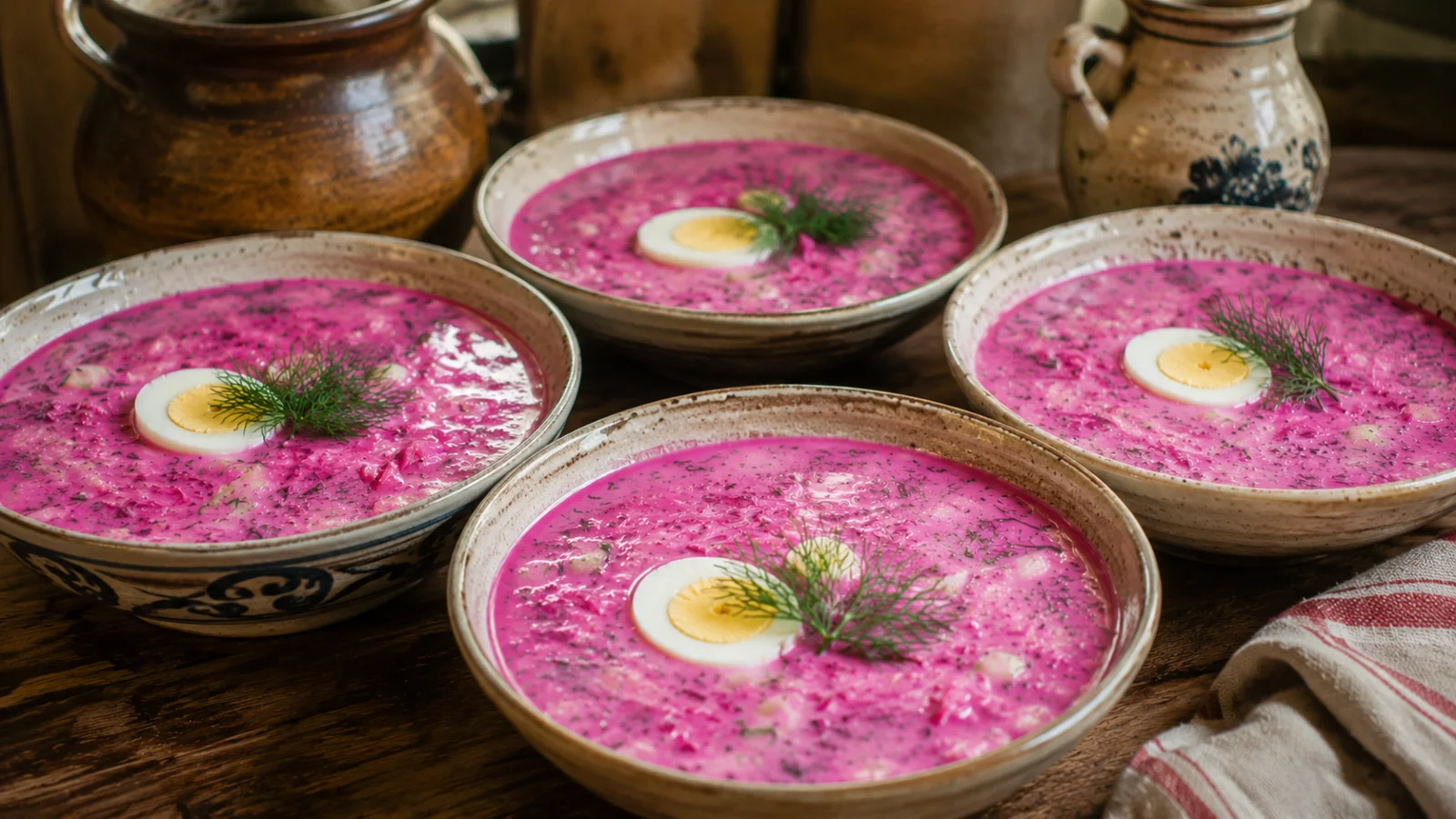
Active time: about 25 minutes, plus time for the beets to cool | Chill time: 1 hour minimum | Serves: 4 | Difficulty: Easy
Quick Overview
- Boil the beets until tender, then cool, peel, and grate them
- Stir the grated beets into cold kefir along with cucumber, scallions, and dill
- Mix in chopped hard-boiled egg and season with salt
- Chill the soup until thoroughly cold and deeply pink
- Boil potatoes separately to serve hot alongside the cold soup
- Ladle into bowls, garnish with extra dill or egg, and serve immediately
What Šaltibarščiai Is
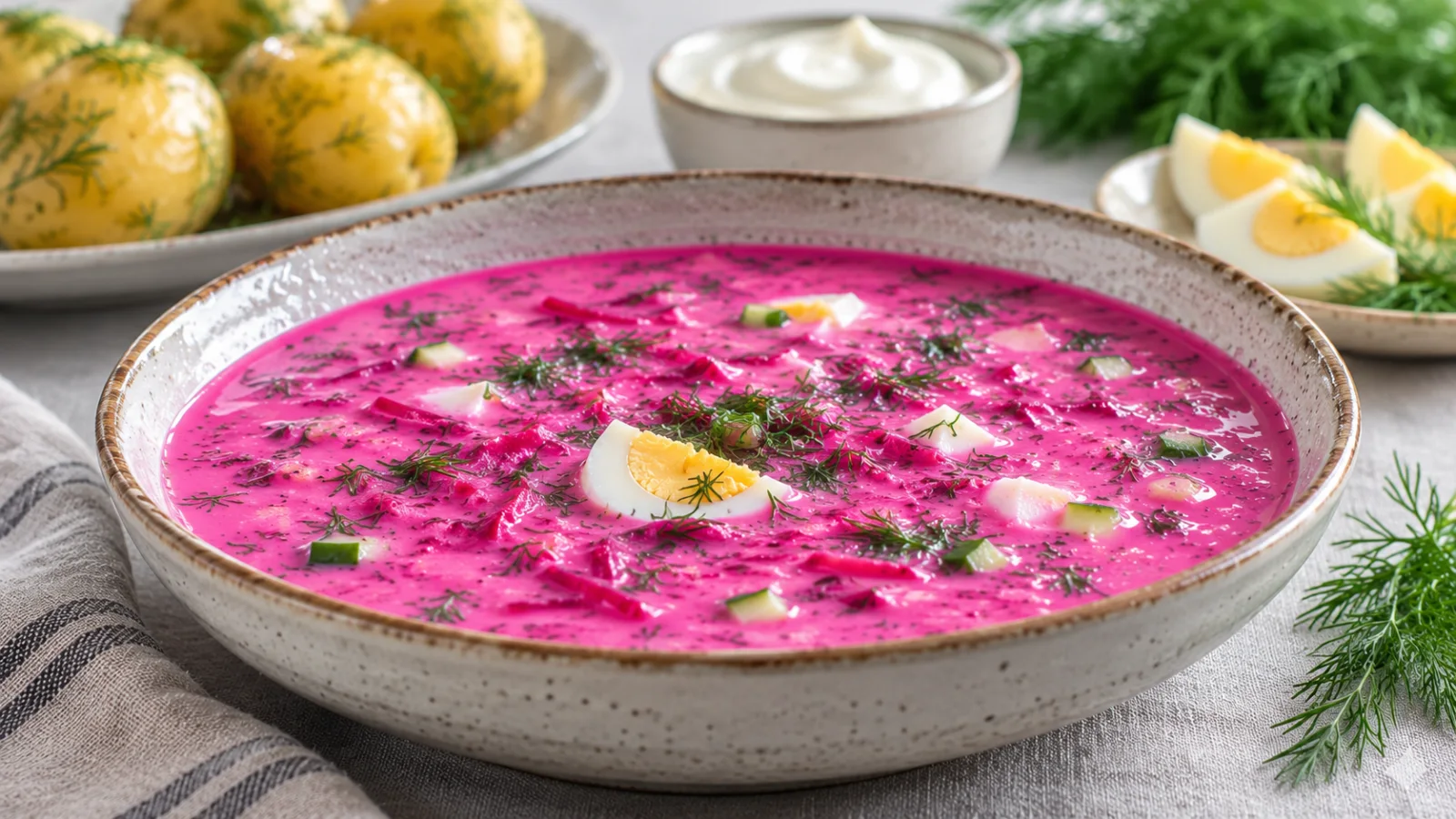
Šaltibarščiai is a cold soup of grated cooked beets and kefir, brightened with cucumber, scallions, dill, and chopped hard-boiled egg, and always served alongside a plate of hot boiled potatoes rather than mixed into the bowl. The name translates literally to “cold borscht,” and the dish belongs to a wider family of cold beet soups found across the Baltic and Slavic regions.¹ In modern Lithuanian cuisine specifically, this beetroot-and-kefir version has become the most prominent form of that soup, regarded as one of the country’s signature summer dishes.¹
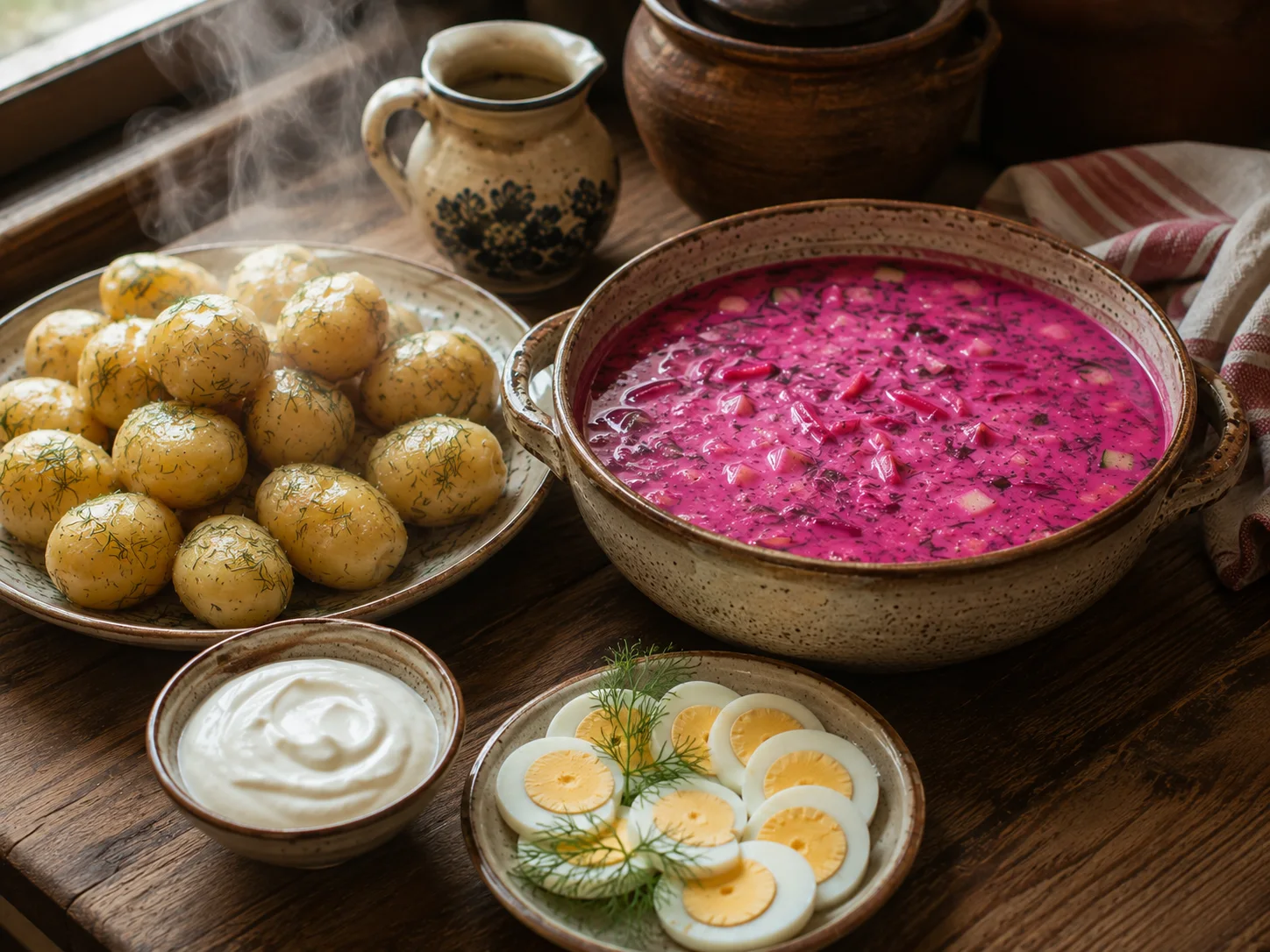
Lithuania’s official tourism board describes the flavor as a Lithuanian take on umami, a balance of sweet, sour, and salty built from a handful of local ingredients.³ The eating ritual matters as much as the flavor: the soup arrives shockingly pink and ice-cold, the potato arrives steaming, and diners typically alternate bites or dip pieces of potato straight into the bowl.⁴
History and Origins
Lithuanians trace šaltibarščiai to the Grand Duchy of Lithuania, a state that survived until 1795 and once stretched into present-day Belarus, Ukraine, and parts of Russia.² Cold sour soups were part of the shared culinary world of the Grand Duchy and the later Polish-Lithuanian Commonwealth, eaten across the entire social spectrum, from noble households to peasant kitchens.¹ That shared origin is also why the dish’s heritage is disputed today, with both Poland and Belarus laying some claim to the tradition alongside Lithuania.²
Written traces of the soup go back further than most Lithuanian dishes. A chef to the Polish-Lithuanian king recorded an early version of the dish in Warsaw at the end of the eighteenth century, and a military doctor stationed near what is now Biała Podlaska described tasting a local cold soup around the same period, noting that it went by several different names depending on the household.¹ By the nineteenth century, cold beet soup recipes were appearing regularly in regional cookbooks, including one published in Vilnius in 1854 by Wincenta Zawadzka specifically as a dish of the local region.¹
The dish also surfaces in Polish-language literature tied to the old Grand Duchy. Adam Mickiewicz’s epic poem Pan Tadeusz, set in the Navahrudak region, includes cold beet soup as part of its portrait of regional food culture, and the writer Gabriela Puzynina described the soup in her own memoirs as something she associated with home while living away in Warsaw.¹
The specific kefir-based version now considered classic grew out of Lithuania’s long dairy tradition, pairing the fermented drink with beets and fresh garden vegetables.⁴ Its role as a symbol of Lithuanian identity is a fairly recent and deliberate development: Vilnius has held an annual šaltibarščiai festival since 2023,¹,² and the city’s tourism promoters have framed the dish as an emblem of the capital’s seven centuries of multicultural history, spanning Lithuanian, Jewish, and Polish culinary influence.²
Traditional Recipe
This recipe was developed independently by Heritage Healthy Kitchen; the sources cited throughout are for further reading on the dish’s history and background, not the basis of the recipe itself.
Ingredients (Serves 4)
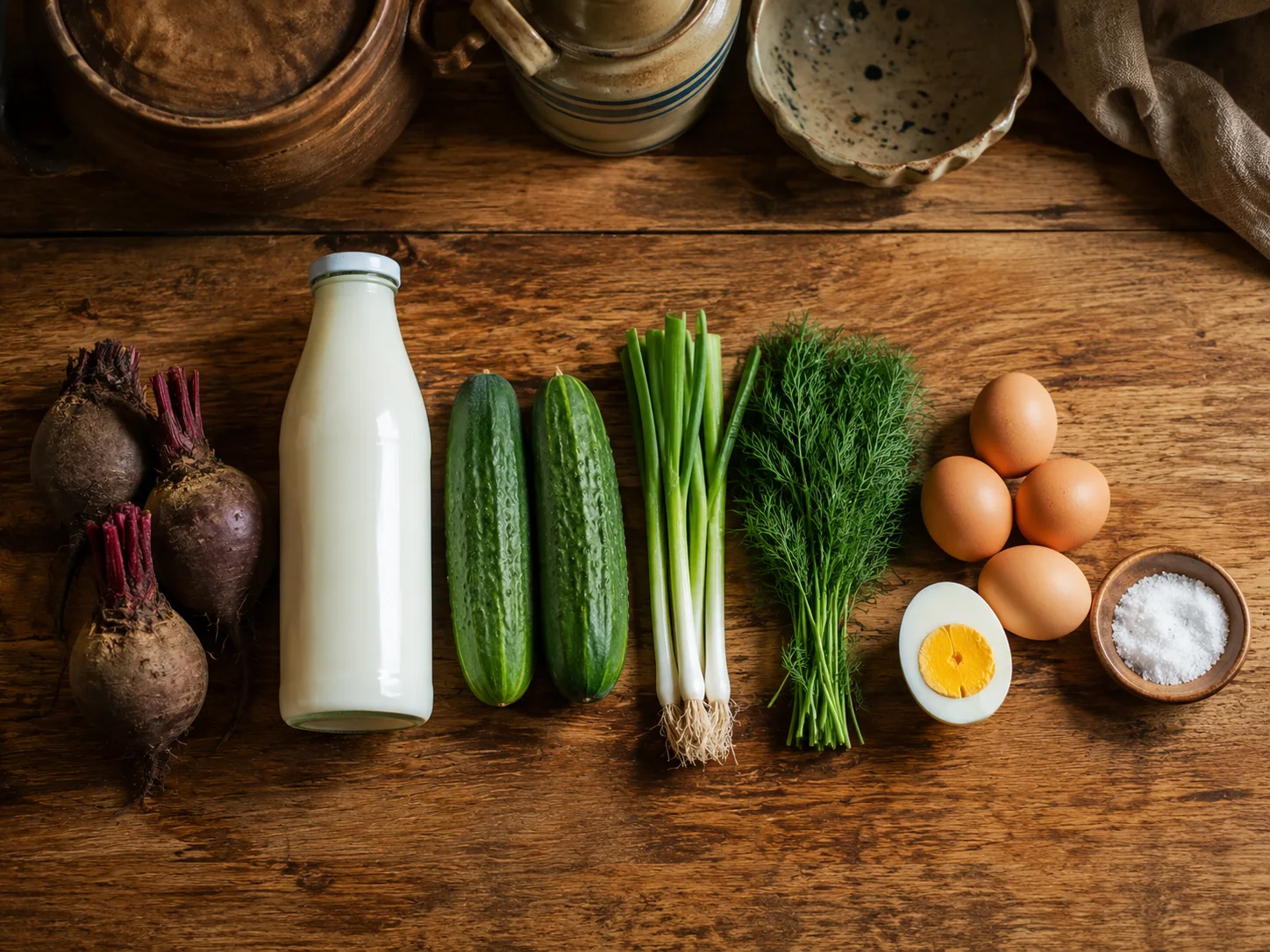
- 500 g (1.1 lb) beets, about 3 medium, unpeeled
- 1 liter (4 cups) plain kefir, well chilled
- 2 medium cucumbers (about 300 g/10.5 oz), diced
- 4-5 scallions (about 30 g/1 oz), thinly sliced
- 1 small bunch fresh dill (about 20 g/0.7 oz), finely chopped, plus more for garnish
- 4 large eggs, hard-boiled
- 1 tsp salt, or to taste
- Cold water, as needed to thin
- 800 g (1.75 lb) small waxy potatoes, for serving
- Sour cream, for serving, optional
Instructions
- Boil the beets. Place the unpeeled beets in a pot, cover with water, and boil until a knife slides through easily, 35 to 45 minutes depending on size. Drain, cool, peel, and coarsely grate.
- Prepare the vegetables. While the beets cook, dice the cucumbers, thinly slice the scallions, and finely chop the dill.
- Hard-boil the eggs. Simmer the eggs for about 9 minutes, then cool in ice water, peel, and chop. Set aside a few slices for garnish.
- Combine the soup. Stir the grated beets into the chilled kefir in a large bowl or pot. Add the cucumber, scallions, dill, and most of the chopped egg, then season with salt.
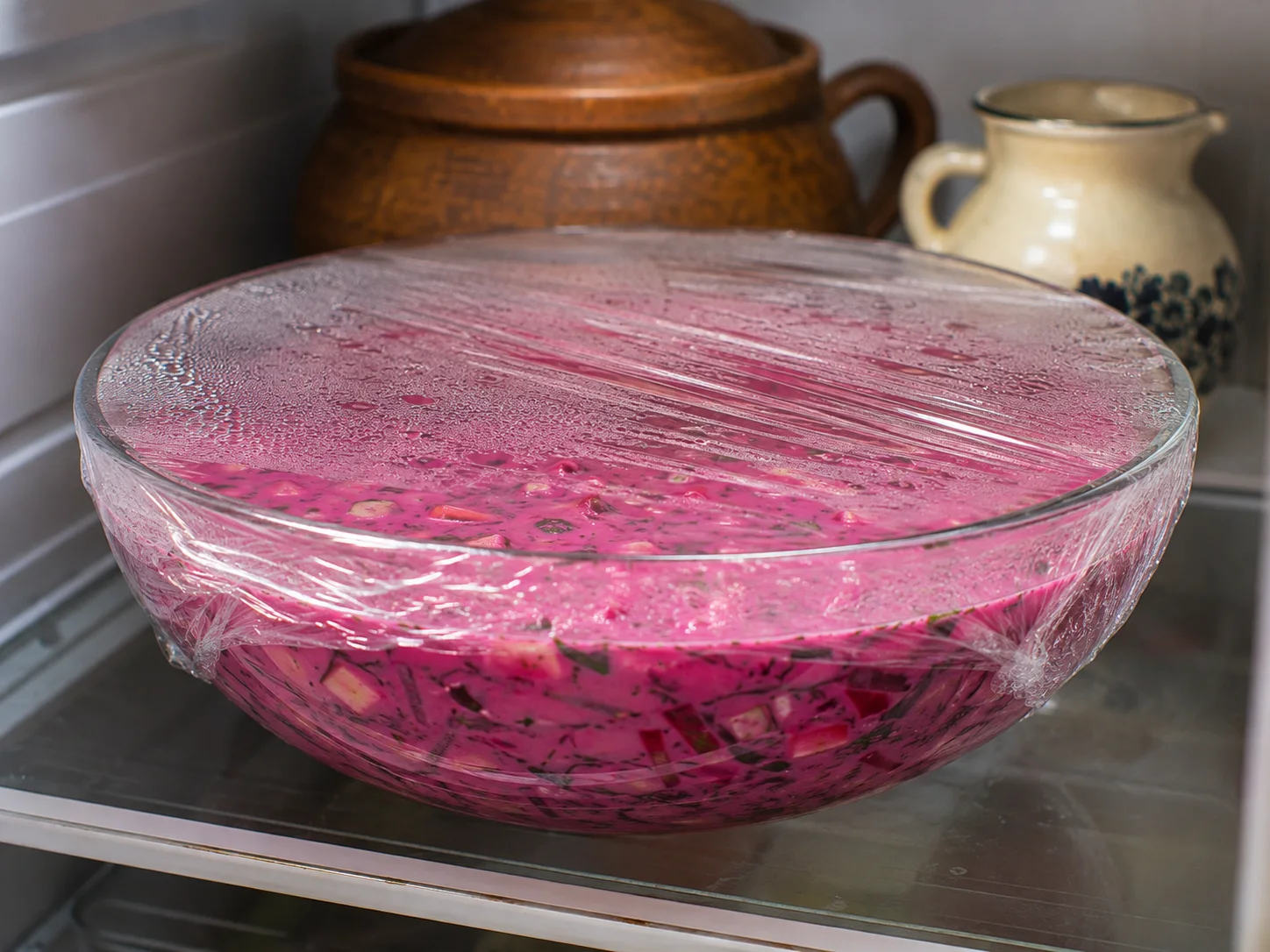
- Adjust and chill. Thin with a little cold water if the soup seems too thick, then refrigerate for at least 1 hour, or until well chilled.
- Boil the potatoes. Separately, boil the potatoes in lightly salted water until tender, about 15 to 20 minutes for small potatoes.
- Serve. Ladle the cold soup into bowls, top with the reserved egg and a sprinkle of dill, and serve immediately with the hot potatoes on the side.
Kitchen Tips
Use full-fat kefir for the creamiest texture. Thin, watery kefir makes for a thin, less satisfying soup.
Boil the beets whole and unpeeled. This keeps their color from bleeding into the cooking water and holds onto more of their nutrients.
Keep the potatoes genuinely hot. The contrast between the icy soup and the steaming potato is central to how the dish is meant to be eaten, so time the potatoes to finish just before serving.
Some cooks blend a portion of the beets before stirring in the kefir for a smoother, more uniform color, though the classic version keeps visible shreds throughout.
Making the soup a few hours ahead is genuinely traditional, not a shortcut. The flavors settle and the color deepens the longer it sits in the refrigerator.⁴
Nutritional Information
Šaltibarščiai with Boiled Potatoes, Per Serving (1 of 4 Servings)
- Calories: approximately 430–530 kcal
- Protein: approximately 19–24g
- Total fat: approximately 13–16g
- Carbohydrates: approximately 62–76g
- Dietary fiber: approximately 6–7g
- Sodium: approximately 790–965mg
Nutritional values are estimates calculated from the specific ingredient quantities in this recipe, using standard reference values. They will vary depending on the fat content of the kefir used, the size of the eggs, and how much salt is added to the soup and to the potato cooking water, which isn’t precisely quantified here.
Kefir does a lot of the nutritional work here. It contains roughly a dozen active probiotic strains and contributes meaningful calcium, phosphorus, magnesium, and vitamin D toward bone health, on top of its protein.⁶ Combined with the fresh cucumber and dill, this is a genuinely vegetable-forward, protein-rich dish before the potato is even added.
Beets are naturally high in dietary nitrates, and some short-term studies suggest nitrate-rich vegetables like beets can modestly lower blood pressure, though the largest study to look at nitrate intake and heart disease, following more than 62,000 women over 26 years, found no link between the two.⁵ Beets also carry more natural sodium than most vegetables, and that shows up in the totals here alongside the salt added directly to the soup and the sodium from the eggs.
Storage and Reheating
The soup keeps well in the refrigerator for up to 2 days in an airtight container. Because it’s dairy-based, it doesn’t hold as long as a broth-based soup, and the color will keep deepening as it sits.
Šaltibarščiai isn’t a candidate for freezing. The kefir separates and the cucumber turns soft and watery once thawed, and neither recovers on thawing.
The soup itself is never reheated, since it’s meant to be eaten cold. Potatoes are best boiled fresh just before serving, though leftover boiled potatoes can be gently reheated separately.
Traditional Lithuanian Šaltibarščiai

Ingredients
Ingredients (Serves 4)
- 500 g (1.1 lb) beets, about 3 medium, unpeeled
- 1 liter (4 cups) plain kefir, well chilled
- 2 medium cucumbers (about 300 g/10.5 oz), diced
- 4-5 scallions (about 30 g/1 oz), thinly sliced
- 1 small bunch fresh dill (about 20 g/0.7 oz), finely chopped, plus more for garnish
- 4 large eggs, hard-boiled
- 1 tsp salt, or to taste
- Cold water, as needed to thin
- 800 g (1.75 lb) small waxy potatoes, for serving
- Sour cream, for serving, optional
Instructions
- Boil the beets until tender, then cool, peel, and grate them
- Stir the grated beets into cold kefir along with cucumber, scallions, and dill
- Mix in chopped hard-boiled egg and season with salt
- Chill the soup until thoroughly cold and deeply pink
- Boil potatoes separately to serve hot alongside the cold soup
- Ladle into bowls, garnish with extra dill or egg, and serve immediately
Frequently Asked Questions
What does šaltibarščiai actually taste like?
Tangy and cool, with an earthy sweetness from the beets set against the sour bite of kefir. The dill and scallions add a sharp, herbal lift, and the whole dish is meant to feel refreshing rather than heavy.
Why is the soup served with hot potatoes instead of mixed together?
The contrast is part of the tradition. The potato arrives steaming, the soup arrives ice-cold, and the two are meant to be eaten side by side, often with the potato dipped straight into the bowl.⁴
Can buttermilk be used instead of kefir?
Yes. Buttermilk and other soured milks are traditional variants of the base liquid in cold beet soups across the region, though kefir is the standard choice in Lithuania today.¹
Is šaltibarščiai the same dish as Polish chłodnik or Belarusian chaladnik?
They share a common ancestor rather than being identical. All three developed out of the same cold sour soup tradition from the old Grand Duchy of Lithuania and the Polish-Lithuanian Commonwealth, then diverged into distinct national versions over time.¹
Can the soup be made ahead of time?
Yes, and many households prefer it that way. A few hours, or even a full day, in the refrigerator lets the flavors settle and deepens the color further.
Is šaltibarščiai vegetarian?
As written, yes. The recipe contains dairy and egg but no meat or fish. It isn’t vegan, since it relies on both kefir and eggs.
Why does the soup turn a brighter pink the longer it sits?
The beet color keeps bleeding into the kefir base over time, which is why the soup looks noticeably more vivid after it has chilled for a while than it does right after mixing.⁴
Looking for a Lighter Version?
Šaltibarščiai is already a fairly light dish by design, built on kefir and raw vegetables rather than anything fried or heavy. Heritage Healthy Kitchen’s Healthy Šaltibarščiai article looks at where the numbers above can still be trimmed, starting with the sodium from the added salt and the eggs.
Further Reading & Sources
The following sources were consulted in researching the history, technique, and cultural background of traditional šaltibarščiai. Heritage Healthy Kitchen’s recipe was developed independently; these links are provided for readers who want to explore further.
- “Cold beet soup.” Wikipedia. en.wikipedia.org/wiki/Cold_beet_soup — regional origins, eighteenth and nineteenth century written and literary references, and the annual Vilnius festival.
- “Lithuania Capital Turns Pink for Love of Beetroot Soup.” VOA News. voanews.com — the 2023 Pink Soup Fest, contested regional heritage, and Vilnius’s multicultural culinary framing.
- “Šaltibarščiai (Pink Soup).” Lithuania Travel, official state tourism board. lithuania.travel — core ingredients, flavor profile, and the dish’s natural color.
- “Cold beetroot soup Šaltibarščiai – Lithuanian cuisine heritage.” Šnekutis, Vilnius. snekutis.com — the kefir dairy tradition, the hot potato serving custom, and the soup’s color deepening over time.
- “Nitrates in food and medicine: What’s the story?” Harvard Health Publishing, Harvard Medical School. health.harvard.edu — dietary nitrate content of beets and the mixed evidence on blood pressure and heart disease risk.
- “Is Drinking Kefir Healthy for You?” Cleveland Clinic Health Essentials. health.clevelandclinic.org — kefir’s probiotic strain count and its contribution to bone health.
Disclaimer
The information in this article is provided for educational and informational purposes only. Heritage Healthy Kitchen makes no representations or warranties regarding the accuracy or completeness of any content on this site. Nutritional values are estimates only and will vary depending on the specific ingredients, brands, and measurements used. This content is not intended as dietary, medical, or professional nutritional advice. Always consult a qualified healthcare provider regarding any dietary needs or health conditions. Heritage Healthy Kitchen is not responsible for any outcomes resulting from the use of recipes or information published on this site.
You Might Also Like
More heritage recipes from our kitchen
Leave a Reply