

Part of our Heritage Kitchen Glossary – short guides to the dishes, ingredients and techniques of Eastern European cooking.
Put a plate of pierogi, a bowl of varenyky and a bowl of barszcz with uszka on the same table, and they can look like one dish served three ways. All three start from unleavened dough, a filling and a pot of boiling water. What separates them is size, shape, filling and the place each one takes in a meal.
The three cousins at a glance
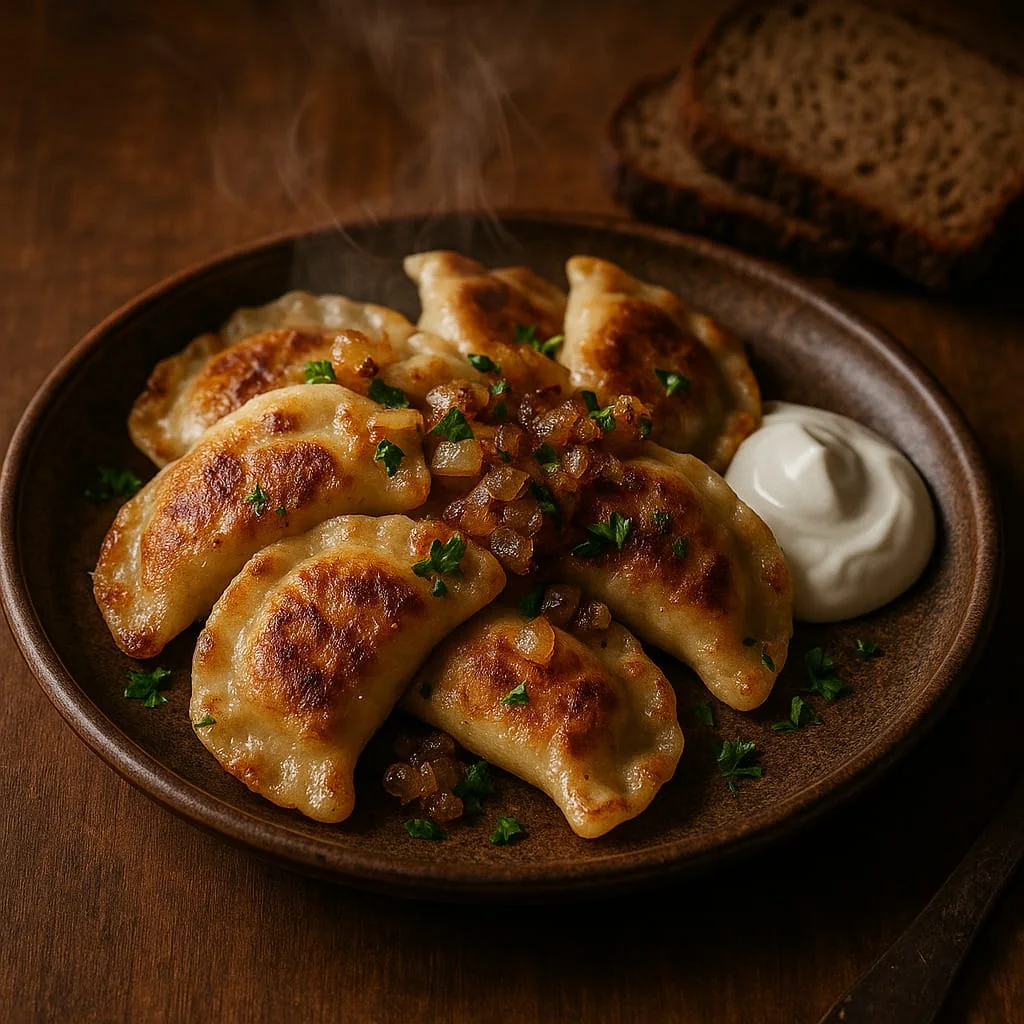
Pierogi are the Polish dumpling. They already appear in the first Polish cookbook, Compendium ferculorum, published in 1682. Rounds of dough are folded over a filling into half-moons, sealed and boiled until they float, then served as they are or fried in butter until golden. The best-known kind, pierogi ruskie, is filled with potatoes and twaróg, a fresh curd cheese, mixed with onion fried in butter. The same dough takes many other fillings, sweet and savory, and on Christmas Eve it goes around sauerkraut and wild mushrooms. Pierogi are much larger than uszka and are eaten as a main course or a side, with fried onion, sour cream or skwarki, small crisp pieces of fried pork fat. This site also has a lighter version, with gluten-free and plant-based versions.
Varenyky are the Ukrainian dumpling: rounds of unleavened dough pinched into half-moons around a filling. Pierogi are the same idea, made from a nearly identical dough, and tend to be a little larger. The classic fillings today are potato, farmer’s cheese, sour cherries and cabbage. Older ones could be almost anything, from poppy seed and berries to beans and buckwheat porridge. The same dough works for savory and sweet fillings. Savory varenyky come with fried onion and sour cream, sweet ones with sour cream. The lenten varenyky for Christmas Eve are made without egg or dairy and served with oil and fried onion instead. There’s a lighter version here too.
Uszka are the smallest of the three. The name comes from ucho, the Polish word for ear, and describes the shape: a small piece of very thin dough folded around a little filling and twisted into a curl. The dough is the same as for pierogi. For Christmas Eve uszka are filled with dried wild mushrooms fried with onion, or with sauerkraut, or a mix of both. They are made to float in a bowl of soup, barszcz czerwony, the clear red beet soup that often opens Wigilia, the Polish Christmas Eve supper.
Customs and shapes
Varenyky turned up at fixed points in the Ukrainian year. On the feast of the Forty Martyrs a cook made forty varenyky and gave them all away. In central Polissia, on St Barbara’s day, beekeepers threw a poppy-seed-and-honey varenyk at a tree, and if it stuck, the tree would make a good hive. On the second day of a wedding the bridesmaids brought varenyky to the bride, and women brought them to a new mother with the wish that she would always be “as full as a varenyk.” Uszka have a rule of their own: many Polish cooks put three or five in each bowl of Christmas Eve barszcz.
Which one should you cook
For a dinner that stands on its own, cook pierogi: they are a main course with sour cream or fried onion. For savory and sweet at one meal, varenyky cover both with a single dough. And if barszcz czerwony is on the Christmas Eve menu, uszka go with it. The two belong together at the Wigilia table.
Frequently Asked Questions
What is the difference between pierogi and varenyky?
Very little. Both are half-moon dumplings made from a nearly identical dough, and pierogi tend to be a little larger. Boiled pierogi can also be fried in butter until golden; savory varenyky are served with fried onion and sour cream.
Why are uszka made so small?
They are made to float in a bowl of barszcz czerwony rather than be eaten on their own. The dough is the same as for pierogi, rolled very thin, about 2mm.
What are varenyky and pierogi served with?
Savory varenyky come with fried onion and sour cream and sweet ones with sour cream; the lenten varenyky for Ukrainian Christmas Eve are served with oil and fried onion instead. Polish pierogi come to the table with fried onion, sour cream or skwarki, small crisp pieces of fried pork fat, and can be fried in butter after boiling.
Do varenyky have a place in Ukrainian customs?
Yes. On the feast of the Forty Martyrs a cook made forty varenyky and gave them all away, bridesmaids brought varenyky to the bride on the second day of a wedding, and women brought them to a new mother with the wish that she would always be “as full as a varenyk.” Varenyky are also among the dishes of the Christmas Eve supper, made lenten.
Can uszka be served outside of Christmas Eve?
Yes. Most Poles make uszka once a year, for Christmas Eve. On other days they go into rosół, Polish chicken soup, or are served with melted butter, and leftovers are fried in butter the next day.
Further Reading & Sources
This entry draws on the sources below and on the recipes it links to elsewhere on this site. They are listed for readers who want to go further.
- Jarosław Dumanowski. “Stanisław Czerniecki’s old Polish pierogi.” Museum of King Jan III’s Palace at Wilanów, 17 August 2015. wilanow-palac.pl
- Daniel Tilles. “Polish restaurants change name of ‘Russian’ dumplings to ‘Ukrainian’.” Notes from Poland, 2 March 2022. notesfrompoland.com
- “The Ultimate Polish Christmas Menu.” Polonist, updated 3 December 2024. polonist.com
- S. Stechishin. “Traditional foods.” Internet Encyclopedia of Ukraine, Canadian Institute of Ukrainian Studies. encyclopediaofukraine.com
- Alexandra Shytsman. “Ukrainian Varenyky with Potato Filling and Fried Onions.” The New Baguette, 19 December 2018, updated 8 April 2025. thenewbaguette.com
- Liudmyla Panasiuk. “Varenyky na pari, v okropi, v dukhovtsi ta morozyltsi: retsepty tista ta nachynok.” Ukrainska Pravda. Zhyttia, 18 February 2026 (in Ukrainian). life.pravda.com.ua
- Bohdana Pavliuk. “12 strav na Sviatvechir: shcho i chomu maie buty na sviatkovomu stoli.” Explainer, 17 December 2025 (in Ukrainian). explainer.ua
- Polonist Test Kitchen. “Uszka: Polish Christmas Dumplings (for Barszcz).” Polonist, 6 November 2019, updated 5 June 2023. polonist.com
- Karolina Klesta. “Polish Uszka Recipe.” Polish Foodies, 16 September 2024. polishfoodies.com
- Magdalena Kasprzyk-Chevriaux. “The 12 Dishes of Polish Christmas.” Culture.pl, December 2013, updated December 2022. culture.pl
Leave a Reply