
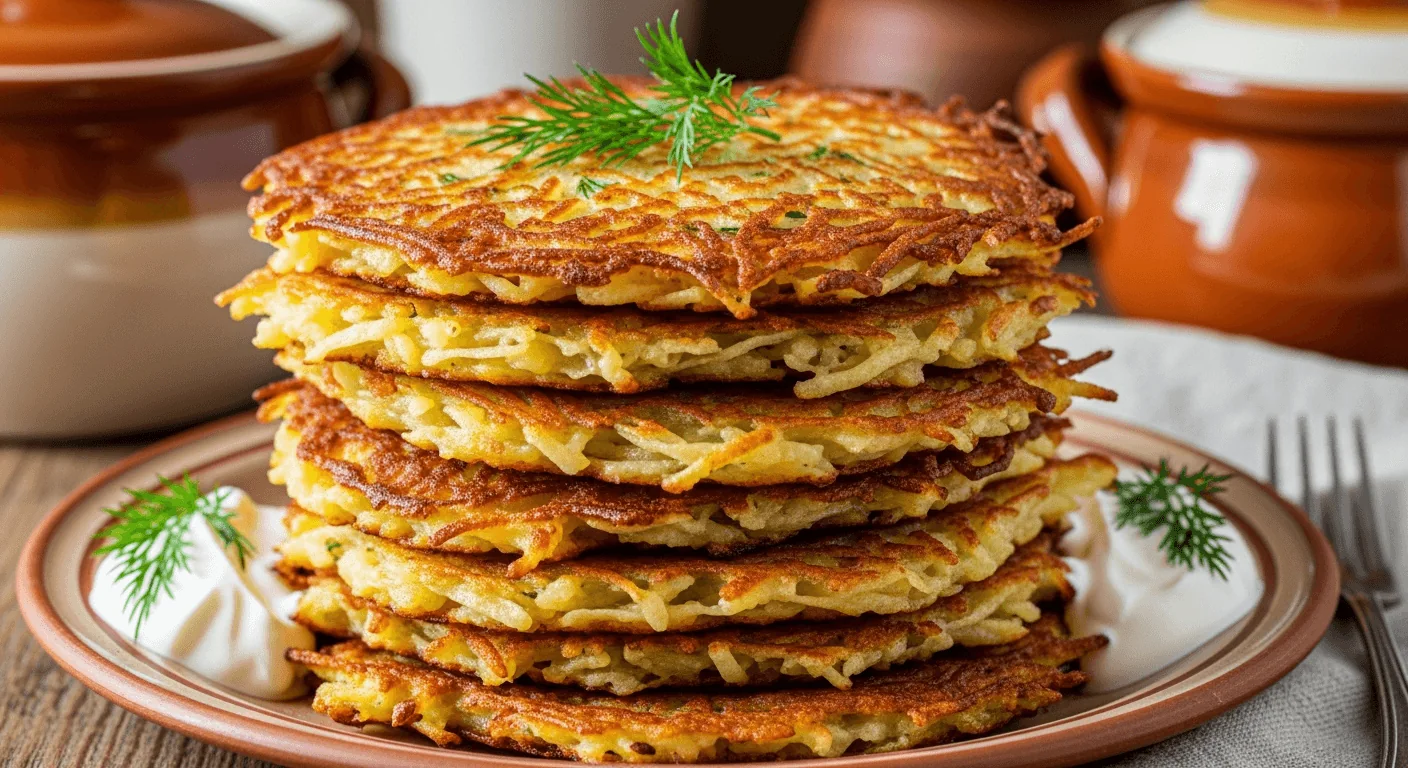
Active time: ~40 minutes | Total time: ~55 minutes | Serves: 4 (16–20 pancakes) | Difficulty: Easy
Quick Overview
- Grate floury potatoes and an onion, half coarse and half fine
- Salt the mixture and let it stand for 15 minutes
- Squeeze out the liquid and keep the starch that settles from it
- Mix in eggs, pepper and, only if needed, a spoonful of flour
- Fry thin pancakes in hot oil until golden and serve straight away
What Placki Ziemniaczane Are
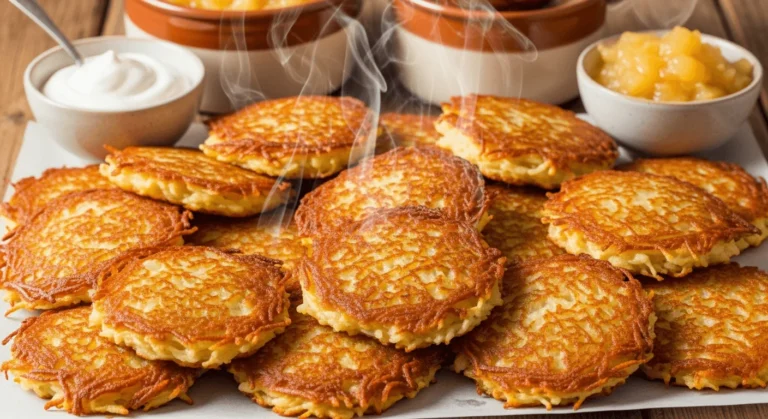
Placki ziemniaczane are Polish potato pancakes: raw grated potato, onion and egg, sometimes with a little flour, shallow-fried until the edges are crisp and the middle stays soft.¹˒² In Poland they are eaten with sour cream, with sugar, or with both at once, and as a main course under mushroom sauce or goulash.¹˒²˒³
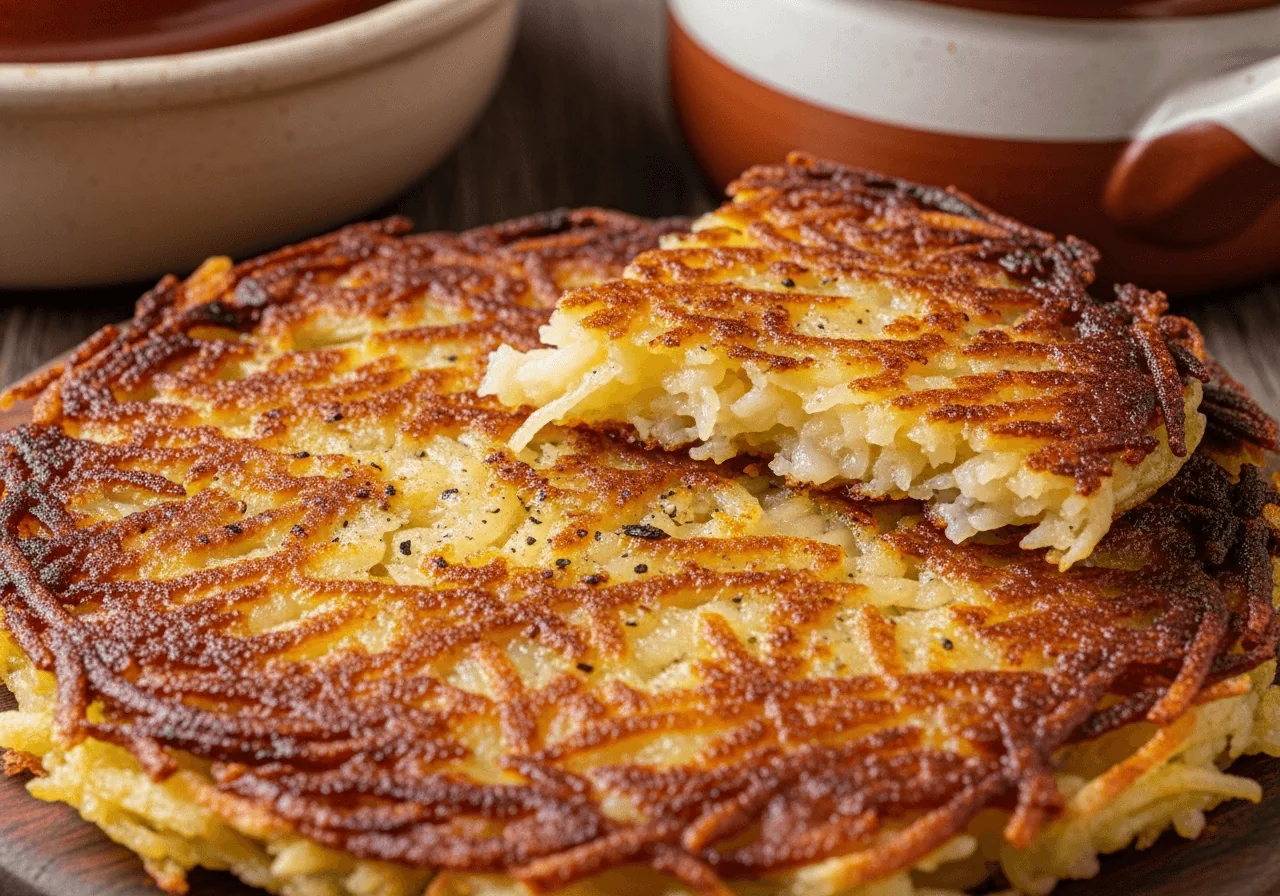
Similar pancakes are made across Central and Eastern Europe; in Germany and Austria they are Kartoffelpuffer or Reibekuchen. Swiss rösti and hash browns are different: they usually have no egg or flour.¹
History and Cultural Roots
The potato reached Polish kitchens later than the popular story says. That story credits King Jan III Sobieski, who supposedly brought potatoes home from Vienna after the victory of 1683 as a garden plant. Historians have found no evidence for it; the first records of potato planting in the Polish-Lithuanian Commonwealth come about half a century after Sobieski’s death.¹⁰ Under King August III (1733–1763) potatoes were first grown on royal lands run by Germans and Saxons, and peasants carried them into their own gardens. In the 19th century the potato became one of the basic crops of Polish farming and, for most of the 19th and 20th centuries, an almost obligatory side dish at dinner.¹⁰
Placki served with goulash are called placki po węgiersku, Hungarian-style.³
The Ashkenazi latke is a close relative. Hanukkah pancakes were long made of cheese; potato latkes became the norm in Eastern Europe after the crop failures of 1839 and 1840 in Ukraine and Poland, when potatoes became cheaper than flour.⁴ For the holiday version, see our traditional latkes recipe.
Traditional Placki Ziemniaczane Recipe
This recipe was compiled by Heritage Healthy Kitchen from a comparison of published recipes; the sources are listed at the end of this article. Figures that are Heritage Healthy Kitchen’s own estimates rather than taken from a published source are marked as such.
The published recipes use one or two eggs and anywhere from no flour to 60g of it for every kilogram of potatoes, and two of them put back the starch that settles out of the squeezed potato liquid. All of them fry the pancakes in oil or lard.¹˒²˒³ This version stays in the middle of that range. The weight of the onion, the number of servings and the total times for a full kilogram of potatoes are Heritage Healthy Kitchen estimates.

Ingredients
Serves 4 (16–20 pancakes)
- 1kg (2.2 lb) floury, high-starch potatoes, such as Russet or Idaho¹˒²˒³
- 1 small onion, about 100g (3½ oz)¹˒³
- 2 large eggs²˒³
- 1 tablespoon all-purpose flour or potato starch, only if the batter is too loose¹˒²
- 1 teaspoon fine salt, plus a pinch for serving¹˒²
- Freshly ground black pepper¹
- Sunflower or rapeseed oil, or lard, for frying¹˒³
To serve
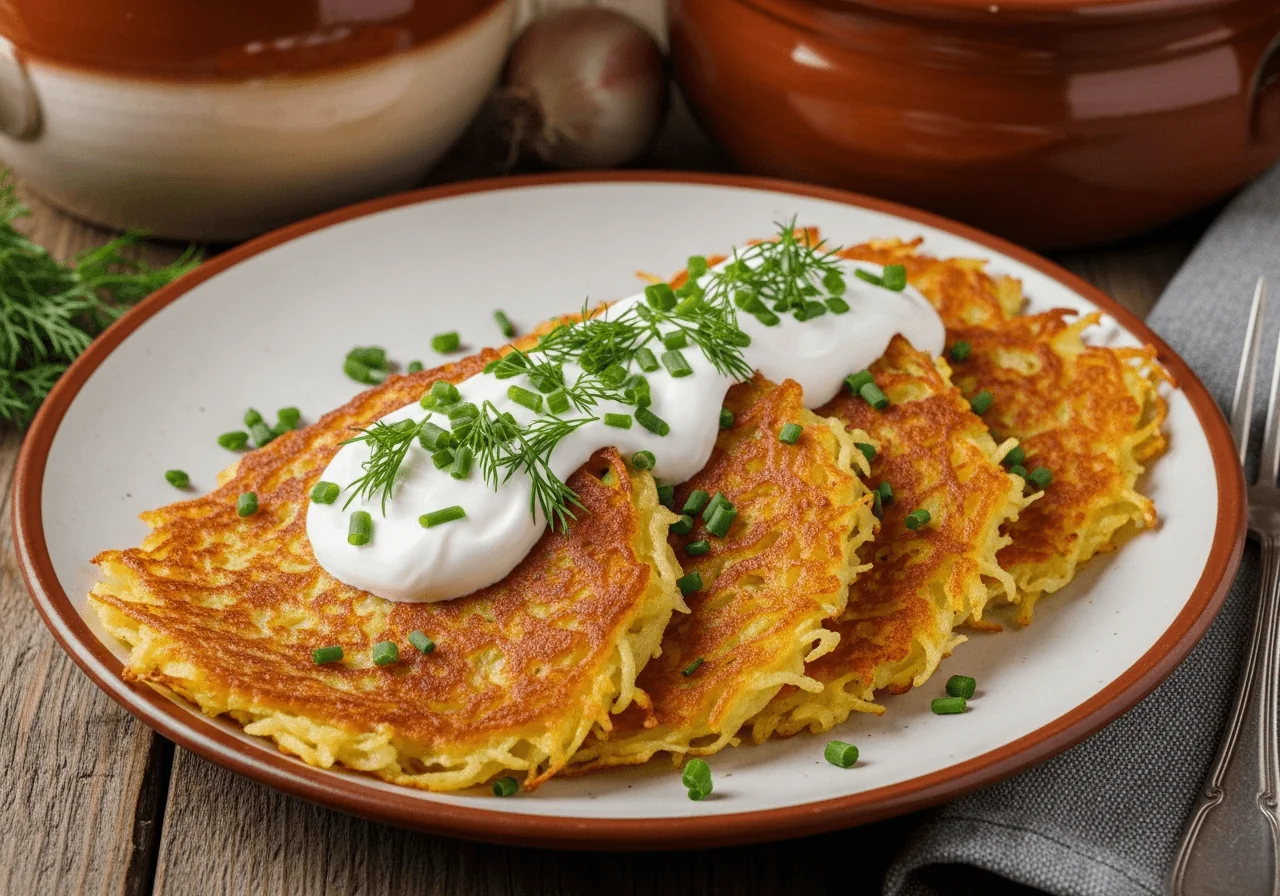
- Sour cream, sugar, or both¹˒²˒³
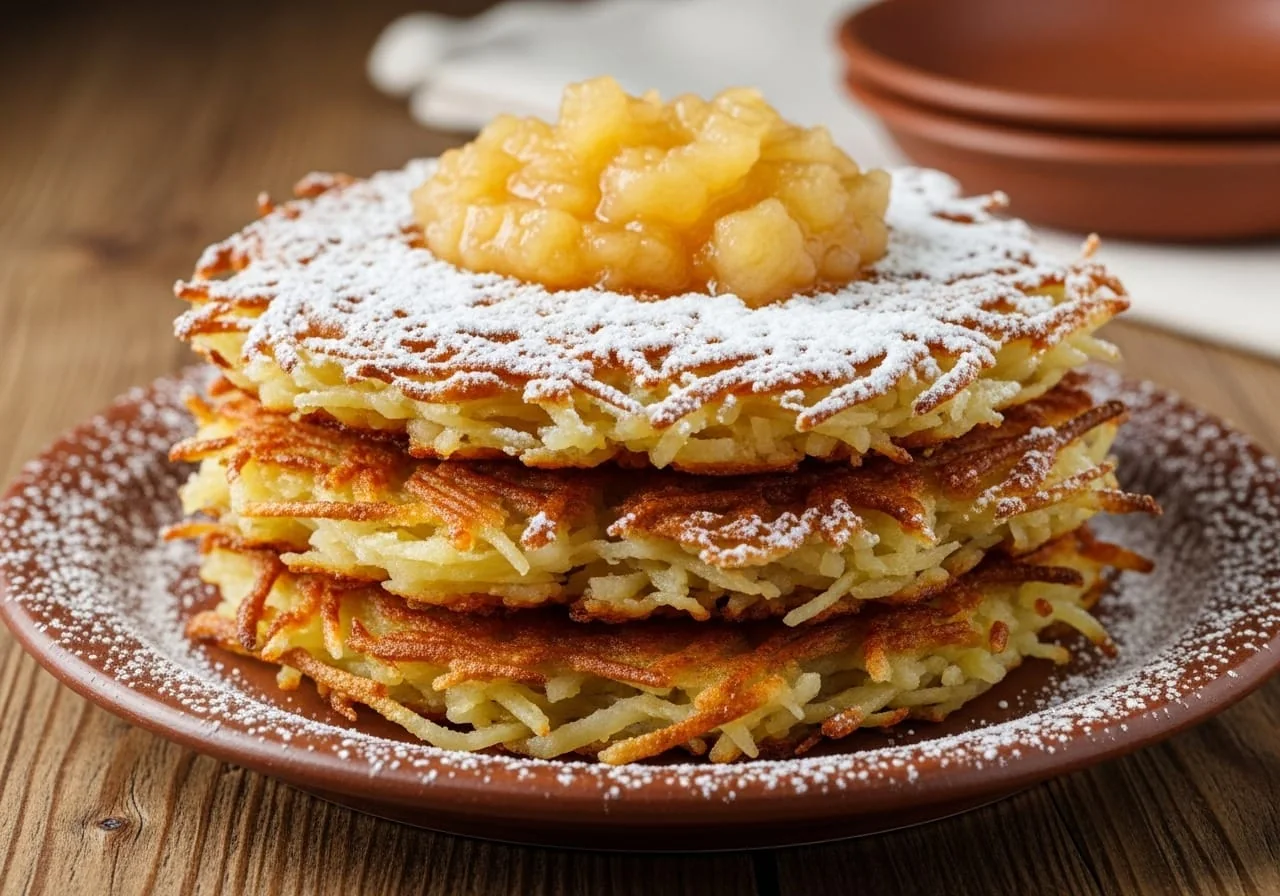
- Applesauce and a sprinkle of sugar, for a sweet version¹
- Mushroom sauce or goulash, for a main course¹˒²˒³
Instructions
- Grate the potatoes. Peel the potatoes. Grate half of them and the onion on the large holes of a box grater and the rest on the small holes.¹ Grated onion also keeps the potato from turning dark.³
- Salt and rest. Mix in 1 teaspoon of salt and leave the mixture for 15 minutes.¹
- Squeeze and keep the starch. Squeeze the potato a handful at a time, or wrapped in a clean kitchen cloth, over a bowl, and get out as much liquid as you can. Let the liquid stand for a few minutes, pour it off carefully and keep the thick white starch that has settled at the bottom.¹˒³
- Mix the batter. Stir the eggs and the starch into the potato. Season lightly with salt and generously with pepper. Add the flour only if the batter is still loose.¹˒²
- Fry. Heat enough oil to come at least a third, and better half, of the way up the pancakes, over medium to medium-high heat. Drop in about 1 heaped tablespoon of batter per pancake, without crowding the pan, and flatten each to ½–¾cm (about ¼ inch). Fry for 2–3 minutes on each side, until golden.¹˒²
- Drain and serve. Lift the pancakes onto paper towels and serve them right away, while they are still crisp.¹˒²
Kitchen Tips
Choose floury potatoes. High-starch potatoes give off little water, bind well and take up less oil. Waxy and new potatoes are too watery for placki.¹
Grate by hand. A box grater gives the best texture. A food processor can do the job, but don’t purée the potatoes until they look like mash.¹
Fine, coarse or both. Potatoes grated only on the small holes make softer, creamier pancakes, the more traditional kind. Grated only on the large holes, they come out crisper and more like fritters, and need longer to cook through. Half and half gives a soft middle with very crisp edges.¹
Or drain them in the bowl. Instead of squeezing, grate the potatoes finely straight into a wide bowl, tilt it and leave it for about 5 minutes without stirring, pouring off the juice as it collects. At the end, press the potatoes down with your hand and pour off the rest.²
Test the first pancake. Fry one and cut it in half. If it is golden outside but raw in the middle, finish it over very low heat and fry the rest a little lower.¹
Use a fat that takes the heat. Oil with a high smoke point, lard or clarified butter all work. Ordinary butter burns too quickly.¹
A Lighter Way to Make Them
Placki can be baked instead of fried. Published oven recipes for potato pancakes brush the baking sheets lightly with oil, 2 tablespoons in one of them, spread the batter into thin rounds and bake them at 220°C (425°F) for 15–20 minutes, until the bottoms are deeply golden, then turn them and bake about 10 minutes more.⁵˒⁶ Baking rather than frying, and measuring oil with a teaspoon or using an oil spray, are among the NHS tips for eating less saturated fat.⁷ With the batter above, that makes a serving about 30 kcal and 3g of fat lighter, a Heritage Healthy Kitchen estimate.
Salt and the topping are the other two places to go lighter. The NHS advises adults to have no more than 6g of salt a day and suggests black pepper, herbs and spices in its place;⁸ half a teaspoon of salt in the batter instead of a full one roughly halves the sodium per serving. Sour cream is on the NHS list of foods high in saturated fat,⁷ and Cleveland Clinic suggests swapping in Greek yogurt for some of the sour cream in dips and soups.⁹ Using it on placki is a Heritage Healthy Kitchen recommendation rather than a step from a published recipe. Two tablespoons of plain low-fat Greek yogurt add about 20 kcal and under 1g of fat, against about 60 kcal and 6g for the same amount of sour cream.
Nutritional Information
Per serving (1 of 4, about 4–5 pancakes), before toppings
- Calories: approximately 305–375 kcal
- Protein: approximately 8–10g
- Total fat: approximately 11–14g
- Saturated fat: approximately 2g
- Carbohydrates: approximately 44–54g
- Dietary fiber: approximately 3–4g
- Sodium: approximately 565–695mg
Two tablespoons of sour cream add about 60 kcal and 6g of fat.
Nutritional values are estimates based on standard ingredient databases (USDA FoodData Central). They vary with the potatoes, how much oil the pancakes take up and how much of the salt leaves with the squeezed-out liquid.
Storage and Reheating
Placki are best straight from the pan. The batter keeps in the fridge for up to 24 hours with plastic wrap pressed onto its surface; it will be watery and darker by then, so squeeze it out again and season it lightly before frying. Pancakes from rested batter come out more oily than fresh ones.¹
Cooked pancakes keep in a closed container in the fridge for up to 48 hours. Reheat them in an oven preheated to 190°C (375°F), or in a dry or lightly oiled non-stick pan, which brings back more of the crispness.¹
Traditional Placki Ziemniaczane

Ingredients
For the pancakes
- 1kg (2.2 lb) floury, high-starch potatoes, such as Russet or Idaho
- 1 small onion, about 100g (3½ oz)
- 2 large eggs
- 1 tablespoon all-purpose flour or potato starch, only if the batter is too loose
- 1 teaspoon fine salt, plus a pinch for serving
- Freshly ground black pepper
- Sunflower or rapeseed oil, or lard, for frying
To serve
- Sour cream, sugar, or both
- Applesauce and a sprinkle of sugar, for a sweet version
- Mushroom sauce or goulash, for a main course
Instructions
- Peel the potatoes. Grate half of them and the onion on the large holes of a box grater and the rest on the small holes.
- Mix in 1 teaspoon of salt and leave for 15 minutes.
- Squeeze out as much liquid as you can over a bowl. Let it stand, pour it off and keep the starch at the bottom.
- Stir in the eggs and the starch, season with salt and pepper, and add flour only if the batter is loose.
- Fry heaped tablespoons of batter, flattened to ½–¾cm, in oil a third to half as deep as the pancakes, 2–3 minutes on each side until golden.
- Drain on paper towels and serve at once.
Frequently Asked Questions
Why do my placki fall apart in the pan?
The batter is usually too wet. Squeeze the potatoes again and make sure the starch from the liquid goes back in; the egg also helps hold the pancakes together. If the batter is still loose, add a tablespoon of potato starch or flour. Waxy or new potatoes give off too much water, so use floury ones.¹˒²
Why are they brown outside but raw in the middle?
The heat is too high or the pancakes are too thick. Finish the raw ones over very low heat, make the rest thinner and fry them a little lower.¹
Do I really need to keep the starch?
Yes. The starch binds the pancakes better than flour, and they taste more of potato. If you have poured it away, add about a tablespoon of shop-bought potato starch or flour instead.¹
Can I make placki without eggs?
Yes. Leave the egg out and add 1 tablespoon of flour instead.¹
Are placki ziemniaczane the same as latkes?
They are very close. Latkes are more like fritters and often have flour or matzo meal in them, sometimes baking powder too.¹ Matzo meal is ground matzo, unleavened bread made only from flour and water and baked, by Jewish tradition, within 18 minutes of mixing, before the dough can rise.¹¹ The potato latke is also the Hanukkah pancake of Eastern European Jews.⁴
What is placek po węgiersku?
A potato pancake served with goulash, named Hungarian-style after the stew. Polish home cooks serve placki with goulash too.²˒³
Further Reading & Sources
The recipe is a compilation based on the published recipes listed here; these links are provided for readers who want to explore further.
- Aleksandra. “Polish Potato Pancakes (placki ziemniaczane).” Everyday Delicious, July 14, 2020, updated July 4, 2022. everyday-delicious.com
- “Placki ziemniaczane.” Kwestia Smaku (no author or date given). kwestiasmaku.com
- Anna. “Potato Pancakes {Placki Ziemniaczane}.” Polish Your Kitchen, April 5, 2016. polishyourkitchen.com
- Brodnitz, Susannah. “The Real History of Potato Latkes Will Surprise You.” The Nosher, My Jewish Learning, December 8, 2022. myjewishlearning.com
- “Oven-Baked Potato Pancakes.” MyPlate Kitchen, U.S. Department of Agriculture; recipe credited to ChopChop Family. myplate.gov
- The Health News Team, with Lily Padilla-Corona, RDN, CDES. “Oven-baked potato pancakes (recipe).” Sharp HealthCare, December 10, 2025. sharp.com
- NHS. “How to eat less saturated fat.” nhs.uk, page last reviewed June 19, 2023. nhs.uk
- NHS. “Salt in your diet.” nhs.uk, page last reviewed April 17, 2023. nhs.uk
- Cleveland Clinic, with Julia Zumpano, RD, LD. “Is Yogurt Good for You?” Health Essentials, November 9, 2020. clevelandclinic.org
- Jakubowski, Melchior. “How Potatoes Conquered Poland.” Polish History, Museum of Polish History. polishhistory.pl
- Krakowski, Yissachar Dov. “Understanding the Not-So-Simple Matzah.” OU Kosher, 25 February 2026. oukosher.org
Disclaimer
This article is for educational and informational purposes only and does not constitute medical or nutritional advice. All nutritional values listed are estimates and will vary depending on ingredients, quantities, and preparation methods. If you have a health condition that requires dietary management, consult a qualified healthcare provider or registered dietitian before making changes to your diet.
You Might Also Like
More heritage recipes from our kitchen


Leave a Reply