

Active time: ~20 minutes | Total time: ~1 hour 20 minutes, plus chilling if served cold | Serves: 6 | Difficulty: Easy
Quick Overview
- Peel the beets, cut them into pieces about 2cm (¾ in) thick and simmer them with an onion in water for 45–60 minutes
- Take out the onion and season with lemon juice and a little sugar until the soup is clearly sweet and clearly sour
- For Passover, sour it with lemon juice only: no vinegar and no bread
- Serve hot or chilled, with a boiled potato, dill and, if you like, halved hard-boiled eggs
- Stir in sour cream for a dairy meal; leave it out and the soup is pareve
What Jewish Beet Borscht Is
Jewish beet borscht is the sweet-and-sour beet soup of Ashkenazi Jewish cooking, the cooking of the Jews of Central and Eastern Europe. Beets are simmered in water, soured with lemon juice and softened with a little sugar, then served hot or cold, often with a boiled potato on the side.1 Jewish kitchens made two kinds: hearty meat versions on chicken or beef broth, eaten without sour cream, and lighter vegetarian ones that could take it, which turned the red soup pink when it was stirred in.1 The recipe here is the lighter kind, written for Passover.
History and Cultural Roots
The English word borscht, with its extra “t,” comes from the Yiddish spelling.2 The first Yiddish records of Jews cooking borsh soup date from the 1500s, according to Aish, a Jewish educational organization.1 Taste varied by region, and cooks in Galicia, in central Europe, were known for adding sugar to make the soup sweet and sour.1 Many non-Jewish cooks in the region, particularly in Ukraine, thought of borscht as a heavy, pork-based soup; Jewish kitchens left the pork out.1
Eastern European Jews began arriving in America in large numbers in the 1880s, and the soup came with them.1 The Catskill Mountains resorts that Jewish families favored came to be called the Borscht Belt.2,3
On the Holiday Table
Beet borscht is closely tied to Passover. One article puts it this way: “For many Jews, Passover wouldn’t feel complete without beet borscht.”1 Families kept root vegetables in cellars through the winter, and by its end beets were often among the few foods left, so a borscht with a boiled potato on the side made a Passover meal from limited stores.1 The Smithsonian Folklife Festival also calls it a soup for the early spring celebration of Passover.2
The old Passover soup began weeks earlier. Moment Magazine records how Passover borscht was made in a New York home around 1900: first came russel, a sour beet brine made by fermenting beets in water, and the soup was then made with it, along with water, sugar, eggs, sour cream and hot boiled potatoes.3 The brine was made in the weeks before the holiday and left to ferment until the first seder,4 for three to four weeks in one account.5 The recipe below skips the fermenting and takes its sourness from lemon juice, as a Passover-tagged recipe from OU Kosher does.6
Seven weeks after Passover comes Shavuot, when it is customary to eat dairy, so the sour cream that goes with the soup fits the holiday.1 The same article says that on Shabbat, since heating liquid is forbidden, a cold beet soup with a dollop of sour cream was served at the third meal, eaten late on Saturday afternoon.1
Traditional Beet Borscht Recipe for Passover
This recipe was compiled by Heritage Healthy Kitchen from a comparison of published recipes; the sources are listed at the end of this article. Figures that are Heritage Healthy Kitchen’s own estimates rather than taken from a published source are marked as such.
This is the Passover version of the soup. On Passover, foods containing vinegar are avoided unless the vinegar is certified for the holiday,7,8 so the recipe keeps to water, beets, onion, salt, sugar and lemon juice, with no vinegar, no vegetable broth and no bread. The rest of the year there are no such limits, and the Kitchen Tips below say what can change.
Published recipes simmer roughly 0.3 to 0.6 kg of beets per liter of water, with sugar at about 1 to 1½ tablespoons per liter in most of them and lemon juice at about 1 to 1½ tablespoons per liter (roughly one lemon for 2 liters). Cooking times run from about 20 minutes for finger-thick pieces to 1½ hours for diced beets, and about an hour is the most common.6,9,10,11 The amounts below sit inside those ranges. The size of the pieces, the 45–60 minute simmer and the garnish amounts are Heritage Healthy Kitchen’s estimates.
Ingredients (serves 6)
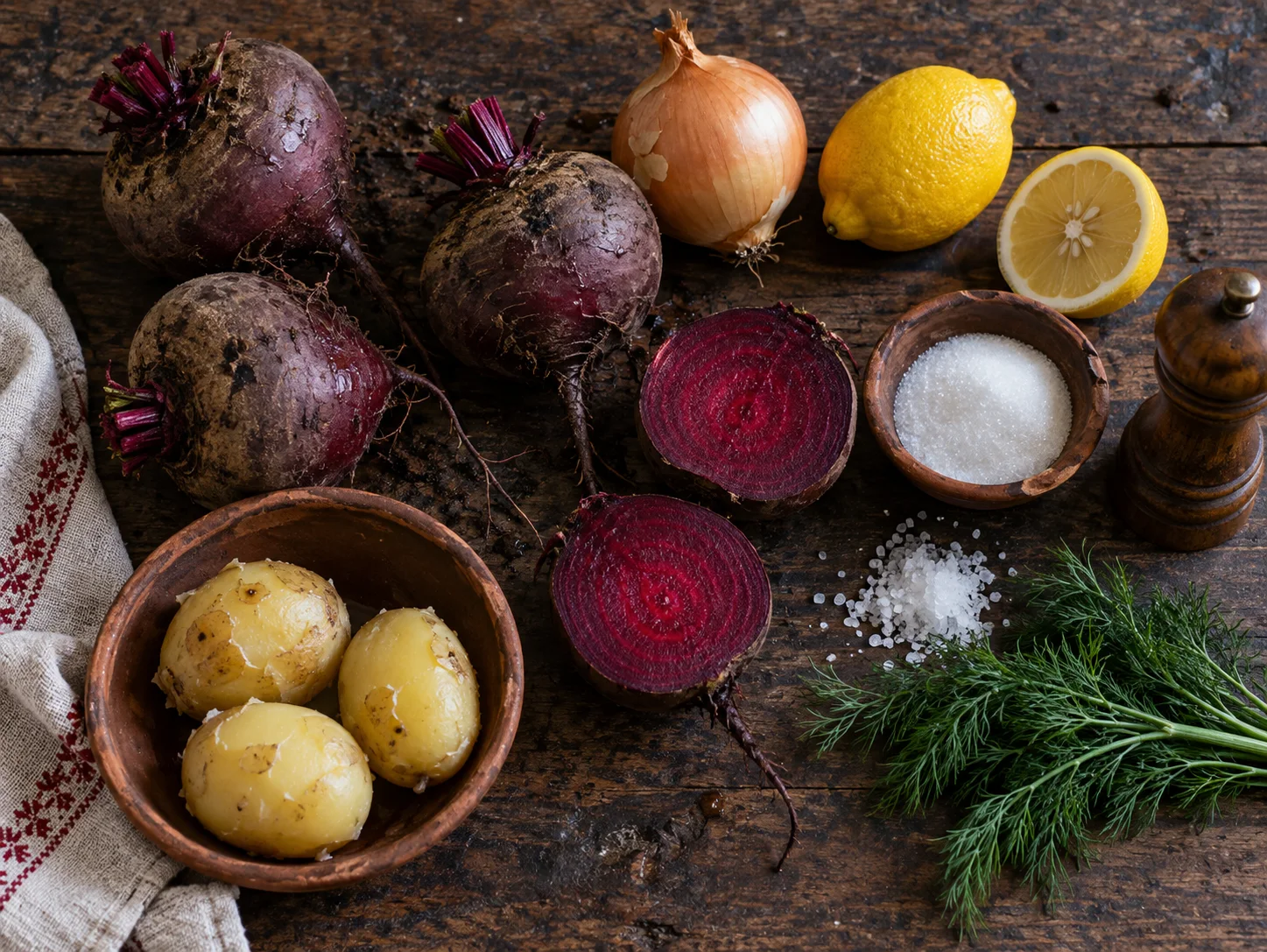
For the soup:
- 1.2 kg (about 8 medium beets), peeled and cut into pieces about 2cm (¾ in) thick
- 2.5 liters (10 cups) water
- 1 medium onion, halved
- 3–4 tablespoons fresh lemon juice (from 1–2 lemons)
- 2–3 tablespoons sugar, to taste
- 1½ teaspoons salt, plus more to taste
- Freshly ground black pepper, to taste (optional)
To serve:
- 6 small potatoes, boiled and peeled
- Fresh dill, chopped
- Sour cream, about 2 tablespoons per bowl, for a dairy meal (leave it out and the soup stays pareve)
- 3 hard-boiled eggs, halved (optional)
Instructions
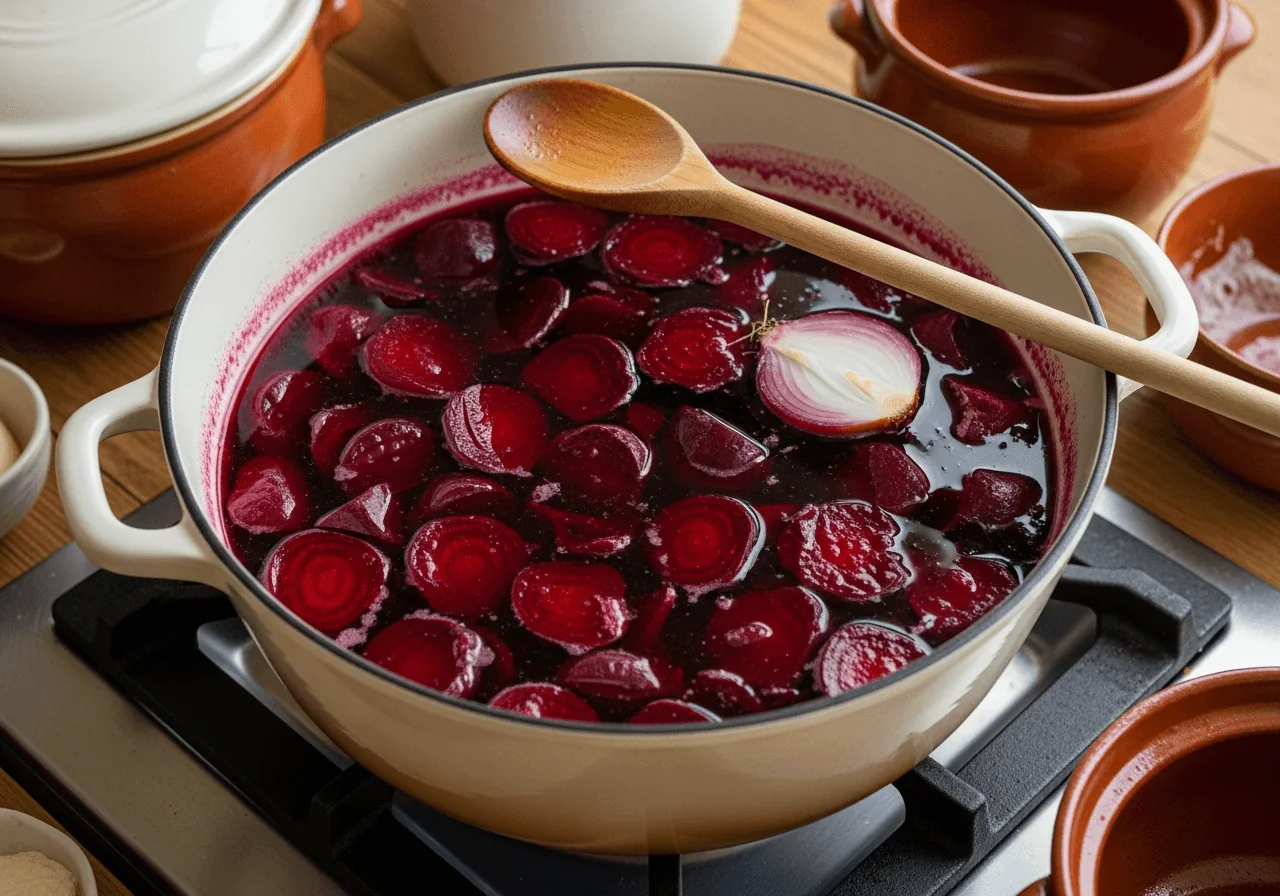
- Cut the beets. Peel the beets and cut them into pieces about 2cm (¾ in) thick, roughly the size of a finger.10,11
- Simmer. Put the beets, onion, salt and water in a large pot and bring to a boil. Reduce the heat, cover partly and simmer for 45–60 minutes, until the beets are very soft.6,9,10
- Season. Remove the onion. Stir in the lemon juice and sugar, then taste. The soup should be clearly sweet and clearly sour at the same time, not muted. Add pepper and more salt if needed.6,9
- Soften, if you like. For a softer texture, blend the soup briefly with an immersion blender, just enough to break up the beets.10
- Boil the potatoes. Boil the potatoes separately in salted water until soft, then peel them.9,10
- Serve. Serve hot, ladled over a potato in each bowl, or chill the soup until cold, at least 4 hours, and serve it with the potato on the side. Top with dill, and with sour cream and halved eggs if using.3,6,9
Kitchen Tips
For Passover: lemon juice only
OU Kosher says that foods containing vinegar shouldn’t be eaten on Pesach,7 and the vinegar that is certified for Passover has historically been cider vinegar.8 That is why this soup is soured with lemon juice alone. If you use vegetable broth in place of water, it also needs a Passover certification unless it’s homemade.12 Matzah is unleavened bread made only from flour and water and baked, by Jewish tradition, within 18 minutes of mixing, before the dough can rise.16 In place of bread, one family recipe crumbles matzah into the soup with sour cream.11
The rest of the year: vinegar is fine
Outside Passover, published borscht recipes are soured with lemon juice, vinegar or sour salt (citric acid).4 To use vinegar, replace the lemon juice with 2–3 tablespoons of white or cider vinegar, adding it a little at a time and tasting as you go (Heritage Healthy Kitchen’s estimate).
On the sweet-sour balance
There’s no single correct ratio, and Galician cooks leaned sweeter.1 Start with the smaller amounts and adjust upward once you’ve tasted. Some published recipes add the lemon juice and sugar to the chilled soup just before serving, which makes the balance easier to judge.9
On serving temperature
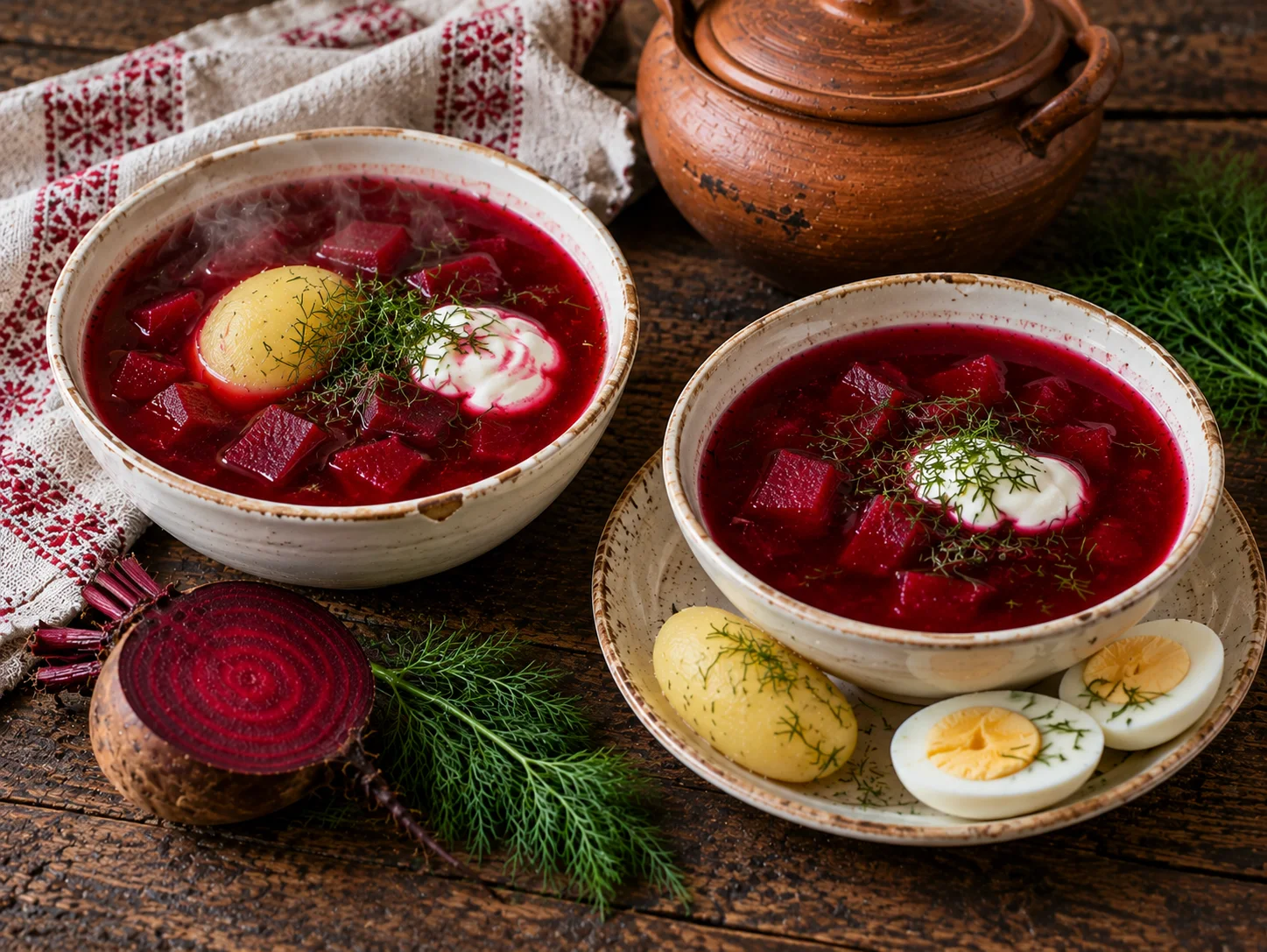
Borscht was traditionally served hot in winter and cold in summer.3 The recipe doesn’t change; only what happens after the soup comes off the stove does. For a cold version, chill the soup fully before adding the potato, dill and sour cream.
Pareve or dairy
Without sour cream the soup is pareve, so it can be served with a meat meal. With sour cream it becomes a dairy dish, and Jewish kitchens traditionally keep the two apart.1,13
Nutritional Information
Per serving (one-sixth of the soup, about 400ml or 1½ cups, without the potato, sour cream or eggs):
- Calories: approximately 100–130 kcal
- Protein: 3–4g
- Total fat: under 0.5g
- Carbohydrates: 23–30g, of which sugars about 17–22g
- Fiber: 5–7g
- Sodium: approximately 650–830mg
Nutritional values are estimates based on standard ingredient databases (USDA FoodData Central).14 Sodium depends on how much salt goes into the pot. Two tablespoons of sour cream add about 48 kcal and 4.7g of fat; a hard-boiled egg adds about 78 kcal.
Storage and Reheating
Refrigerate the soup within 2 hours of cooking, in shallow covered containers. It keeps for 3 to 4 days in the refrigerator or 3 to 4 months in the freezer.15 Keep the potatoes, sour cream and eggs separate and add them fresh when serving.
Reheat a hot version on the stove until it reaches 74°C (165°F).15 A cold version needs no reheating, just a stir.
Traditional Beet Borscht

Ingredients
For the soup
- 1.2 kg (about 8 medium beets), peeled and cut into pieces about 2cm (¾ in) thick
- 2.5 liters (10 cups) water
- 1 medium onion, halved
- 3–4 tablespoons fresh lemon juice (from 1–2 lemons)
- 2–3 tablespoons sugar, to taste
- 1½ teaspoons salt, plus more to taste
- Freshly ground black pepper, to taste (optional)
To serve
- 6 small potatoes, boiled and peeled
- Fresh dill, chopped
- Sour cream, about 2 tablespoons per bowl, for a dairy meal (leave it out and the soup stays pareve)
- 3 hard-boiled eggs, halved (optional)
Instructions
- Cut: Peel the beets; cut into pieces about 2cm thick.
- Simmer: Beets, onion, salt and water: boil, then simmer partly covered 45–60 minutes until very soft.
- Season: Remove the onion; stir in lemon juice and sugar; taste for clearly sweet and clearly sour.
- Soften: Optional: blend briefly with an immersion blender.
- Potatoes: Boil separately in salted water until soft; peel.
- Serve: Hot over a potato, or chilled at least 4 hours; top with dill, sour cream and eggs if using.
Frequently Asked Questions
What is the difference between Jewish beet borscht and Ukrainian or Polish borscht?
Many non-Jewish cooks in Eastern Europe, particularly in Ukraine, knew borscht as a heavy, pork-based soup. Jewish versions left the pork out and ranged from hearty meat soups to lighter vegetarian ones.1 On this site, see our Ukrainian borscht and Polish barszcz czerwony.
Is Jewish beet borscht always vegetarian?
No. There is also a hearty meat version made with chicken or beef broth and eaten without sour cream.1 The recipe in this article is the lighter, vegetarian one.
Is this recipe suitable for Passover?
It is written for Passover. The only ingredients are beets, onion, water, salt, sugar and lemon juice, with no vinegar and no bread, and the method follows the same pattern as a Passover-tagged recipe published by OU Kosher.6 As with any Passover cooking, check that packaged ingredients such as sugar, salt and sour cream carry a Passover certification.
Can I use vinegar instead of lemon juice?
Outside Passover, yes: published borscht recipes are soured with lemon juice, vinegar or, in old-style kitchens, sour salt.4 On Passover, use lemon juice, or a vinegar that carries a Passover certification.7,8
Why do some versions of this soup taste much sweeter than others?
The difference is regional: cooks in Galicia added sugar to give the soup a sweet-and-sour taste.1 Start with the smaller amounts of sugar and lemon juice in the recipe and adjust to taste.
Can this be made ahead of time?
Yes. Many published recipes chill the soup before serving,6,9 so it can be made a day or two ahead. Refrigerated, it keeps for 3 to 4 days.15
What can I serve alongside this soup?
A boiled potato is the usual companion, with sour cream and hard-boiled eggs.1,3 At Passover, one family recipe crumbles matzah into the bowl with sour cream.11
Further Reading & Sources
The recipe is a compilation based on the published recipes listed here; these links are provided for readers who want to explore further.
- Yvette Alt Miller. (1 April 2025). Borscht: The Favorite Jewish Soup. Aish. Meat and vegetarian borscht and sour cream; the pink color; pork-based versions; the first Yiddish records in the 1500s; sugar in Galicia; emigration from the 1880s; Passover, Shavuot and Shabbat customs.
- Daniel Zhang. (3 July 2023). A Brief History of Borshch. Smithsonian Folklife Festival. The extra “t” from the Yiddish spelling; Passover; the name Borscht Belt.
- Joan Nathan. (11 October 2011). Talk of the Table | Borscht: Hot and Cold and Red All Over. Moment Magazine. Passover borscht in a New York home around 1900: the russel (beet brine), then water, sugar, eggs, sour cream and hot boiled potatoes; borscht served hot in winter and cold in summer; the Catskill resorts.
- Leah Koenig. (15 April 2019). The Key to Old World Borscht. Tablet Magazine. Russel made before Passover and fermented until the first seder; borscht soured with lemon juice, vinegar or sour salt (citric acid).
- Ruth Abusch-Magder. (12 March 2015). Passover: A Tribute to Women’s Wisdom. My Jewish Learning. Rosl (russel) buried for three to four weeks; the liquid used to flavor borscht.
- OU Kosher, courtesy of the Women’s Branch of the OU. (3 September 2025). Borscht. kosher.com. Published recipe tagged for Passover: 4 beets, ½ onion, 1 quart water, 1½ teaspoons salt, 1 tablespoon lemon juice, 1 tablespoon sugar; shredded beets simmered about an hour; lemon juice stirred in after cooking; chilled, sour cream optional.
- Rabbi Dovid Cohen. Which Foods Are Chametz? OU Kosher (page undated; metadata gives 2013). Foods containing vinegar shouldn’t be consumed on Pesach.
- Rabbi Akiva Tendler. (3 July 2017). Versatile Vinegar. Behind the Union Symbol, OU Kosher. Grain-based vinegar might not be certifiable for Passover; kosher-for-Passover vinegar has historically been cider vinegar.
- Claudia Roden (the page prints no byline; its credit line and biography box name The Book of Jewish Food and Claudia Roden). A recipe for traditional cold beet soup. My Jewish Learning (no date given). Published recipe: 1 kg beets, 2 liters water, 2 tablespoons sugar, the juice of 1 lemon; simmered about 1½ hours; chilled; lemon and sugar added just before serving; a boiled potato in each bowl, sour cream passed separately.
- Lisa Dawn Angerame. Vegan Borscht. Reform Judaism (no date given). Published recipe: 8 small beets, 1 onion, 1 lemon, 3 tablespoons sugar, 2 quarts water; about an hour’s simmer; briefly blended; potatoes boiled separately; dill and sour cream.
- Dahlia Lamdani (recipe), with Tal Itkin. Beet Borscht. Foodish, ANU – Museum of the Jewish People. Published family recipe: 6 medium beets cut into finger-thick pieces, 5 liters of water, 1 tablespoon sugar, lemon juice; about 20 minutes’ vigorous simmer; served chilled; on Passover the family ate it with crumbled matzah and sour cream.
- Faith Gorsky. Vegetarian Borscht Recipe. An Edible Mosaic (no date given). Lemon juice used instead of vinegar to keep the soup Passover-friendly; vegetable stock must be kosher for Passover unless homemade.
- Kashruth. Encyclopaedia Britannica (no author named). Strict separation of meat and dairy products in eating and in preparation; pareve foods.
- U.S. Department of Agriculture. FoodData Central, SR Legacy: beets, raw (FDC 169145), onions, raw (170000), sugars, granulated (169655), lemon juice, raw (167747), table salt (173468), cream, sour, cultured (171257), egg, whole, hard-boiled (173424). Nutrient values per 100g used for the estimates in this article.
- USDA Food Safety and Inspection Service. (last updated 31 July 2020). Leftovers and Food Safety. Refrigerate within 2 hours in shallow covered containers; leftovers keep 3 to 4 days in the refrigerator or 3 to 4 months in the freezer; reheat to 165°F (74°C).
- Rabbi Yissachar Dov Krakowski. (25 February 2026). Understanding the Not-So-Simple Matzah. OU Kosher. Matzah as bread that has not risen, made from flour and water alone and fully baked within 18 minutes of mixing.
Disclaimer
This article is for educational and informational purposes only and is not intended as medical or nutritional advice. Nutritional values provided are estimates and may vary depending on specific ingredients used, preparation methods, and serving sizes. If you have specific dietary needs or health conditions, please consult a qualified healthcare provider or registered dietitian before making changes to your diet.
Cook by Occasion
This recipe is part of our Passover menu, our Shavuot menu and our Shabbat table.
You Might Also Like
More heritage recipes from our kitchen


Leave a Reply